


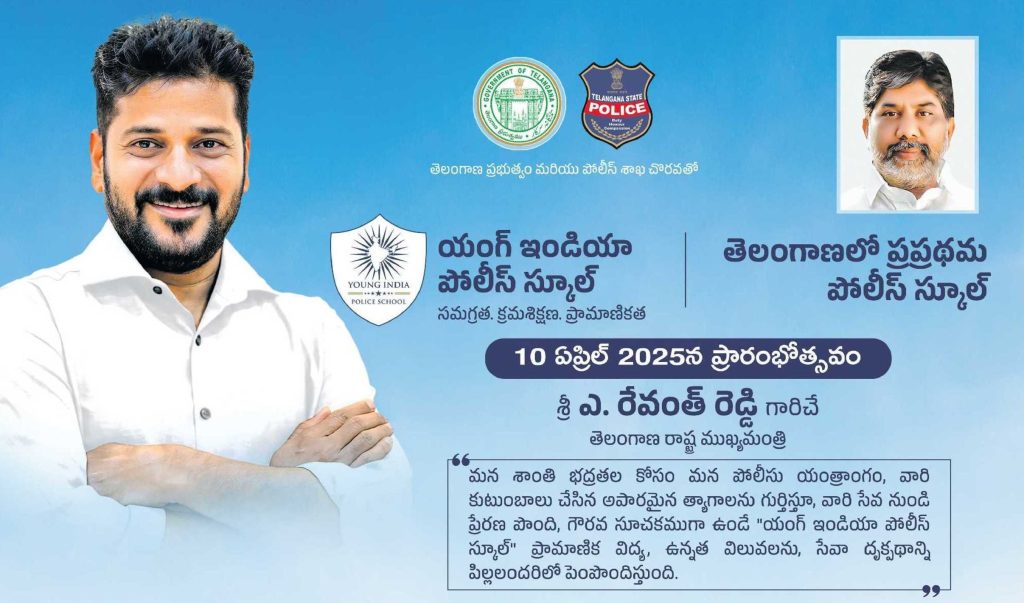
Telangana’s newly launched Young India Police School (YIPS), touted as a revolutionary government initiative to offer holistic, values-based education, is under fire. And not just a small flicker—this is a blazing controversy igniting frustration and disbelief among hopeful parents. Why? The school’s exorbitant fee structure defies the very idea of affordable, accessible public education.
For a school that’s supposed to serve the community, especially those in uniform and service, the fee details have come as a gut-punch to many middle-class families. The figures? Let’s just say they’d rival any premium private institution in Hyderabad.
Admissions Come at a Cost: A Jaw-Dropping ₹20,000 Entry Fee
Despite being a state-led educational initiative under the leadership of Chief Minister A. Revanth Reddy, YIPS charges an eye-watering ₹20,000 admission fee for students falling under the non-police category. That’s just to get through the gate—not even tuition.
To break it down:
- Uniformed personnel (SIs, Inspectors, DSPs, Additional SPs) pay ₹10,000.
- Children of martyrs (Category-1 personnel) are charged ₹2,000.
- Students from non-police backgrounds? ₹20,000 flat.
The public response? Utter disbelief.
Many parents were expecting a reasonable, government-backed schooling alternative with a focus on discipline, values, and holistic development. What they got instead feels like a corporate school wrapped in khaki branding.
Tuition Fees Touch the Sky: ₹1.75 Lakh for Primary Grades
Parents were further alarmed when they uncovered the tuition fees. The numbers are enough to spark a collective gasp across WhatsApp parenting groups.
- Classes I–III: ₹1.6 lakh (non-police category)
- Classes IV–V: ₹1.75 lakh
- SP and above category: ₹1.4 lakh (I–III), ₹1.45 lakh (IV–V)
And yes, these amounts are payable in four terms—an eerily familiar structure straight out of elite private school handbooks.
“Rs 1.6 lakh for my kid in Class II? That’s more than what I pay for rent,” shared a parent who had to abandon the idea of enrolling both her children after getting the full fee details.
Violation of GO MS 91: The Legal Loophole No One’s Talking About
The fee structure not only hurts wallets—it clashes head-on with GO MS 91, the government order that sets guidelines for fee collection in private institutions.
According to GO MS 91:
- Application fee should not exceed ₹100
- Registration fee capped at ₹500
- Refundable, non-interest-bearing caution deposit must be within ₹5,000
- No one-time or hidden charges permitted
The Young India Police School, however, seems to be charging well beyond those limits, under what many are calling a legal grey zone created by being a ‘government initiative but not quite a public school.’
Parental Backlash: “Unjustifiable Fees for a Government School”
Parents expressed disbelief at the sky-high costs. One parent, planning to admit two children, abandoned the idea after learning of the Rs 1.6 lakh tuition fee for Class II. “Though it’s a CBSE-affiliated school, such fees defeat the purpose of a government initiative,” they told Telangana Today.
Critics highlight that Telangana’s welfare societies—Social, Tribal, and BC Welfare—provide free education, making YIPS’s pricing even more perplexing. K. Venkat Sainath of the Hyderabad Schools Parents’ Association slammed the discriminatory fee model: “How can fees vary by parents’ ranks? Central schools like KVs and JNVs charge uniformly, regardless of background.”
A Dangerous Precedent: Is YIPS Paving the Way for Private School Pricing?
Parent advocacy groups and fee regulation activists are calling foul. K. Venkat Sainath, Joint Secretary of the Hyderabad Schools Parents’ Association, didn’t mince words:
“Admission fee of ₹20,000 violates all the rules. How can a government school charge fees based on ranks and designations?”
He went on to question how schools like KVs, JNVs, and central government institutions manage to provide quality education with standardized fees—while YIPS introduces a tiered, unequal pricing model.
His warning? If this is normalized, other private schools will quickly follow suit, making it even harder for middle-class and lower-income families to find affordable education.
Infrastructure Dreams vs. Financial Nightmares
Set on a 50-acre plot near Manchirevula on Hyderabad’s outskirts, YIPS is an ambitious project. While only 7 acres are operational right now, the future plans are grand:
- A 1,750-bed hostel under construction
- Classes starting from I to V with 200 seats
- Equal allocation of 100 seats each for police families and the general public
- A projected expansion to serve 5,000 students
But ambition doesn’t justify alienation. With only 4 children from non-police families admitted so far, compared to 83 from police households, the writing on the wall is clear: non-police families are priced out of this opportunity.
The Rationale Behind YIPS’s Fee Model: Questions Unanswered
Repeated attempts to contact Young India Police Educational Society officials for clarification failed. However, sources suggest the fees aim to fund the school’s CBSE curriculum, smart classrooms, and extracurricular facilities. Yet, critics counter that government subsidies and grants should cover such costs, not parents.
CBSE Curriculum, but at What Cost?
YIPS promises the Central Board of Secondary Education (CBSE) syllabus, which is often considered a quality standard for holistic learning. However, CBSE alignment doesn’t automatically justify sky-high fees, especially when government and trust-run CBSE schools charge far less.
Parents have rightly questioned why the CBSE tag is being used as a cover to hike prices—when many Kendriya Vidyalayas charge less than ₹2,000 annually.
The Bigger Picture: Is Education Becoming a Luxury Brand?
This incident begs a larger, more troubling question: Is education, especially under government-branded institutions, becoming a luxury? When state-supported schools begin mimicking corporate pricing models, we risk transforming learning into an elitist commodity rather than a democratic right.
It’s not just about one school or one policy. It’s about the dangerous normalization of pay-to-play education models, where only the privileged get access to structured, safe, and value-driven learning environments.
No Comment from the Authorities: Silence Speaks Volumes
Despite repeated efforts from parents and media to seek clarification, officials from the Young India Police Educational Society have remained tight-lipped.
Transparency, which should be a cornerstone of any public initiative, is sorely lacking here. No clear justification has been offered for the fee structure, the categorization of students, or the apparent policy loopholes.
Final Thoughts: Reform or Retreat?
The launch of YIPS could’ve been a beacon of educational reform, bringing together values, discipline, and inclusivity under a state-supported umbrella. Instead, it’s rapidly being seen as a gated educational complex for the elite uniformed few.
Here’s what needs to happen:
- Immediate re-evaluation of the fee structure to align with GO MS 91
- Standardized fees regardless of parental designation
- Increased transparency in admission and funding models
- Broader access for the general public, not just police families
Until then, the promise of Young India learning under the tricolor of values and discipline will remain just that—a promise, not a reality.
The Bottom Line: Education Isn’t Just a Service—It’s a Right
In a country where education is seen as the ultimate equalizer, this move feels like a step backward. Government initiatives should bridge gaps, not create new financial divides.
So let’s ask the hard questions, challenge the broken systems, and remind our leaders—education should empower, not bankrupt.