


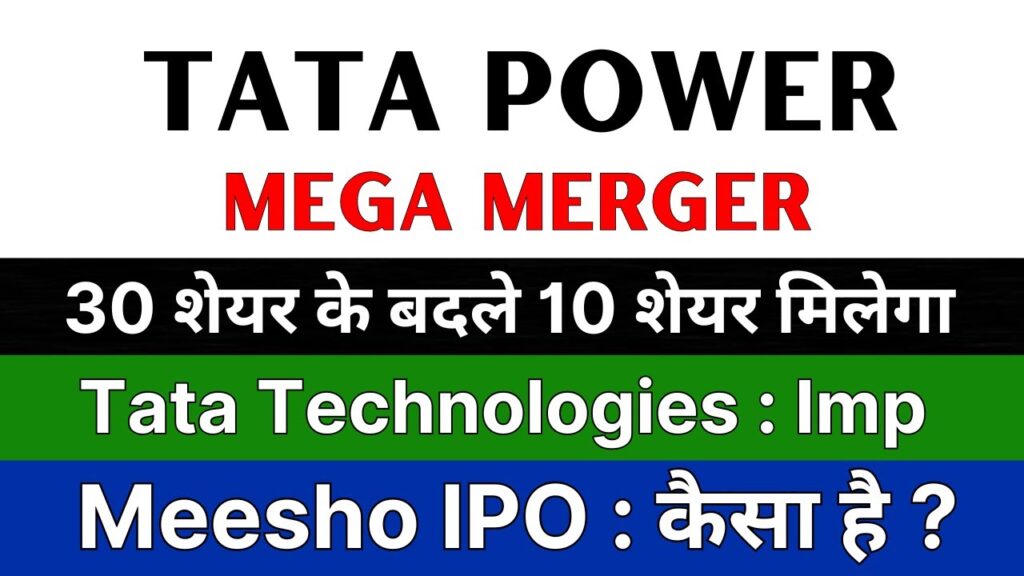
As December 2025 unfolds, the spotlight shines on transformative events like the highly anticipated Meesho IPO, Tata Power’s bold renewable energy mergers and partnerships, Tata Technologies’ aggressive acquisition spree, and the brewing consolidation between Devyani International and Sapphire Foods.
This comprehensive guide dives deep into these developments, offering actionable insights for retail investors, seasoned traders, and market enthusiasts. From IPO allotment timelines to valuation corrections and merger swap ratios, we unpack the details that could redefine portfolios in the coming quarters.
Whether you’re eyeing e-commerce disruption, engineering prowess, quick-service restaurant synergies, or green energy surges, these stories highlight India’s resilient economy. Backed by fresh financials, analyst perspectives, and regulatory nods, this article equips you to navigate the buzz with confidence. Let’s explore how these powerhouses position themselves for explosive growth amid global uncertainties.
Meesho IPO 2025: A Game-Changer in Indian E-Commerce Expansion
India’s e-commerce sector surges forward, fueled by rising digital adoption and affordable data. At the forefront stands Meesho, the Bengaluru-based unicorn that democratizes online selling for small businesses and resellers. Founded in 2015 by Vidit Aatrey and Sanjeev Barnwal, Meesho empowers over 1.8 million entrepreneurs—many women from tier-2 and tier-3 cities—to reach 198 million annual transacting users. With 1.83 billion orders processed in FY25, Meesho claims the throne as India’s largest e-commerce platform by order volume, per Redseer Strategy Consultants.
The Meesho IPO 2025 marks a pivotal milestone, injecting fresh capital into a platform already valued at $4.9 billion pre-IPO. This book-built issue totals ₹5,421.20 crore, blending a ₹4,250 crore fresh issue for expansion with a ₹1,171.20 crore offer for sale (OFS) by promoters and early investors like SoftBank. The fresh proceeds will supercharge cloud infrastructure, AI-driven personalization, marketing blitzes, and potential tuck-in acquisitions—essentials for scaling against rivals like Flipkart and Amazon India.
Meesho IPO Timeline: Key Dates for Allotment, Refunds, and Listing
Investors must master the Meesho IPO timeline to avoid missing out. The public issue opened on December 3, 2025, and closed on December 5, 2025, drawing bids for 13.87 times subscription by day three. Qualified institutional buyers (QIBs) snapped up 7.15 times their quota, non-institutional investors (NIIs) 9.61 times, and retail folks 9.61 times—signaling robust demand.
Allotment finalizes on December 8, 2025, via registrar KFin Technologies. Successful bidders see shares credited to demat accounts on December 9, alongside refunds for non-allottees. The grand debut hits BSE and NSE on December 10, 2025. Grey market premium (GMP) hovers at ₹46-₹49, hinting at a 41-44% pop over the ₹105-₹111 price band upper end. Minimum lot: 135 shares at ₹14,985—perfect for retail entry.
Track allotment status on KFin’s portal or NSE/BSE apps. UPI mandate confirmation deadline? 5 PM on December 5. This structured rollout minimizes glitches, ensuring smooth transitions for over 75% QIB allocation.
Meesho IPO Financial Performance: Revenue Surge Amid Profit Challenges
Meesho’s financials paint a tale of hyper-growth tempered by scaling pains. FY25 revenue soared 26% to ₹9,900.90 crore from ₹7,859.24 crore in FY24, driven by NMV (net merchandise value) hitting ₹1.5 lakh crore. Yet, losses widened dramatically to ₹3,941.71 crore from ₹327.64 crore—a 1,103% dip—stemming from aggressive user acquisition and logistics investments.
EBITDA remains negative at -₹550 crore, but debt-free status offers breathing room. Assets dipped slightly to ₹6,640 crore from ₹7,226 crore, reflecting efficient capital use. Post-IPO, promoters’ stake dilutes from 18.51% to 14.6%, with anchors like BlackRock and Temasek locking in 30-90 days.
Valuation metrics? Pre-IPO P/E clocks negative 11.5x; post-listing, expect -35.75x on trailing losses. Analysts like Kotak Securities urge long-term bets, citing Meesho’s zero-commission model and social commerce edge. Risks? Intense competition and profitability timelines. Still, with 39,618 content creators driving ₹946 crore NMV, Meesho IPO 2025 screams potential for e-commerce dominance.
Strategic Use of Proceeds: Fueling Meesho’s Next Growth Phase
Meesho channels IPO funds strategically. ₹4,250 crore fresh issue targets tech upgrades: AI for hyper-local recommendations, cloud scaling for 1 billion+ monthly visits, and marketing to penetrate rural markets. Acquisitions loom large—think logistics bolsters like Valmo, which handled one-third of India’s e-commerce shipments in FY25.
OFS ₹1,171.20 crore enriches promoters’ pockets, signaling confidence. Logistics partners (13,678 strong) and delivery agents (85,000+) get a boost, slashing fulfillment times. Under PM Surya Ghar echoes, Meesho eyes sustainable packaging integrations.
Long-term? Meesho aims for profitability by FY27, leveraging 3.9 GWp EPC portfolio synergies. Investors, note: This isn’t just an IPO; it’s a bet on India’s $350 billion e-commerce pie by 2030.
Tata Technologies Share Price: Navigating Corrections and Acquisition-Driven Recovery
Tata Technologies, the Tata Group’s engineering darling, grapples with post-IPO blues but eyes revival through savvy moves. Listed in November 2023 at ₹500, shares peaked at ₹1,074.95 but cratered 30% from 52-week highs, trading at ₹673-₹676 in early December 2025. Market cap? ₹27,231 crore, down 29% YTD amid auto sector headwinds.
Q2 FY26 shines brighter: Revenue up 2.07% YoY to ₹1,323.33 crore, net profit 5.14% to ₹165.50 crore. Aerospace and industrial heavy machinery segments surged 6.4%, offsetting automotive stabilization. Employee costs eat 48.16% of ops, but zero debt fortifies balance sheets.
Why Tata Technologies Valuation Dropped: Hype vs. Reality in Engineering Services
Valuations tumbled from 80x P/E to 40x, a 50% haircut. Why? Post-IPO hype—first major Tata listing in years—drove 101% oversubscription. Peers like LTTS, Tata Elxsi, KPIT Tech, and LTI Mindtree traded lower multiples, yet Tata Tech’s growth lagged: Single-digit profit gains, flat revenue YoY.
Market dynamics play in: Growth trumps hype. IRFC’s railway boom faded on corrections; Tata Tech mirrors that. Q1 FY26 revenue dipped 1.94% to ₹1,244.29 crore, PBT up modestly 6% to ₹232.55 crore. Attrition and macro pressures weigh, but EPS-accretive strategies beckon.
Analysts like Prabhudas Lilladher upgraded to “Reduce” (target ₹640), citing Q2 resilience. JPMorgan stays cautious at “Underweight” (₹570), flagging execution risks.
Tata Technologies Acquisitions: ES-Tec Deal Boosts European Foothold
Tata Technologies strikes back with the €75 million ($81 million) acquisition of ES-Tec Group, Germany’s automotive ER&D specialist. Closed November 27, 2025—ahead of schedule—this adds 300 engineers, euro 36.1 million CY24 revenue, and 7-8% topline contribution.
ES-Tec’s ADAS, electrification, and software-defined vehicle expertise aligns with Tata’s vision. Payment spans two years with earn-outs; EPS accretive from year one. CEO Warren Harris hails it as a “strategic leap” for OEM partnerships in Europe’s €11.7 billion ESP market by 2030.
Prior moves? Similar tuck-ins fortified digital services. Post-deal, shares popped 2-3%, signaling investor nod. Forward P/E at 39x reflects optimism, but recovery hinges on revenue ramps to 10%+ growth.
Future Outlook for Tata Technologies Stock: Growth Catalysts Ahead
Tata Technologies targets double-digit aerospace growth and education sector pipelines. Q3 board meet on October 17 eyes results; ESOP allotments (31,764 shares December 1) reward talent. Risks: GST demands (₹1.77 crore penalty, under appeal) and CFO transition (Savitha Balachandran out December 30).
Bull case: Acquisitions yield 15% revenue CAGR, P/E re-rating to 50x. Bears? Auto slumps persist. For IPO 2025 vibes, Tata Tech embodies engineering resilience—watch for Q3 beats.
Devyani International and Sapphire Foods Merger: Swap Ratio Hurdles in QSR Consolidation
Quick-service restaurants (QSR) face headwinds—rising costs, tepid demand—but mergers promise salvation. Devyani International (DIL) and Sapphire Foods, Yum! Brands’ Indian franchisees for KFC and Pizza Hut, advance talks to merge, creating a 3,000-store behemoth. DIL (market cap ₹19,935 crore) absorbs Sapphire (₹10,313 crore), consolidating ops for leverage in rentals, logistics, and procurement.
Talks hit advanced stages by December 4, 2025, per CNBC-TV18 sources. Yet, swap ratio stalls progress: DIL pushes 1:3 (three Sapphire shares for one DIL), Sapphire counters 1:2. This “delicate” valuation gap reflects DIL’s scale (2,030 stores across India, Thailand, Nigeria, Nepal) versus Sapphire’s 963 (India, Sri Lanka, including Taco Bell).
Background on Devyani-Sapphire Merger Talks: Yum! Brands’ Strategic Push
Yum! mediates to unify fractured marketing—past ad spend clashes hurt Pizza Hut volumes. July 2025 ET reports sparked 9-10% Sapphire surges, but clarifications downplayed immediacy. Now, advanced dialogues eye KFC/Pizza Hut rights transfer to DIL or full consolidation.
Financials falter: DIL’s Q2 FY26 net loss ₹23.9 crore (revenue ₹1,212 crore, up 16% YoY); Sapphire’s ₹12.8 crore loss (₹711 crore revenue, up 13%). Merged entity? Enhanced bargaining, cost synergies of 10-15%.
Swap ratio at 1:3 implies Sapphire undervaluation; 1:2 boosts it 50%. Resolution could unlock final outcomes by Q1 2026.
Impact of Merger on KFC and Pizza Hut Franchise in India
Post-merger, India ops unify under DIL’s listed banner, slashing overlaps. KFC (1,500+ stores) and Pizza Hut (800+) gain unified campaigns, potentially lifting same-store sales 5-7%. Yum! eyes revival amid QSR slowdown—sector growth halved to 8% in FY25.
Shareholders: Sapphire holders gain DIL exposure (up 3% post-news); DIL dilutes minimally. Risks? Integration hiccups, regulatory nods. Analysts forecast 20% upside if sealed, valuing combined at ₹30,000 crore.
Investor Strategies Amid Devyani-Sapphire QSR Merger Buzz
Hold DIL for stability; accumulate Sapphire on dips if 1:2 materializes. Track Q3 earnings for loss narrowing. This merger exemplifies QSR consolidation—watch for ripple effects on Jubilant Foodworks.
Tata Power Renewable Energy Merger and Partnerships: Solar Surge in 2025
Tata Power pivots green, with renewables at 45% of 14.5 GW portfolio. December 2025 spotlights rooftop solar push via UCO Bank tie-up, order book strength, and Mundra Ammonia Project (MRA) maintenance. Analysts flag attractive valuations but execution risks for Tata Power, NTPC, NHPC, JSW Energy.
Tata Power Rooftop Solar Partnership with UCO Bank: Financing the Green Revolution
TPREL inks MoU with UCO Bank December 4, 2025, turbocharging residential rooftop solar under PM Surya Ghar: Muft Bijli Yojana. UCO’s UCO Suryodaya Scheme offers collateral-free loans (up to ₹2 lakh for 3kW, 7% interest, 10% margin). TPREL’s 3 lakh+ installs (3.9 GWp) pair with UCO’s 10,000 financed projects.
Benefits: 25-year warranties, lifetime support, insurance. C&I clients span hospitality to textiles. This “win-win” accelerates 500 GW renewable target by 2030.
Similar pacts: Bank of Baroda (MSME/C&I up to 10 MW, 7.75% rates), IndusInd (MSE focus). TPREL’s EPC: 15.7 GWp ground-mount, 3 GW rooftop.
Tata Power Order Book and Capacity Targets: 1.5 GW Milestone by FY26
Rooftop order book hits ₹1,000 crore (mid-2025), eyeing stronger FY26. TPREL commissions 1.5 GW in FY26—100% growth from FY25’s 782 MW. Total renewables: 11.3 GW (9.3 GW PPA), operational 5.7 GW (4.7 GW solar).
MRA suspension? Temporary 5-6 month shutdown for maintenance at Mundra facility, ensuring smooth ops. No major disruptions; enhances reliability.
Analyst Views on Tata Power Renewable Energy: Attractive Yet Cautious
Analysts praise valuations but highlight delays in capacity additions. Emkay Global: “Neutral” (target ₹480), citing execution risks. Strengths: Debt-free renewables, 15% CAGR potential. Bears: Thermal exposure (55%). Tata Power trades at 25x FY26 P/E—bargain vs. peers.
Investment Strategies for Tata Power, Technologies, and QSR Plays in December 2025
Diversify: 40% Meesho IPO for growth, 30% Tata Tech on acquisitions, 20% DIL-Sapphire merger bets, 10% Tata Power greens. Research via SEBI-registered channels; avoid hype. Risks: Volatility, macros.
Conclusion: Seizing Opportunities in India’s Stock Market Evolution
Meesho IPO 2025, Tata mergers, and QSR consolidations signal India’s bull run. Stay informed, act decisively—your portfolio thanks you.