


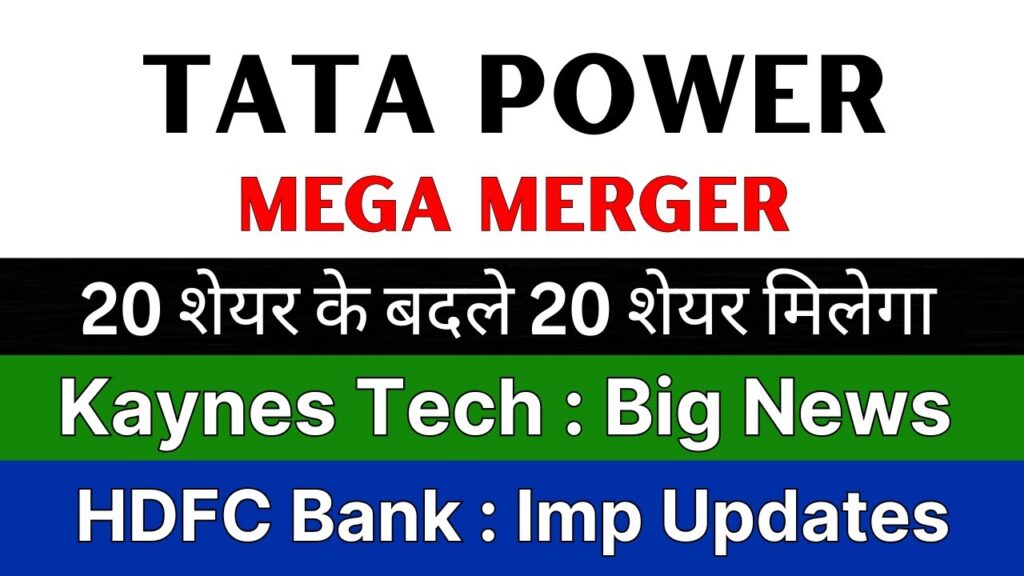
The Indian stock market landscape is currently witnessing a dynamic shift, driven by aggressive capital expenditure plans in the energy sector, strategic global partnerships in semiconductor manufacturing, and significant banking consolidations. For investors navigating this complex terrain, understanding the granular details of corporate actions and financial health is paramount.
This comprehensive analysis delves into the latest developments surrounding key market players: Kaynes Technology, HDFC Bank, Tata Power, Adani Ports, and Dr. Lal PathLabs. We will dissect their recent strategic moves, financial reports, and the broader economic implications for shareholders.
Kaynes Technology: Navigating the Semiconductor Boom and Valuation Concerns
The narrative surrounding Kaynes Technology is currently two-fold: an optimistic future anchored in the burgeoning semiconductor industry and a present reality challenged by governance concerns and valuation corrections.
Strategic Partnerships in Chip Manufacturing
Kaynes Technology is aggressively positioning itself at the forefront of India’s semiconductor revolution. The company’s subsidiary, Kaynes Semi Private Limited, has initiated critical steps to operationalize its manufacturing capabilities within India. A pivotal development in this regard is the company’s recent strategic alliance with two prominent Japanese firms.
The first major tie-up is with AOI Electronics Co. Ltd, a global technology firm based in Japan. The second partnership involves Musashi (phonetically referenced as Musui/CEO Co. Ltd in market updates). These collaborations are designed to bolster Kaynes’ technical capabilities in semiconductor assembly and testing.
Why This Matters: The global demand for semiconductors is projected to remain robust for the next 10 to 15 years, driven primarily by the Artificial Intelligence (AI) revolution and the continued electrification of the automotive industry (EVs). For an emerging market like India, establishing a domestic semiconductor ecosystem is a national priority. Kaynes Technology’s proactive approach to securing Japanese technology partners places it in a favorable position to capitalize on this long-term structural trend.
Addressing the Governance “Discount” and Stock Correction
Despite the positive industrial outlook, Kaynes Technology’s stock has faced significant selling pressure recently. This volatility stems from a report by Kotak Institutional Equities, which highlighted concerns regarding “management disclosures” and potential mismatches in reported data.
- The Issue: The concern was not strictly about business growth but rather the transparency and accuracy of information shared by the management. When investors suspect a lack of clarity or potential manipulation in disclosures, the market assigns a “governance discount” to the stock.
- Valuation Compression: Following these concerns, the stock’s valuation has compressed significantly. The Price-to-Earnings (P/E) ratio, which previously hovered around a lofty 140x, has corrected to approximately 70x. For context, the company’s 5-year median P/E stands at roughly 120x.
- The Investor Perspective: This scenario mirrors the situation faced by Polycab India during the income tax raids. In Polycab’s case, the stock witnessed a sharp dip but eventually recovered as the underlying business fundamentals remained intact and the regulatory issues were priced in.
Investment Verdict: For existing shareholders, the key variable to monitor is the actual impact on business operations. If the disclosure issues are merely administrative hiccups and do not reflect deep-rooted financial irregularities, the current valuation drop could represent a consolidation phase before a recovery. However, if these issues begin to slow down the company’s growth trajectory or delay its semiconductor projects, the recovery will be prolonged. Investors must scrutinize quarterly reports for sustained revenue growth to validate the management’s integrity.
HDFC Bank & Bank of Baroda: Securing Capital from Overseas Markets
The Indian banking sector is increasingly looking outward to diversify its funding sources. A prime example of this trend is the recent collaborative fundraising effort by HDFC Bank and Bank of Baroda.
The $1.5 Billion Overseas Loan Pact
In a significant financial maneuver, these two banking giants have collectively raised $1.5 billion from the overseas loan market. This fundraising is structured as a syndicated loan with a five-year tenure, indicating confidence from global lenders in the Indian banking system’s stability.
- The Split: Out of the total corpus, HDFC Bank has secured $1 billion, while Bank of Baroda has raised $500 million.
- Key Lenders: The deal was financed by major global banking institutions, including MUFG (Mitsubishi UFJ Financial Group) and HSBC. The involvement of these tier-one global banks serves as a testament to the creditworthiness of top-tier Indian financial institutions.
Financial Health Check: HDFC Bank’s Growth Trajectory
While the fundraising news is positive, HDFC Bank’s recent financial performance has sparked debates regarding its growth momentum.
- Revenue vs. Profit Disconnect: In the past year, HDFC Bank reported a revenue growth of roughly 8%, yet the profit growth lagged at only 5%. When compared to its 10-year historical average, these figures appear muted. The bank has been grappling with higher costs of funds, which has compressed its Net Interest Margins (NIMs).
- The Macro Turnaround: However, the outlook is shifting. With the Reserve Bank of India (RBI) signaling a pause and potential future reduction in Repo Rates, banks are beginning to pass on benefits to customers. A lower interest rate environment typically spurs credit uptake.
- Future Outlook: As the cost of credit reduces, HDFC Bank’s loan book is expected to strengthen. Lower credit costs combined with sustained loan demand could help the bank realign its profit growth with its revenue trajectory. Investors should watch for improvements in operating leverage in the coming quarters.
Tata Power: A ₹1.25 Lakh Crore Vision for 2030
Tata Power is undergoing a massive transformation, pivoting from a traditional utility provider to a green energy powerhouse. The company’s latest announcements regarding capital expenditure (Capex) and international expansion highlight its aggressive growth strategy.
Strategic Expansion in Bhutan
Tata Power is expanding its geopolitical footprint by investing in Bhutan’s hydropower sector. The company has committed ₹64 Crore to acquire a 40% stake in a Bhutan-based hydro company, identified as Khorlochhu Hydro Power (referenced as HPL/Hydro FM in updates).
This investment is strategic for two reasons:
- Clean Energy Mix: It adds to Tata Power’s renewable portfolio.
- Cross-Border Trade: It strengthens India’s energy ties with Bhutan, allowing for efficient power import/export dynamics.
The ₹25,000 Crore Annual Capex Plan
The most headline-grabbing update from Tata Power is its long-term financial commitment to capacity expansion. The company has outlined a roadmap up to the Financial Year 2030.
- Capex Surge: For FY2025, the Capex was initially projected at around ₹17,273 Crore. The management has revised this ambition significantly, targeting an annual investment of ₹25,000 Crore continuously until 2030.
- Total Investment: This translates to a staggering cumulative investment of approximately ₹1.25 Lakh Crore over the next five years.
Capacity Expansion Targets
This capital will be deployed to achieve specific generation milestones:
- Thermal Energy: The company plans to double its thermal capacity from the current 15.7 GW to 30 GW. This ensures baseload stability while the grid transitions.
- Green Energy: The renewable portfolio is set for exponential growth, targeting a jump from 7 GW to 20 GW.
Implications for Investors: Tata Power’s clear guidance provides visibility into its future earnings potential. However, such heavy Capex usually implies higher debt levels or free cash flow utilization. Investors must monitor the company’s debt-to-equity ratio and the execution speed of these projects. If executed well, Tata Power could solidify its status as India’s leading integrated power utility.
Adani Group Updates: The Harbour & Ports Merger
The Adani Group continues to streamline its operational structure through strategic consolidation. The latest update concerns the merger between Adani Harbour Services and Adani Ports and Special Economic Zone (APSEZ).
- Regulatory Approval: The merger process has received its first stage of approval from the National Company Law Tribunal (NCLT).
- Business Impact: Consolidating harbor services into the listed entity (Adani Ports) is expected to create operational synergies, reduce administrative redundancies, and improve the overall margin profile of the ports business. For Adani Ports shareholders, this is a positive development towards a leaner, more efficient corporate structure.
Dr. Lal PathLabs: Understanding the Bonus Adjustment
Investors in Dr. Lal PathLabs may have noticed a sharp 50% drop in the stock price on the last trading day. It is crucial to understand that this is not a market crash but a technical adjustment due to a corporate action.
- The Event: The company declared a 1:1 Bonus Issue. This means for every 1 share an investor holds, they receive 1 additional share for free.
- Price Adjustment: When a stock goes ex-bonus, the price is divided in proportion to the bonus ratio. Since the number of shares doubles, the price per share halves to maintain the same market capitalization.
- Portfolio Impact: While the price appears to have crashed, the total value of the investment remains theoretically unchanged once the bonus shares are credited to the Demat account. This typically takes a few weeks from the record date. Investors should not panic sell based on the price drop alone.
Market Resources and Due Diligence
In volatile markets, access to timely data and technical analysis is vital. For traders seeking real-time insights, utilizing SEBI-registered research resources is highly recommended. Many analysts now provide detailed technical charts and F&O data points via platforms like Telegram.
Disclaimer: All financial information provided in this article is for educational purposes only. Stock market investments are subject to market risks. Readers are advised to conduct their own independent research or consult with a SEBI-registered investment advisor before making any financial decisions.
Conclusion
The current market cycle is defined by “Capex and Consolidation.” Tata Power is building the infrastructure for tomorrow, Kaynes is laying the chips for the digital future, and HDFC Bank is fueling the economy with global capital. While volatility is inevitable—as seen with Kaynes Tech—the long-term structural stories of these companies remain compelling for the astute investor who can look past short-term noise.