


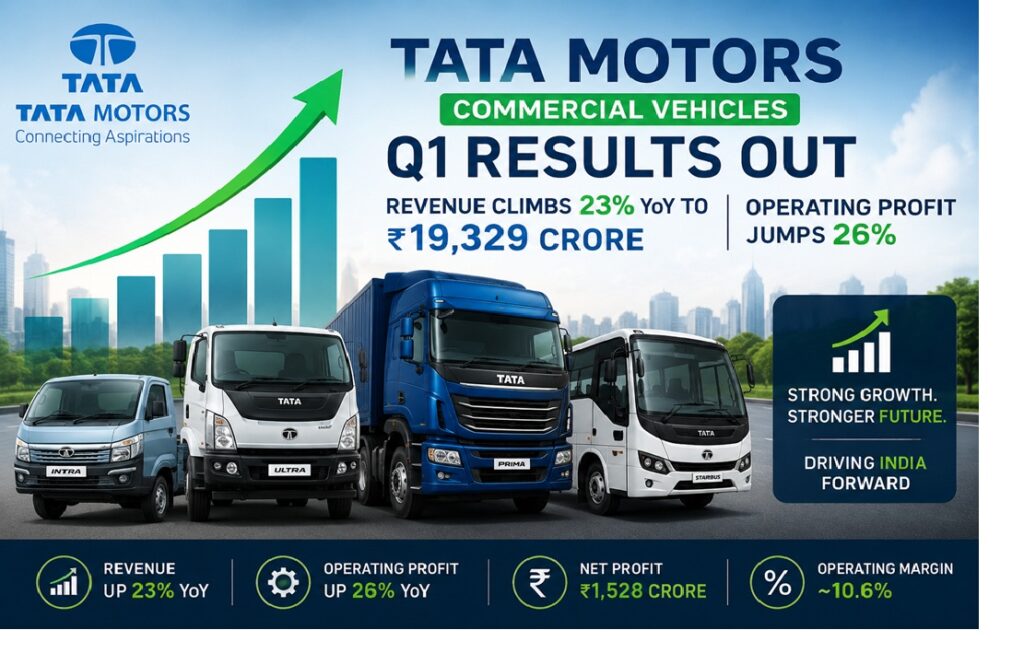
The Tata Group dominated market conversation this week, and for four very different reasons. Tata Motors’ commercial vehicle arm posted a Q1 result that beat expectations on revenue and cash flow. Tata Steel slipped after N Chandrasekaran signalled he will not seek another term as chairman. Tata Power delivered its strongest operating quarter in over a year while quietly nudging shareholders to move physical certificates into demat form. And on the small-cap side, PH Capital announced a bonus issue so generous that the stock locked into its upper circuit within minutes.
Below is a complete breakdown of what each company reported, what management actually said, and what long-term investors should watch from here.
Tata Motors Commercial Vehicles Q1 Results: Revenue Surges 23%, Margins Slip
Tata Motors’ commercial vehicle business closed at ₹456, up 1.59% on the day, while most other Tata Group counters traded in the red. That divergence tells its own story: the market rewarded a genuinely strong operational quarter even as sentiment across the wider group turned cautious.
The company’s market capitalisation now sits at roughly ₹1.68 lakh crore.
Standalone Numbers: Steady Profit Growth on a Much Bigger Top Line
For the June quarter, the standalone business reported:
| Metric | Q1 (Current) | Q1 (Year Ago) | Change |
|---|---|---|---|
| Net Profit | ₹1,528 crore | ~₹1,411 crore | +8.3% |
| Revenue from Operations | ₹19,329 crore | ₹15,682 crore | +23% |
| EBITDA (Operating Profit) | ₹2,176 crore | ₹1,987 crore | +9.5% |
| EBITDA Margin | 11.26% | 12.67% | −141 bps |
The headline that matters most here is revenue. A 23% year-on-year jump in a commercial vehicle business is not a rounding error — it reflects real volume expansion combined with a better product mix, not just price increases passed through to fleet buyers.
Net profit growth of 8.3% looks modest next to that revenue number, and the gap is entirely explained by margin compression. Which brings us to the softer part of the result.
Where Margins Went — and Why It Matters
EBITDA margin contracted from 12.67% to 11.26%, a decline of roughly 141 basis points. Operating profit still grew 9.5% in absolute terms, but it grew far slower than the top line, meaning the company converted less of each incremental rupee of sales into operating profit than it did a year ago.
Two forces sit behind this:
Input cost inflation. Steel, rubber, and electronic component costs moved against manufacturers through the quarter. Commercial vehicle makers carry heavy raw material weight in their bill of materials, so even a modest commodity move compresses margin quickly.
Mix and discounting pressure. Growth driven partly by smaller commercial vehicles and higher export volumes typically carries a different margin profile than premium heavy trucks sold into a tight domestic market.
Neither issue is structural. Both are the kind of pressure that reverses when commodity cycles turn or when the mix shifts back toward higher-margin segments. But investors should not model a return to 12.5%+ margins as automatic.
Consolidated Performance: An 83% Profit Jump — With an Asterisk
On a consolidated basis, the picture looks even stronger at first glance:
- Revenue rose 19% to approximately ₹20,700 crore
- EBITDA rose 10% to roughly ₹2,300 crore
- EBITDA margin narrowed 90 basis points to 10.9%
- Profit After Tax surged 83% year on year
That 83% profit jump is the number that will end up in every headline. It deserves context.
Management explicitly attributed a meaningful portion of the increase to mark-to-market gains on the company’s investment in Tata Capital. That is a genuine gain and it genuinely sits on the books — but it is a one-time, non-operating item. It does not repeat quarter after quarter, and it does not reflect how many trucks the company sold or how efficiently it built them.
Strip that out and the underlying operating story is the one already visible in the standalone numbers: strong revenue growth, healthy but slower profit growth, and margins under real pressure.
Serious investors should model the operating business on its operating merits and treat the Tata Capital gain as a windfall rather than a run-rate.
Free Cash Flow: The Quietly Impressive Number
Here is the metric that arguably matters more than the profit line.
Tata Motors reported positive free cash flow of ₹1,100 crore for the quarter — an improvement of approximately ₹900 crore over the same period last year. Management credited stronger business performance combined with tighter working capital management.
Free cash flow is where accounting meets reality. A company can report profit growth through favourable one-offs, revaluations, or accounting treatment. It cannot fabricate cash walking in the door. A ₹900 crore swing in a single year signals genuine improvement in how the business converts sales into cash — better receivables discipline, leaner inventory, and more favourable payment terms with suppliers.
The domestic business also ended the quarter in a net cash position, and the company paid out approximately ₹1,429 crore in dividends during the period.
Return on Capital Employed: Still Excellent, Slightly Lower
ROCE in the auto business came in at 68%, down from around 72% in the prior fiscal year.
For context, a 68% return on capital employed is exceptional by any industrial standard. Most capital-intensive manufacturers would consider 20% strong. The modest decline mirrors the margin compression already discussed and does not indicate deterioration in capital discipline.
Volumes and Market Share: The Core Business Is Winning
Operationally, this was the strongest part of the result.
- Wholesale volumes rose approximately 26% year on year
- Domestic and export volumes grew in a band of roughly 26% to 35%
- Domestic commercial vehicle market share improved by about 100 basis points
Segment-wise, the company reported meaningful share positions across its categories:
- SCV (Small Commercial Vehicles): ~56.3%
- ILMCV (Intermediate & Light Medium Commercial Vehicles): ~36.9%
- MHCV / heavier segments: ~27.7%
- CV Passenger (buses and passenger carriers): ~14.3%
Gaining share while growing volume 26% is the combination that matters. Volume growth alone can simply reflect a rising market. Share gain alongside volume growth means the company is taking business from competitors — a far more durable indicator.
The weakest segment is CV Passenger at roughly 14%. Buses and passenger carriers remain a contested space with strong competition, and this is the obvious area for management to target.
What Management Said
The company’s commentary was measured rather than triumphant. Leadership acknowledged that commodity price pressure persisted throughout the quarter and that the global operating environment remained difficult.
Three levers were credited for holding performance together:
- Improved pricing strategy — disciplined price realisation rather than chasing volume through discounting
- Cost reduction initiatives — structural cost-out programmes across manufacturing and procurement
- Operational efficiency gains — better throughput and asset utilisation
The subtext is straightforward: the company delivered this quarter despite the macro environment, not because of it. That is a stronger position than it sounds. Companies that perform well only in favourable conditions face a much harder test when conditions turn.
Tata Steel Share Price Falls: N Chandrasekaran Will Not Seek Another Term
Tata Steel closed at ₹185, down 1.73%, and the decline had almost nothing to do with steel prices.
The Announcement That Moved the Market
N Chandrasekaran confirmed that he will not put his name forward for another term as chairman once his current tenure concludes. His existing term runs until 20 February 2027.
The reaction rippled across the group. TCS, Tata Motors Passenger Vehicles, Tata Steel, and Tata Consumer Products all traded weak on the news.
Why the Market Reacted This Way
Chandrasekaran has led Tata Sons since 2017, and his tenure coincided with a period of significant restructuring across the group — consolidation of businesses, aggressive expansion into new energy and electronics, the turnaround at Air India, and the strategic repositioning of Tata Steel’s European operations.
Markets do not dislike succession. Markets dislike uncertainty about succession. When a long-serving leader with deep institutional knowledge signals an exit without a named successor already in place, investors immediately begin discounting for the unknown: Will strategic priorities shift? Will capital allocation discipline hold? Will ongoing restructuring programmes retain executive sponsorship?
The selling is a reflexive risk premium, not a verdict on the business.
Important Context on Timing
The term does not expire until February 2027. That is a long runway by corporate governance standards — ample time for the board to identify, evaluate, and transition to a successor in an orderly way.
This is materially different from a sudden, unexplained departure. An announced non-renewal well ahead of term expiry is, in governance terms, a sign of a functioning board rather than a distressed one.
Tata Steel’s Structural Change: The Expanded Apex JCM
Separately, and largely overlooked in the noise, Tata Steel announced a significant organisational restructuring.
The company has constituted an expanded Apex Joint Consultative Council of Management (Apex JCM), with:
- T V Narendran, CEO & Managing Director, as Chairman
- Sanjeev Kumar Chaudhary, President of the Tata Workers Union, as Vice Chairman
Previously, the Joint Consultative Council operated primarily at the Jamshedpur unit level. The expanded structure now brings Kalinganagar, Noamundi, and other operating units under a single consultative framework, unifying employee representation across the company’s manufacturing footprint.
Why This Restructuring Matters More Than the Market Realised
Tata Steel’s labour relations have historically been among the strongest in Indian heavy industry, and that is a competitive advantage most investors take for granted. Extending a proven consultative structure from a single plant to the entire operating network is a meaningful institutional upgrade.
Practically, it means:
- Faster resolution of operational disputes across multiple sites
- Consistent workforce policy rather than plant-by-plant variation
- Reduced disruption risk during capacity expansion and modernisation
- A single forum for management to communicate strategic change
For a company undertaking large capital projects and navigating a complex international portfolio, workforce alignment is not a soft issue. It directly affects execution timelines and cost.
The Investor View on Tata Steel
The distinction worth holding onto is this: the chairman announcement is a sentiment event, while the JCM expansion is a structural event.
Sentiment events move prices in days. Structural changes affect performance over years. The market priced the first and largely ignored the second.
The short-term pressure is understandable and likely temporary. The medium-term question for Tata Steel remains what it always was — global steel spreads, the trajectory of the European operations, and the pace of domestic capacity ramp-up. None of those changed this week.
Tata Power Q1 Results: Strongest Operating Quarter in Over a Year
Tata Power closed at ₹378, down approximately 0.51%.
The Numbers
| Metric | Current Quarter |
|---|---|
| Revenue | ~₹19,051 crore |
| Total Expenses | ~₹15,191 crore |
| Operating Profit | ~₹3,860 crore |
| Other Income | ~₹630 crore |
| Net Profit | ~₹1,400 crore |
Revenue at roughly ₹19,051 crore represents the strongest top line across the last three to four quarters. Expenses rose alongside, as expected in a growing utility business, but operating profit of approximately ₹3,860 crore is the standout — also the best in three quarters.
The Detail That Reveals Real Quality Improvement
Here is where the result becomes genuinely interesting.
Other income this quarter came in around ₹630 crore. In the March quarter, other income was approximately ₹1,773 crore — a decline of over ₹1,100 crore.
Now compare the net profit lines. This quarter delivered roughly ₹1,400 crore. The March quarter delivered roughly the same.
Tata Power produced comparable net profit while receiving ₹1,100 crore less in non-operating income.
That is the entire story in one sentence. In the March quarter, strip out the outsized other income and the company would have been operating at or near a loss at the net level. This quarter, the profit is carried by the operating business itself.
This is exactly the kind of quality-of-earnings improvement that rarely makes headlines but matters enormously for long-term valuation. Earnings supported by operations command a higher multiple than earnings supported by treasury gains, asset sales, or interest income — and they should.
Tata Power’s Notice to Physical Shareholders
Tata Power also informed the exchanges that it has published advertisements in Financial Express, Indian Express, and Loksatta directed at shareholders still holding physical share certificates.
The company is urging these shareholders to:
- Convert physical shares into dematerialised (demat) form at the earliest
- Complete pending KYC formalities
- Update bank account details not yet registered with the company
- Resolve any PAN or Aadhaar mismatches in their records
To support this, Tata Power has opened a special window through which its Registrar and Share Transfer Agent (RTA) will process the required formalities.
Why Physical Shareholders Should Act Immediately
This is not a routine administrative notice. It has real financial consequences.
Under current SEBI regulations, physical shares cannot be transferred or sold. They must be dematerialised first. Holders of physical certificates who ignore this face several concrete risks:
- Inability to sell when they want to — the conversion process takes time
- Suspended dividend payments where KYC or bank details are incomplete
- Unclaimed dividends eventually transferring to the Investor Education and Protection Fund (IEPF), after which recovery becomes a lengthy legal process
- Physical loss or damage to certificates, requiring duplicate issuance procedures
If you or a family member holds Tata Power shares in physical form — often inherited certificates from decades-old holdings — this notice is a direct instruction to act. The special window makes the process simpler than it will be later.
The Outlook for Tata Power
Combining an operationally-driven profit with the company’s ongoing renewable capacity build-out, the medium-term setup looks constructive. The key variables to track remain regulatory tariff decisions, the pace of solar and transmission capacity additions, and debt levels relative to expansion spending.
PH Capital Bonus Issue: A 1:10 Ratio Sends the Stock to Upper Circuit
The most dramatic move of the day came from a micro-cap.
PH Capital announced a bonus issue in a 1:10 ratio — meaning every shareholder holding one equity share will receive ten bonus shares.
The stock immediately locked into its 5% upper circuit on the announcement.
The Stock’s Extraordinary Run
The price action leading into this announcement was already remarkable:
- 52-week low: approximately ₹165
- 52-week high: approximately ₹1,150
- The stock trades near its all-time high
- It has moved from roughly ₹200 to near ₹1,000 — a rise of nearly five times
That kind of move in a micro-cap over twelve months is exceptional and, importantly, cuts both ways.
Understanding What a Bonus Issue Actually Does
A bonus issue is one of the most misunderstood corporate actions among retail investors, so it’s worth being precise.
A bonus issue does not create wealth. It restructures existing shareholding.
When a company issues bonus shares in a 1:10 ratio, the share count increases eleven-fold, and the share price adjusts downward proportionally on the ex-bonus date. A shareholder holding 100 shares at ₹1,000 (₹1,00,000 value) will hold 1,100 shares at approximately ₹91 (₹1,00,100 value). The company’s market capitalisation, assets, earnings, and business fundamentals remain entirely unchanged.
What a bonus issue does achieve:
- Improved liquidity — more shares outstanding means easier trading with lower bid-ask spreads
- Lower per-share price — psychologically more accessible to small investors
- Signalling — management typically issues bonus shares when confident about retained earnings and future prospects
- Capitalisation of reserves — free reserves convert into permanent share capital
What it does not achieve: any increase in the intrinsic value of your holding.
A Necessary Word of Caution on Micro-Caps
The upper circuit reaction reflects genuine enthusiasm, but micro-cap stocks that have risen five-fold in a year carry risk profiles fundamentally different from large-cap Tata Group names.
Specific risks include:
- Low liquidity — exiting a position can be difficult when sentiment turns, particularly in circuit-bound stocks
- Limited analyst coverage — far less independent scrutiny of financials
- Higher volatility — the same circuit mechanism that traps buyers on the way up traps sellers on the way down
- Valuation risk — a five-fold move often prices in years of expected growth
Bonus issues are frequently followed by short-term profit booking once the excitement fades. Anyone considering a position should study the underlying business — revenue, profitability, promoter holding, and debt — rather than the corporate action alone.
Key Takeaways for Investors
| Company | The Headline | What Actually Matters |
|---|---|---|
| Tata Motors CV | Revenue +23%, PAT +8.3% standalone | ₹1,100 crore positive free cash flow and 100 bps market share gain |
| Tata Steel | Chandrasekaran won’t seek re-appointment | Expanded Apex JCM strengthens execution capability across all units |
| Tata Power | Best operating quarter in over a year | Comparable profit on ₹1,100 crore less other income — real earnings quality |
| PH Capital | 1:10 bonus issue, upper circuit | No wealth creation; improves liquidity, high micro-cap risk |
Frequently Asked Questions
Did Tata Motors’ commercial vehicle business have a good quarter?
Yes, operationally. Revenue grew 23% year on year to ₹19,329 crore standalone, wholesale volumes rose about 26%, and domestic CV market share improved roughly 100 basis points to around 56.8% in its core segments. Free cash flow turned positive at ₹1,100 crore, a ₹900 crore improvement. The weakness was margin — EBITDA margin fell from 12.67% to 11.26% on commodity cost pressure.
Why did the consolidated profit jump 83%?
A significant portion came from mark-to-market gains on the company’s Tata Capital investment. This is a genuine but non-recurring, non-operating gain. The underlying operating performance is better reflected in the standalone numbers.
Why did Tata Steel shares fall?
The decline followed N Chandrasekaran’s confirmation that he will not seek reappointment as chairman when his term ends on 20 February 2027. The reaction reflected leadership-transition uncertainty rather than any change in Tata Steel’s operating fundamentals. Other Tata Group stocks including TCS and Tata Consumer also traded weak.
Is the Tata Steel decline a long-term concern?
The announcement is a sentiment event with a long transition runway — over eighteen months. The company simultaneously announced a structural positive: the expanded Apex JCM covering all operating units, which strengthens workforce coordination across Jamshedpur, Kalinganagar, Noamundi, and other sites.
What should I do if I hold physical Tata Power shares?
Convert them to demat form through the company’s special window immediately. Physical shares cannot be sold under current SEBI rules, and pending KYC or bank details can result in dividends going unpaid and eventually transferring to the IEPF. Contact Tata Power’s Registrar and Share Transfer Agent to begin the process.
Will the PH Capital bonus issue make me money?
No. A 1:10 bonus increases your share count elevenfold while the price adjusts downward proportionally. The total value of your holding stays the same. Bonus issues improve liquidity and signal management confidence, but they do not create value on their own.
Final Word
The common thread across these four stories is the gap between the headline and the substance.
Tata Motors’ 83% consolidated profit jump reads more impressive than it is; its ₹1,100 crore free cash flow reads less impressive than it is. Tata Steel’s chairman announcement dominated coverage while a genuinely significant organisational restructuring went largely unremarked. Tata Power’s flat-looking profit actually represents a substantial improvement in earnings quality. And PH Capital’s dramatic bonus issue creates no wealth at all.
Reading past the headline is the entire discipline. The numbers that move markets in a single session and the numbers that build returns over a decade are rarely the same numbers.
This article is intended for educational and informational purposes only. It does not constitute investment advice, a recommendation, or a solicitation to buy or sell any security. Financial figures are drawn from publicly reported results and should be verified against official company filings and exchange disclosures. Markets carry risk, including the possible loss of principal. Please consult a SEBI-registered financial advisor and conduct your own research before making any investment decision.