


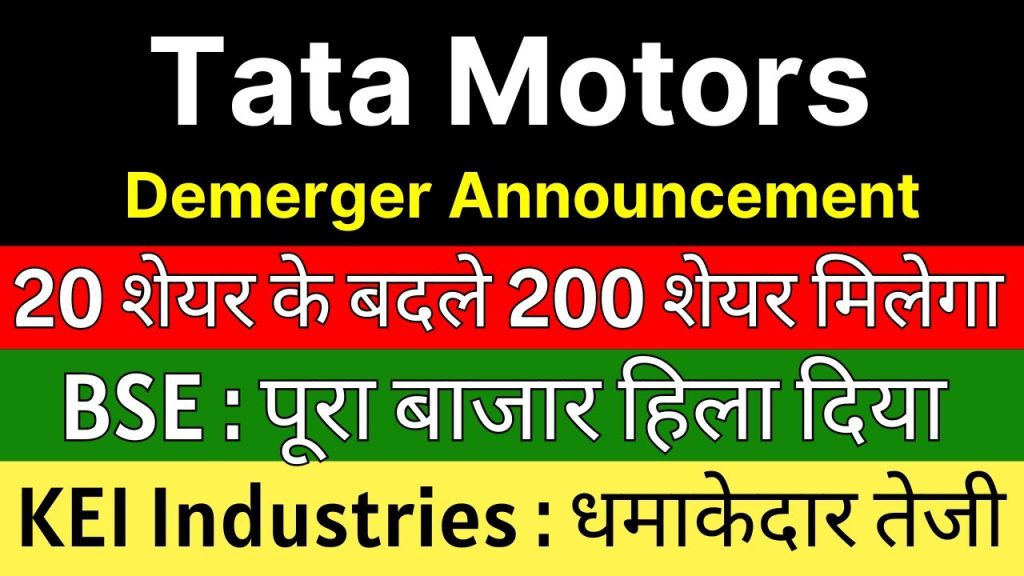
The Indian stock market is buzzing with significant developments, particularly surrounding Tata Motors and BSE Ltd. From Tata Motors’ transformative demerger announcement to BSE’s stellar Q4 earnings, these updates are reshaping investor sentiment and driving market performance. This article dives deep into the latest news, analyzing the implications of Tata Motors’ strategic restructuring, BSE’s financial triumphs, and other key players like KEI Industries and Rajasthan Tube Manufacturing Company. Packed with insights, this comprehensive guide aims to equip investors with the knowledge needed to navigate these dynamic market shifts.
Tata Motors Demerger: A Game-Changing Move for Investors
Tata Motors has captured the spotlight with its bold decision to split its passenger and commercial vehicle businesses into two distinct entities. Approved by an overwhelming 99.99% of shareholders, this demerger is poised to unlock significant value for investors. Let’s explore the details and implications of this strategic overhaul.
What the Demerger Means for Tata Motors Shareholders
The demerger will see Tata Motors’ commercial vehicle (CV) business operate as a separate entity, with its own stock listing. For every Tata Motors share held, investors will receive one additional share of the new CV entity. This restructuring aims to enhance operational focus, allowing each business to pursue tailored strategies and capitalize on market opportunities.
By separating the passenger vehicle (PV) and commercial vehicle segments, Tata Motors seeks to streamline operations and boost efficiency. The CV business, which includes trucks and buses, will target heavy-duty logistics and infrastructure-driven growth. Meanwhile, the PV segment, encompassing electric vehicles (EVs) and premium brands like Jaguar Land Rover (JLR), will focus on innovation and global expansion.
Why Investors Are Excited About the Demerger
The demerger has sparked enthusiasm among investors for several reasons:
- Enhanced Value Creation: Separating the businesses allows each entity to attract specific investor bases, potentially leading to higher valuations.
- Operational Clarity: Dedicated management teams can prioritize segment-specific goals, improving performance and accountability.
- Market Appeal: The CV entity may appeal to investors seeking exposure to India’s infrastructure boom, while the PV business aligns with the global shift toward EVs and luxury vehicles.
This move positions Tata Motors to capitalize on diverse market trends, from India’s logistics growth to the global EV revolution. Investors are optimistic that the demerger will drive long-term profitability and shareholder value.
India-UK Free Trade Agreement: A Boost for Tata Motors
In addition to the demerger, Tata Motors stands to benefit from the proposed India-UK Free Trade Agreement (FTA). This agreement promises to eliminate import tariffs on 99% of Indian exports to the UK, directly impacting Tata Motors’ subsidiary, Jaguar Land Rover (JLR).
JLR’s Competitive Edge in the UK Market
JLR generates a significant portion of its revenue from international markets, including the UK, Europe, the US, and China. The FTA will reduce import taxes on JLR vehicles exported to the UK, making them more competitively priced. Lower prices could drive higher sales volumes, boosting JLR’s market share in the premium automotive segment.
For instance, JLR’s luxury vehicles, such as Range Rover and Jaguar models, previously faced import tariffs that inflated costs. With these taxes removed, JLR can offer more attractive pricing, potentially capturing demand from competitors. This development is particularly timely, as JLR has already seen strong growth in the US, despite tariff concerns.
Broader Implications for Tata Motors’ Global Strategy
The FTA also reduces tariffs on UK goods entering India, fostering a reciprocal trade environment. For Tata Motors, this could mean cost savings on imported components, further strengthening JLR’s profitability. Additionally, the agreement aligns with Tata Motors’ global expansion strategy, particularly in markets like Europe and China, where muted growth has been a challenge.
Investors should keep an eye on Tata Motors’ upcoming earnings call on May 13, 2025. While the demerger and FTA news may not immediately impact Q1 results, management’s guidance on these developments will provide critical insights into the company’s growth trajectory.
BSE Ltd: Q4 Earnings Exceed Expectations
While Tata Motors dominates headlines, BSE Ltd has emerged as a standout performer in the financial sector. The company’s Q4 earnings report has sent its stock soaring, driven by exceptional financial metrics and strategic market positioning.
BSE’s Stellar Q4 Performance
BSE reported a jaw-dropping 354% year-on-year (YoY) growth in earnings for Q4, far surpassing market expectations. The company’s EBITDA reached ₹555 crore, nearly double the anticipated ₹292 crore, reflecting a 100% beat on projections. Key highlights include:
- Revenue Surge: BSE’s revenue grew by 70% YoY, with double-digit growth on a quarter-on-quarter (QoQ) basis.
- Profit Explosion: Annual profit growth for the fiscal year hit 189%, with revenues climbing 102%.
- Dividend Announcement: BSE declared a special plus final dividend of ₹23 per share, signaling confidence in its financial health.
These numbers underscore BSE’s ability to capitalize on market dynamics, positioning it as a top performer in India’s financial ecosystem.
The Sensex Expiry Shift: A Strategic Advantage
A key driver behind BSE’s stellar results is the strategic shift in Sensex futures and options (F&O) expiry from Friday to Tuesday. This change has given BSE a competitive edge over the National Stock Exchange (NSE), which maintains its Nifty expiry on Thursday.
Why the Expiry Shift Matters
In the F&O market, trading volumes peak on expiry days, generating significant transaction fees for exchanges. By moving Sensex expiry to Tuesday, BSE captures a larger share of weekly trading volumes, boosting revenue and profitability. The NSE considered shifting its Nifty expiry to Monday but backed off following a consultation paper from the Securities and Exchange Board of India (SEBI).
This decision has handed BSE a clear advantage. With Sensex expiry occurring earlier in the week, BSE attracts higher trading activity, translating into robust financial performance. The Q4 results reflect this strategic win, with BSE’s revenue and profit growth outpacing expectations.
What’s Next for BSE Investors?
BSE’s exceptional Q4 performance suggests strong momentum heading into 2025. However, investors should conduct thorough research before making decisions. The company’s ability to sustain high trading volumes and innovate in financial products will be critical to maintaining its upward trajectory.
For those considering BSE as an investment, focus on:
- Market Trends: Monitor trading volumes and F&O activity to gauge BSE’s revenue potential.
- Competitive Dynamics: Assess NSE’s response to BSE’s expiry shift and potential regulatory changes from SEBI.
- Dividend Policy: BSE’s generous dividend payout signals financial strength, appealing to income-focused investors.
While BSE’s Q4 results are impressive, prudent investors should analyze the company’s long-term growth strategy and market positioning.
KEI Industries: Riding the Growth Wave
Another company making waves is KEI Industries, a leader in the cables and wires sector. The company’s recent financial performance has bolstered its stock, driven by strong demand in infrastructure and real estate.
KEI Industries’ Q4 Highlights
KEI Industries reported robust Q4 results, with key metrics exceeding market expectations:
- Net Profit Growth: Net profit surged by 34% YoY, reflecting operational efficiency and strong sales.
- Revenue Increase: Revenue grew by 25% YoY, reaching ₹915 crore against expectations of ₹2700 crore.
- Earnings Per Share (EPS): EPS hit ₹23, surpassing forecasts of ₹20, indicating solid profitability.
Despite stable margins, KEI Industries’ ability to deliver consistent growth has positioned it as a favorite among investors.
Factors Driving KEI Industries’ Success
Several factors contribute to KEI Industries’ strong performance:
- Infrastructure Boom: India’s focus on infrastructure development, including smart cities and renewable energy projects, has fueled demand for KEI’s products.
- Real Estate Recovery: The revival of India’s real estate sector has increased the need for high-quality cables and wires.
- Operational Excellence: KEI’s focus on cost management and production efficiency has supported margin stability.
The company’s Q4 results, announced after market close, triggered a positive stock response, reflecting investor confidence in its growth story.
Guidance and Future Outlook
KEI Industries has yet to release its updated guidance, pending the completion of its earnings call. Investors should await management’s commentary on future plans, particularly regarding capacity expansion and market penetration. The company’s ability to capitalize on India’s infrastructure push will be a key determinant of its long-term success.
For now, KEI Industries’ strong financials and market positioning make it an attractive option for growth-oriented investors. Stay tuned for the earnings call video, which will provide deeper insights into the company’s strategic roadmap.
Rajasthan Tube Manufacturing Company: Stock Split Announcement
Rounding out the market updates is Rajasthan Tube Manufacturing Company, which recently announced a 1:10 stock split. This move aims to enhance liquidity and make the stock more accessible to retail investors.
Details of the Stock Split
The stock split will divide each existing share into ten, reducing the share price proportionally. The company initially set April 21, 2025, as the record date but later revised it to May 8, 2025. This adjustment ensures smoother implementation and aligns with market conditions.
Implications for Investors
For existing shareholders, the stock split increases the number of shares held without altering the overall investment value. The lower share price may attract new investors, potentially boosting trading volumes and stock liquidity.
While the stock split is a positive development, it does not inherently change the company’s fundamentals. Investors should evaluate Rajasthan Tube Manufacturing Company’s financial health and growth prospects before making investment decisions.
Strategic Insights for Investors
The latest updates from Tata Motors, BSE, KEI Industries, and Rajasthan Tube Manufacturing Company highlight the dynamic nature of India’s stock market. Here are actionable insights for investors:
- Tata Motors: The demerger and FTA present significant growth opportunities. Focus on management’s guidance during the May 13 earnings call to assess the company’s strategic direction.
- BSE Ltd: The expiry shift and strong Q4 results position BSE as a leader in the financial sector. Monitor trading volumes and competitive dynamics to gauge its sustainability.
- KEI Industries: With robust financials and exposure to high-growth sectors, KEI is well-poised for continued success. Await the earnings call for clarity on future plans.
- Rajasthan Tube: The stock split enhances accessibility but requires careful evaluation of the company’s fundamentals.
Navigating Market Volatility
As with any investment, thorough research and risk management are essential. The stock market is subject to volatility, driven by macroeconomic factors, regulatory changes, and company-specific developments. Investors should:
- Diversify Portfolios: Spread investments across sectors to mitigate risks.
- Stay Informed: Follow earnings calls, management guidance, and market news to make informed decisions.
- Consult Experts: Leverage insights from SEBI-registered analysts for data-driven strategies.
Conclusion: Seizing Opportunities in a Dynamic Market
The Indian stock market is brimming with opportunities, fueled by transformative moves like Tata Motors’ demerger, BSE’s financial prowess, KEI Industries’ growth trajectory, and Rajasthan Tube’s stock split. By understanding these developments and their implications, investors can position themselves for success.
Whether you’re drawn to Tata Motors’ strategic restructuring, BSE’s market dominance, or KEI Industries’ infrastructure-driven growth, now is the time to act. Conduct thorough research, monitor upcoming earnings calls, and align your investments with your financial goals. The market rewards those who stay informed and proactive—seize the moment and capitalize on these exciting developments.
Disclaimer: This article is for informational purposes only and does not constitute investment advice. Always conduct your own research or consult a financial advisor before making investment decisions.