


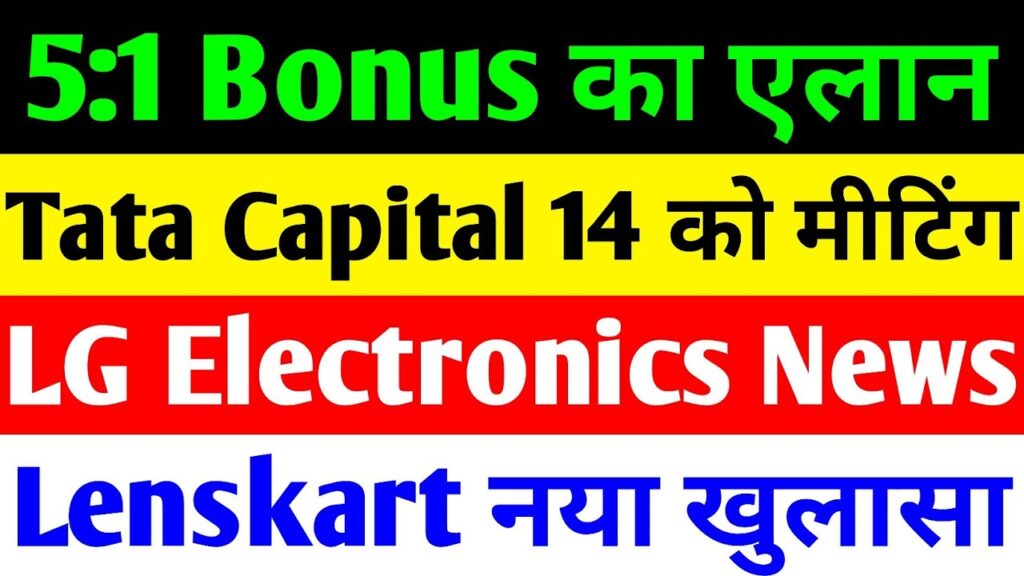
Tata Capital’s shares hover near their IPO levels amid fresh board changes and an impending lock-in expiry, while LG Electronics India consolidates gains after a stellar debut. Lenskart’s much-hyped IPO faces valuation headwinds despite massive oversubscription, and Auto Riders International delights shareholders with a generous 5:1 bonus announcement.
This comprehensive analysis dives deep into these developments, offering actionable insights for retail and institutional players alike. Whether you’re tracking Tata Capital share news today or eyeing long-term plays in consumer electronics and eyewear retail, we’ve got the data-driven breakdown to guide your decisions.
As markets rebound from recent volatility, these stories highlight the interplay between corporate governance, post-IPO realities, and macroeconomic tailwinds like India’s booming consumer spending. With the Nifty 50 touching new highs and foreign inflows surging, understanding these nuances could unlock significant alpha. Let’s unpack each thread, starting with the non-banking financial powerhouse that’s been the talk of Dalal Street.
Tata Capital’s Post-IPO Journey: Stability Amid Subdued Gains and Strategic Shifts
Tata Capital Limited, a cornerstone of the Tata Group’s financial services arm, continues to draw sharp focus from investors navigating the post-IPO landscape. Launched in early October 2025 with a price band of ₹310-₹326, the ₹9,260 crore IPO marked one of India’s largest public offerings that year. Shares debuted modestly on October 13, listing at ₹330—a mere 1.2% premium over the issue price—before settling into a tight trading range. Fast-forward to November 11, 2025, and the stock trades around ₹324.50, reflecting a subtle 0.5% dip from its debut close but underscoring remarkable stability in a market prone to swings.
This resilience speaks volumes about Tata Capital’s robust fundamentals. The company boasts a diversified portfolio spanning consumer finance, wealth management, and infrastructure lending, with assets under management exceeding ₹1.5 lakh crore. Yet, early investors express mild disappointment as the stock lingers below unlisted market premiums of around ₹825, a stark reminder of how listing discounts can erode hype-driven expectations.
Despite this, analysts remain optimistic, with JM Financial recently hiking its target to ₹370, citing strong execution in digital lending and retail growth. What drives this confidence? Let’s zoom in on the latest catalysts.
Fresh Board Appointments: Bolstering Governance for Long-Term Growth
Corporate governance takes center stage as Tata Capital shareholders approve two pivotal resolutions via postal ballot. On October 6, 2025, the company issued notices for e-voting, which ran from October 10 morning to November 8 evening, culminating in unanimous support for the proposals. The spotlight falls on Geeta Ravi Ravichandran, appointed as an Independent Director, bringing her expertise in risk management and regulatory compliance from stints at global banks like HSBC. Complementing her is Ankur Verma, stepping in as a Non-Executive Director, whose background in fintech innovation at startups like Paytm could supercharge Tata Capital’s digital pivot.
These moves aren’t mere formalities—they signal a proactive board refresh amid India’s tightening regulatory scrutiny under RBI’s lens. Independent directors like Ravichandran enhance oversight on lending practices, crucial as non-banking financial companies (NBFCs) face rising NPAs in unsecured loans. Verma’s addition, meanwhile, aligns with Tata Capital’s aggressive push into embedded finance, partnering with e-commerce giants for instant credit solutions.
Investors applaud this, as evidenced by a 1% intraday bump on the announcement day. For those pondering Tata Capital share news today, these appointments underscore a commitment to sustainable scaling, potentially unlocking 15-20% upside by FY26 as per brokerage estimates.
November 14 Institutional Meeting: Eyeing Game-Changing Decisions
Adding intrigue, Tata Capital schedules a virtual Group Institutional Meeting on November 14, 2025, hosted from its Mumbai headquarters. This closed-door session with institutional investors promises discussions on strategic expansions, perhaps delving into overseas forays or green financing initiatives aligned with India’s net-zero ambitions. Such meetings often precede blockbuster announcements—recall how similar huddles at HDFC led to merger synergies that propelled shares 25% higher.
For retail holders nursing flat returns, this event could be a pivot point. With the stock’s price-to-book ratio at 1.8x—below peers like Bajaj Finance’s 3.5x—Tata Capital appears undervalued, trading at a forward P/E of 12x against sector averages of 18x. If the meeting yields clarity on capital allocation, expect renewed buying interest, potentially pushing shares toward ₹350 by year-end. Savvy traders might consider accumulating on dips below ₹320, using stop-losses at ₹315 to mitigate volatility.
Lock-In Period Expiry: 7.1 Crore Shares Hit the Market—Sell-Off or Opportunity?
The elephant in the room? The one-month lock-in expiry on November 10, 2025, freeing 7.1 crore shares—or about 2% of outstanding equity—for trading. Anchor investors, who anchored ₹3,500 crore at the IPO, now hold the power to book profits, injecting mild selling pressure. Indeed, Monday’s session saw a 0.8% dip to ₹324.45, with volumes spiking 20% above average. Yet, history tempers fears: In similar scenarios for Zomato’s lock-in release, shares dipped just 2% before rebounding 15% on fresh inflows.
Tata Capital’s case mirrors this resilience. Not all freed shares will flood the market—many anchors eye long-term holds given the company’s 25% CAGR in AUM over five years. Post-expiry, focus shifts to quarterly results due December 2025, where analysts forecast 18% YoY loan book growth. For risk-averse investors, this lock-in unwind presents a tactical entry: Buy the fear, sell the greed, targeting 10-12% returns in 3-6 months. Recent X chatter echoes this caution, with users like @VishalShenoy9 warning against unlisted traps while praising listed stability.
In sum, Tata Capital’s narrative blends caution with conviction. While short-term noise from lock-ins persists, governance upgrades and strategic meets position it for a breakout. Long-term bulls see it as a defensive play in a high-beta market.
LG Electronics India: From IPO Fireworks to Steady Consolidation in Consumer Tech
LG Electronics India Pvt. Ltd. stole headlines with its October 2025 IPO, a ₹4,300 crore blockbuster that listed at ₹1,715— a whopping 50% premium over the ₹1,140 issue price—delivering instant riches to allottees. As of November 11, 2025, shares close at ₹1,662, up 1.01% but consolidating below the ₹1,700 open, signaling a healthy breather after the euphoria. This phase isn’t weakness; it’s maturation in a sector where consumer durables grapple with input cost spikes and festive demand normalization.
LG’s India arm, a subsidiary of the South Korean giant, commands 30% market share in appliances like refrigerators and TVs, fueled by urbanization and premiumization trends. The IPO’s success—54x oversubscription, anchored by Norway’s sovereign fund and Singapore’s Temasek—validated this dominance. But with lock-ins expiring, questions swirl: Will selling cap the rally, or will fundamentals propel it higher?
Revenue and Profit Explosion: A Testament to Operational Excellence
LG Electronics India’s financials paint a picture of relentless growth. Fiscal 2023 revenue clocked ₹19,864 crore, surging to ₹21,352 crore in 2024 and an estimated ₹24,366 crore in 2025—a 12% CAGR driven by e-commerce penetration and omnichannel expansion. Profitability tells an even brighter story: Net earnings leaped from ₹134.8 crore in 2023 to ₹151 crore in 2024, then rocketed to ₹223 crore in 2025, thanks to margin optimization via local sourcing and AI-integrated products like smart washers.
This trajectory outpaces peers; while Voltas grew revenues 8% YoY, LG’s 14% clip reflects superior R&D spend—5% of sales versus industry 3%. Analysts at Motilal Oswal peg a ₹2,000 target, implying 20% upside, hinging on Q3 festive sales beating estimates by 15%. For investors, this isn’t just numbers—it’s proof of LG’s moat in a ₹2 lakh crore market projected to hit ₹3.5 lakh crore by 2030, per KPMG.
Lock-In Dynamics and Short-Term Trading Tactics
November 10’s lock-in expiry unleashes 7.1 crore shares, mirroring Tata Capital’s unwind and contributing to the broader 12.5 crore share release across four IPOs. Trading mixed on Monday, LG dipped 0.5% intraday before recovering, as select anchors trimmed holdings to lock in 40% gains. X users note the pressure, with @indianstockbot highlighting the event’s ripple effects.
Don’t panic-sell yet. Only 20-30% of freed floats typically trade immediately, per historical data from Paytm’s expiry. LG’s 25x forward P/E, though premium, justifies via 18% ROE—double the sector median. Swing traders could eye ₹1,650 support for entries, targeting ₹1,750 resistance. Long-term, with India’s middle class swelling to 500 million by 2027, LG’s premium appliance push positions it for 25% EPS growth annually. Missed the IPO? Secondary market dips offer a second bite at this apple.
LG’s story? A masterclass in blending global tech with local hustle, priming shares for a festive-fueled rebound.
Lenskart IPO 2025: Hype, High Valuations, and a Rocky Road to Redemption
Lenskart Solutions Ltd., the unicorn eyewear disruptor founded by Peyush Bansal, commanded ₹7,278 crore in its November 2025 IPO—the largest in consumer retail that year—oversubscribed 28.26x, with retail bids at 7.54x and HNIs at 18.23x. Priced at ₹382-₹402, it valued the firm at ₹70,270 crore ($8.4 billion), drawing SoftBank and TPG as anchors. Yet, listing on November 10 brought a reality check: Shares opened at ₹390 (3% discount) on NSE, plunged to ₹365 intraday (-9%), before clawing back to ₹404.55—a mere 0.6% gain.
By November 11, a 2.64% pop to ₹415 signals tentative recovery, up 7% over two days. Why the stumble? Overhyped valuations in a cautious market, where FII outflows hit ₹15,000 crore in October.
Listing Blues: When Buzz Meets Market Skepticism
The debut echoed Swiggy’s muted 2024 listing—strong anchors, weak sentiment. Lenskart’s 236x P/E dwarfs peers like Titan’s 80x, sparking debates on sustainability. X sentiment mirrors this: @ArvindAk7 questions future listings post-Lenskart’s discount, while @the_avais quips, “Hype fades. Numbers don’t.” Intraday volatility stemmed from profit-taking amid broader Nifty dips, but closing above issue price hints at underlying strength.
Lenskart’s edge? A 1,000-store network, 20 million customers, and FY25 revenues of ₹8,200 crore (up 28% YoY), with losses narrowing to ₹100 crore from ₹500 crore. AI-driven personalization and exports to 50 countries fuel optimism. SBI Securities’ Sunny Agarwal advises waiting two quarters for profitability proof before piling in.
Valuation Verdict: Premium Priced for Perfection?
At ₹70,000 crore valuation, Lenskart trades at 8.5x sales—steep versus Nykaa’s 4x—but justified by 40% EBITDA margins and AR glasses launch slated for 2026. Analyst Javed Khan from One97 Communications calls it “doubled up” against retail comps, urging caution until Q3 shows 15% margin expansion. SmartKarma notes strong anchor support but weak secondary trading dynamics.
For dip-buyers, ₹380 offers value; targets at ₹480 (20% upside) if festive sales hit ₹2,000 crore. Early allottees, hold firm—this 7x return since unlisted pricing (₹52 in Jan 2025) proves timing trumps all. Lenskart’s arc? From unicorn to blue-chip, if execution matches ambition.
Auto Riders International’s 5:1 Bonus Bombshell: Rewarding Loyalty in Logistics
Micro-cap darling Auto Riders International Ltd. (BSE:512277) surges 1.97% to ₹587 on November 11, 2025, capping a 5% upper circuit triggered by its blockbuster 5:1 bonus approval. Announced September 29 via board resolution and ratified November 7 through postal ballot (51.37% turnout, 100% favor), this move issues five ₹10 face-value shares per held share, record date November 18.
A two-wheeler rental specialist, Auto Riders has delivered multibagger returns—300% in two years—via fleet expansion to 50,000 vehicles. The bonus, funded from ₹20 crore reserves, boosts liquidity without dilution, a classic wealth transfer to loyalists.
Bonus Mechanics: How It Supercharges Shareholder Value
Post-record date, demat accounts swell: One share becomes six, ex-bonus adjustment likely drops price to ₹98 (₹587/6). This cosmetic tweak masks real value—enhanced tradability and signaling strong cash flows. Per KDA & Partners’ Kaushal Dalal, such issues correlate with 15% average pops in three months.
Q2 FY26 tempers the party: Net profit slips 11% to ₹2.39 crore amid 12% cost inflation from fuel hikes, though sales rose 8% to ₹45 crore. Operating margins hold at 9%, buoyed by EV rentals (20% of fleet). With India’s logistics market at ₹20 lakh crore, Auto Riders eyes 25% growth via tier-2 city tie-ups.
Balancing Act: Costs vs. Expansion in a Competitive Arena
Rising inputs pressure margins, but the bonus underscores confidence in FY26’s 15% revenue target. Compared to Delhivery’s 5% margins, Auto Riders’ niche focus yields superior ROCE at 22%. Investors: Accumulate pre-record date for bonus perks, with stops at ₹550. Post-adjustment, ₹110 resistance beckons 20% gains.
This bonus isn’t flash—it’s a logistics leader’s nod to steady scaling.
Lessons from the Pack: IPO Strategies for the Savvy Indian Investor
Juxtaposing these tales reveals patterns. Tata and LG’s lock-in expiries freed 14.2 crore shares combined, yet dips stayed sub-2%, affirming market maturity. Lenskart’s valuation trap warns against FOMO in retail IPOs, where 240x P/E screams caution. Auto Riders’ bonus, meanwhile, spotlights micro-caps’ reward mechanics.
| Stock | IPO Size (₹ Cr) | Listing Premium | Current P/E | Key Catalyst | 6-Mth Target |
|---|---|---|---|---|---|
| Tata Capital | 9,260 | +1.2% | 12x | Board Refresh | ₹370 |
| LG Electronics India | 4,300 | +50% | 25x | Revenue Growth | ₹2,000 |
| Lenskart | 7,278 | -3% | 236x | Margin Expansion | ₹480 |
| Auto Riders Intl | N/A (Bonus) | N/A | 15x | 5:1 Issue | ₹120 (Adj.) |
Data sourced from NSE/BSE as of Nov 11, 2025.
Tip: Diversify across IPO stages—anchor early winners like LG, wait out valuation froth in Lenskart. Always DYOR; consult advisors.
Outlook 2025: Navigating Volatility Toward Wealth Creation
As 2025 closes, RBI rate cuts could juice NBFCs like Tata Capital 15%, while consumer plays like LG and Lenskart ride 10% GDP growth. Auto Riders embodies small-cap alpha in logistics boom. Risks? Geopolitics and inflation, but opportunities abound in India’s $5 trillion economy.
Position now: 40% defensives (Tata), 30% growth (LG/Lenskart), 30% specials (Auto Riders). Track Q3 earnings for pivots. In this bull run, patience pays—here’s to outranking the market.