


Introduction
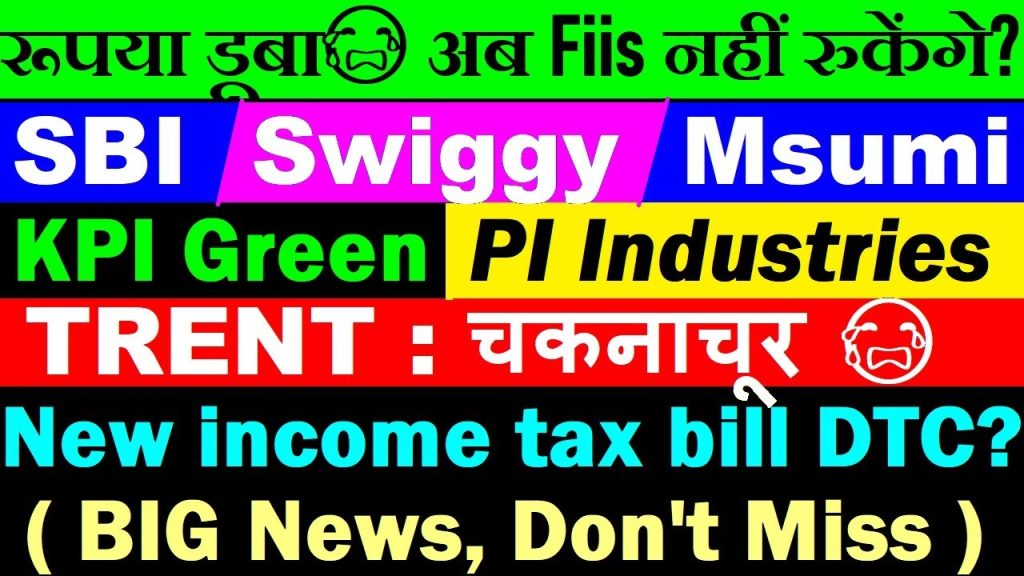
Foreign Institutional Investors (FIIs) continue their aggressive selling spree, impacting Indian stock markets significantly. The sharp depreciation of the Indian Rupee, the performance of key stocks such as Trent, SBI, Swiggy, and KPI Green, along with the anticipated New Income Tax Bill, have added further uncertainty to the market. In this article, we analyze these developments and their potential implications.
KPI Green Energy’s Strong Q3 Performance
KPI Green Energy delivered robust Q3 results, with notable revenue and profit growth. The company’s revenue increased by over 38% year-on-year, surpassing ₹450 crores compared to ₹330 crores in the same period last year. Similarly, its EBITDA surged by 32%, rising from ₹104 crores to ₹137 crores. These strong numbers resulted in a significant stock price rally, demonstrating investor confidence in the company’s growth trajectory.
PI Industries Faces Headwinds Despite Market Leadership
PI Industries, a dominant player in the agrochemical sector, reported mixed results. While the company continues to hold the No. 1 position in its segment, its revenue remained flat, and net profit declined by approximately 17% year-on-year. The results missed market estimates, causing concern among investors. Competitors such as UPL and Sumitomo Chemicals are also experiencing similar challenges, raising questions about the overall sector outlook.
Swiggy’s Growing Revenue and Widening Losses
Swiggy, one of India’s leading food delivery startups, reported a substantial 31% increase in revenue due to aggressive customer acquisition and market expansion. However, this came at the cost of widening net losses, which jumped from ₹574 crores in the same quarter last year to nearly ₹800 crores. The intense competition with Zomato and rising operational costs remain critical challenges for Swiggy.
Quick Commerce Boom – A Silver Lining?
Swiggy’s quick commerce segment, Instamart, reported a 17.7% revenue increase, reaching ₹576.5 crores. Despite rapid growth, the business is still heavily reliant on urban markets, with rural expansion facing significant hurdles. The scalability of quick commerce in India remains a key question.
Motherson Sumi’s Profit Decline Due to Expansion Costs
Motherson Sumi Wiring India reported a 9% increase in revenue. However, its net profit fell by 17% due to a ₹140 crore expansion expenditure. While the company’s long-term growth strategy remains intact, short-term profitability concerns have led to a cautious outlook among investors.
State Bank of India (SBI) – Solid Profits, but NII Misses Estimates
SBI, India’s largest public sector bank, reported a 54% increase in standalone net profit, reaching ₹16,890 crores. However, its net interest income (NII) grew by only 4%, missing market expectations. Despite stable asset quality and controlled non-performing assets (NPAs), the bank’s performance on key financial metrics remains a mixed bag.
Trent’s Market Volatility Despite Strong Earnings
Trent Limited, a Tata Group retail giant, delivered impressive numbers with a 34% increase in revenue and a 33% rise in consolidated net profit, reaching approximately ₹500 crores. However, the stock witnessed a sudden drop post-results, as expectations were higher. Additionally, Trent’s announcement regarding the consolidation of Jio stores created some investor uncertainty.
FIIs Maintain Aggressive Selling Streak
Foreign Institutional Investors (FIIs) initially provided some relief with net buying of around ₹800 crores. However, this was short-lived, as they resumed aggressive selling, offloading stocks worth ₹3,500 crores in a single day. The major reasons behind this selling pressure include global economic uncertainty, a weakening Indian Rupee, and concerns over U.S. monetary policy.
The Indian Rupee’s Decline – A Major Concern
The Indian Rupee has been on a downward spiral, reaching new lows of ₹87.6 against the U.S. Dollar. Analysts predict that it may soon touch ₹88 or beyond. A weaker Rupee erodes foreign investor confidence, reducing the attractiveness of Indian assets and leading to higher inflationary pressures. The Reserve Bank of India (RBI) has introduced several measures, including liquidity adjustments and forex interventions, but the pressure remains.
Upcoming RBI Monetary Policy – Will It Provide Relief?
All eyes are now on the upcoming RBI Monetary Policy Committee (MPC) meeting, where key decisions regarding interest rates and liquidity measures will be discussed. Any announcement related to stabilizing the Rupee or foreign investment inflows will be critical in determining market direction.
New Income Tax Bill – What to Expect?
The government is set to introduce the much-anticipated New Income Tax Bill in Parliament. Finance Minister Nirmala Sitharaman had earlier mentioned that the bill would be presented within a week. Speculations suggest that the bill may include major tax reforms aimed at simplifying compliance and boosting investment.
Conclusion
The Indian stock market continues to experience volatility due to multiple factors, including FIIs’ sustained selling, the depreciating Rupee, and company-specific earnings performance. While some companies like KPI Green and SBI posted strong numbers, others, including PI Industries and Swiggy, faced significant challenges. The upcoming RBI policy meeting and the New Income Tax Bill will play crucial roles in shaping market sentiment in the coming days.
Stay Updated
For the latest stock market updates and financial insights, follow our website. Let us know your thoughts on these market developments in the comments!