


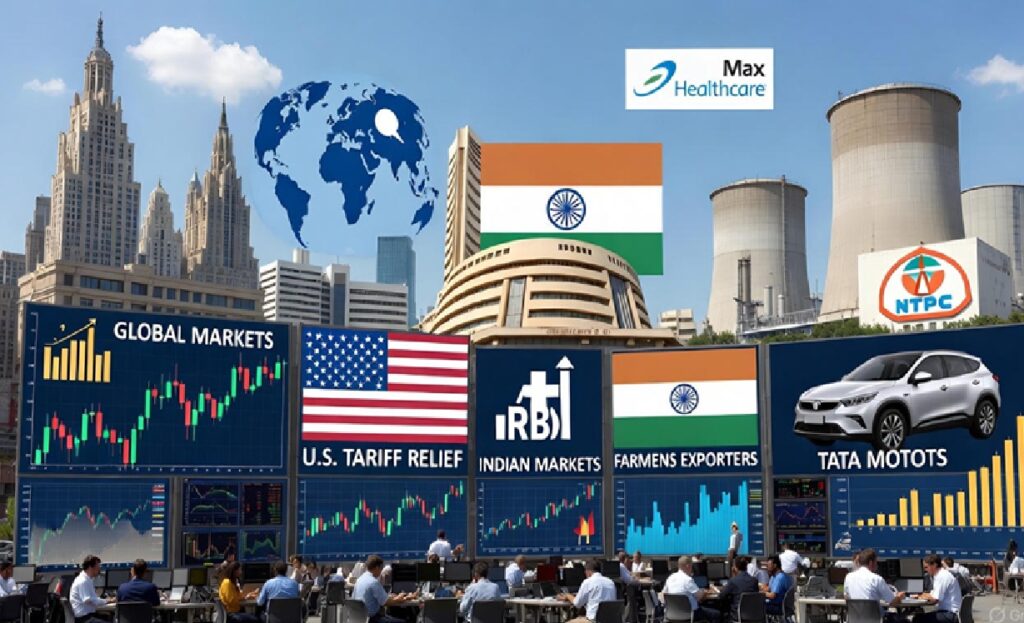
November 17, 2025, kicks off with a mix of optimism and caution. Investors worldwide tune into key developments shaping markets, from U.S. tariff adjustments that could open doors for Indian exporters to cooling inflation numbers in India hinting at potential RBI rate cuts. As stock markets in India and abroad navigate AI-driven pressures and energy shifts, companies like Tata Motors and Max Healthcare deliver standout quarterly results.
This comprehensive stock market news roundup dives deep into the day’s headlines, offering actionable insights for retail investors. Whether you’re tracking Nifty 50 movements or eyeing long-term plays in renewable energy, stay ahead with our expert analysis on U.S.-India trade dynamics, wholesale price index (WPI) trends, consumer price index (CPI) updates, and beyond.
Global Market Insights: AI Pressures and U.S. Fed’s Cautious Stance
Markets rarely sleep, and last week’s global cues set a reflective tone for today’s trading session. U.S. equities faced notable headwinds, particularly in the AI sector, where lofty valuations sparked intense debates among analysts and traders. The Nasdaq Composite, heavily weighted toward tech giants, experienced sustained selling pressure over the past seven days. Investors questioned whether the AI boom—fueled by innovations in machine learning and data processing—had outpaced fundamentals, leading to a 2-3% dip in key indices.
Adding to the mix, Federal Reserve officials signaled a more restrictive monetary policy ahead. Fed Chair Jerome Powell, in late October remarks, emphasized the need for vigilance amid persistent inflation risks. St. Louis Fed President Alberto Musalem echoed this, suggesting that further rate cuts this year might not materialize. Recall the August Fed meeting: Markets anticipated cuts in October and December, with the October 25 basis-point reduction already in the books. Now, December hangs in the balance, complicated by robust economic data.
The upcoming release of October FOMC meeting minutes promises clarity. These notes will reveal the nuanced views of Fed directors on everything from employment trends to inflation trajectories. Traders view this as a pivotal event—will it confirm a pause on rate cuts, or hint at easing? Early signals point to restraint, which ripples across asset classes. Gold prices dipped slightly as higher-for-longer rates reduce its appeal as a non-yielding safe haven. The 10-year U.S. Treasury yield climbed back to 4.15%, reversing a brief dip below 4%, signaling bets on sustained borrowing costs.
Energy markets tell a similar story of volatility. Crude oil hovered comfortably around $64-65 per barrel for months, but a recent uptick to $73 stems from geopolitical tensions. A Ukrainian drone strike on a Russian Black Sea port prompted export restrictions, tightening supply. Meanwhile, U.S.-Russia dialogues—and India’s own negotiations on discounted Russian crude—add layers of uncertainty. For India, this means monitoring import costs closely, as oil remains a linchpin in the trade deficit equation.
These global threads weave into broader economic narratives. As investors digest Fed hawkishness, attention shifts to how it influences emerging markets like India. Lower U.S. yields typically support capital flows to high-growth economies, but a hawkish pivot could reverse that. Keep an eye on currency pairs: The USD/INR strengthened marginally today, reflecting these crosscurrents.
U.S. Tariff Relief: A Lifeline for Indian Farmers and Exporters
In a move that could reshape bilateral trade, U.S. President Donald Trump announced tariff reductions on over 200 grocery items, aiming to ease pricing pressures on American consumers. This relief targets essentials like tea, coffee, cashews, fruits, and vegetables—categories where India holds a competitive edge. With baseline tariffs on Indian goods already hovering at 50-55%, this adjustment offers short-term breathing room for exporters.
Indian farmers stand to gain the most. Tea plantations in Assam and Darjeeling, coffee growers in Karnataka, and cashew processors in Kerala could see boosted shipments to the U.S., the world’s largest consumer market. The decision addresses inflation concerns stateside, where grocery bills have surged 5-7% year-over-year. By slashing duties, the U.S. hopes to curb imported inflation, but it inadvertently bolsters Indian agri-exports, projected to hit $55 billion in FY26.
For stock market implications, watch agri-focused firms like ITC and Godrej Agrovet. These companies, with deep supply chains in export-oriented crops, could report margin expansions in upcoming quarters. Broader trade negotiations between India and the U.S.—including the ongoing mini-trade deal talks—gain momentum here. Trump’s recent Truth Social posts hint at aggressive reciprocity, but today’s concessions signal pragmatism.
This isn’t isolated; it’s part of a global tariff recalibration. The EU’s parallel reviews on agricultural imports could extend similar benefits. For Indian investors, this underscores diversification: Agri-stocks now blend growth potential with geopolitical tailwinds, making them resilient hedges against tech volatility.
India’s Inflation Landscape: WPI and CPI Numbers Pave Way for RBI Rate Cuts
Domestic headlines steal the show with Friday’s inflation data painting a benign picture. The Consumer Price Index (CPI) rose a mere 0.25% in October, well within the RBI’s comfort zone of 2-6%. This headline figure masks underlying stability: Food inflation eased to 4.5%, while core CPI (excluding food and fuel) held steady at 3.8%. Urban consumers, hit hardest by rising essentials, now enjoy a breather, supporting discretionary spending.
Even more encouraging, the Wholesale Price Index (WPI) plunged into negative territory at -1.21%—a 27-month low. This wholesale deflation reflects softer commodity prices, with manufactured goods down 2.1% and primary articles slipping 0.8%. Fuel and power segments contributed positively, but overall, it signals ample slack in the economy.
What does this mean for monetary policy? The RBI, fresh off two rate cuts to 5.25%, faces mounting calls for another. Governor Shaktikanta Das’s recent report highlights slowing credit growth to 11.3% (from 11.5% two weeks prior) and deposit growth steady at 9.7%. The narrowing credit-deposit gap—once a red flag at 15-20%—now converges, easing liquidity strains on banks. This duo of low inflation and balanced banking metrics strengthens the case for a December cut, potentially unlocking cheaper loans for MSMEs and homebuyers.
Sectoral spotlights add nuance. Coal imports surged 12% year-on-year, driven by festive season stockpiling and winter power demand forecasts. India remains hooked on high-grade thermal coal imports, as domestic production lags at 750 million tonnes annually against a 1,100-million-tonne appetite. Power utilities like NTPC and Adani Power brace for costlier inputs, but renewable transitions offer long-term relief.
As markets open today, expect Nifty Bank and financials to lead gains, buoyed by rate-cut bets. Broader indices like Sensex could test 82,000, with IT dragging due to global AI jitters. Investors should prioritize quality: Low-debt cyclicals in FMCG and autos thrive in this low-inflation regime.
Upcoming Economic Indicators: FOMC Minutes, Trade Talks, and U.S. Jobs Data
This week brims with catalysts that could swing sentiment. Monday’s FOMC minutes top the list, offering granular insights into Fed thinking. Will dovish undercurrents emerge, or reinforce the hawkish tilt? Markets price in a 60% chance of no December cut, but surprises abound.
Indo-U.S. and Indo-EU trade pacts simmer in the background. Updates on tariff negotiations, intellectual property clauses, and market access could surface, especially post-Trump’s weekend rhetoric. His emphasis on “fair deals” aligns with India’s push for zero-duty on textiles and pharma.
U.S. data deluge follows: Manufacturing and services PMI flash readings on Tuesday, alongside jobless claims and Philly Fed surveys. The recent government shutdown delayed releases, so pent-up figures on non-farm payrolls (due Friday) will clarify labor market health. Strong jobs could dash rate-cut hopes; weakness might accelerate them.
For India, Q3 GDP advance estimates mid-week provide a reality check. Consensus eyes 6.8% growth, tempered by monsoon variability but lifted by capex cycles. Geopolitical watchers note Ukraine-Russia escalations impacting energy; Brent crude’s volatility could shave 20-30 basis points off growth if prolonged.
Retail investors, gear up: Volatility indices like India VIX may spike 5-10%, rewarding hedged portfolios. Focus on defensives—pharma and consumer staples—amid data noise.
Company Spotlights: Tata Motors Q2 Results and Passenger Vehicle Resilience
Tata Motors’ passenger vehicle (PV) arm unveiled Q2 results that blend challenges with silver linings. Revenue dipped 14% year-on-year to ₹18,500 crore, missing estimates amid a Jaguar Land Rover (JLR) cyber incident that disrupted wholesale volumes by 24%. Retail sales fell 17%, but India’s domestic business bucked the trend with 10% volume growth and 8% revenue uptick.
Exports shone, up 15% on strong SUV demand in Europe and the Middle East. Tata’s India market share holds firm at 12.8%, dominating EVs at 41%—a testament to the Nexon EV and Punch models. CNG variants gain traction, with volumes up 20% quarter-on-quarter, aligning with green mobility mandates.
New launches fuel optimism: The Curvv coupe-SUV hit showrooms last month, while facelifted Harrier and Safari variants roll out by Diwali. Profitability? A staggering ₹7,600 crore net profit masks one-time gains from the PV-CV demerger. Adjusted for that, EBITDA margins contracted to 9.2% from 11%, pressuring consensus.
Strategically, Tata doubles down on electrification: 30% of PV sales targeted as EVs by FY27. Partnerships with Tata Electronics for chip sourcing mitigate supply risks. For investors, this positions Tata Motors as an auto sector bellwether—buy on dips below ₹1,000, with upside to ₹1,200 on export recovery.
Banking Buzz: Kotak Mahindra’s Stock Split Looms
Kotak Mahindra Bank stirs excitement with a proposed stock split, its first since 2010 when face value halved from ₹10 to ₹5. The board meets November 21 to deliberate, but leaks suggest approval is likely. This ritual—common in high-priced stocks—aims to enhance liquidity and retail participation without altering fundamentals.
Current share price nears ₹2,000; a 1:2 or 1:5 split could democratize access. Remember, splits are cosmetic: Earnings per share adjust proportionally, preserving value. Yet, they often catalyze short-term pops, as seen in HDFC Bank’s 2023 move.
Kotak’s Q2 was robust—loans grew 18%, NIMs at 4.5%—but deposit mobilization lags at 14%. In a rate-cut world, this split could spotlight the bank’s digital prowess, serving 50 million customers via neo-banking. Long-term holders, ignore the noise; it’s the 20% ROE trajectory that matters.
Healthcare Heroes: Max Healthcare’s Phenomenal Q2 Growth
Max Healthcare Institute continues its ascent, posting a 74% net profit jump to ₹425 crore on 25% revenue growth to ₹1,890 crore. OPD visits surged 18%, driven by urban wellness trends, while international patient revenue climbed 25% from medical tourism hubs like Delhi and Mumbai.
Pathology and home healthcare segments—still nascent at 10% of revenue—posted 35% gains, underscoring diversified revenue streams. Debt rose modestly to ₹2,500 crore, funding ₹456 crore in capex for bed expansions and tech upgrades. With 40 hospitals in pipeline, Max eyes 15% CAGR through FY28.
Part of savvy model portfolios, Max trades at 60x forward PE—premium, but justified by 25% ROCE. In a post-pandemic world, where preventive care booms, Max exemplifies healthcare’s defensive growth. Target ₹950; resistance at ₹1,000.
Energy Evolution: NTPC’s Bold Bet on Nuclear Power
NTPC, India’s power behemoth, accelerates its nuclear pivot, planning multiple reactors totaling 4,000 MW by 2030. Capacities span 700 MW, 1,000 MW, and 1,600 MW units across coastal sites like Tamil Nadu and Andhra Pradesh. This aligns with the government’s 30% nuclear mix by 2047, countering coal dependency.
Echoing peers like JSW Energy and Tata Power, NTPC eyes small modular reactors (SMRs) for agility. Upfront costs? A 1 GW plant demands ₹15,000-20,000 crore, but lifecycle benefits shine: 60-year operations, minimal maintenance, and levelized costs at ₹3-4/kWh versus coal’s ₹5+.
Risks persist—regulatory hurdles, uranium sourcing—but subsidies and global tech transfers (e.g., from GE-Hitachi) mitigate them. NTPC’s stock, up 15% YTD, could rally 20% on project clearances. For green portfolios, it’s a clean energy cornerstone.
Investment Wisdom: Why PE Ratios Aren’t the Sole Stock-Picking Metric
As result season winds down— with rebalancing underway in model portfolios—let’s tackle a perennial query: Does a high price-to-earnings (PE) ratio doom a stock? Spoiler: Not always. High-PE picks can deliver outsized returns if earnings growth ignites.
Consider UK investor Terry Smith’s illuminating chart, tracking 2015 cohorts. Legacy giants like Deutsche Bank (PE 19x), Exxon (12x), GE (16x), IBM (10x), and Shell (15x) boasted “bargain” multiples. Fast-forward to 2025: Earnings per share (EPS) largely declined—Exxon’s from $7.60 to $6.50, IBM’s stagnant at $9. These behemoths, once blue-chips, illustrate value traps: Low PE lured buyers, but stagnant growth eroded value.
Contrast with growth darlings: Alibaba traded at 136x PE in 2015 on $5 EPS; now, EPS triples to $15 at 45x PE. Amazon, loss-making then, commands 41x on $4.10 EPS. Facebook (now Meta) leaped from $1 to $10 EPS, PE contracting from 71x to 25x. Netflix? From 9 cents to $6 EPS, PE slashed from 555x to 35x.
The lesson? PE alone deceives. It ignores earnings trajectory—the true wealth creator. Markets re-rate stocks on future cash flows, not historical snapshots. PSU rallies (e.g., HAL from 10x to 50x PE on defense orders) reinforce this: Recent bias fools us into chasing “cheap” laggards.
When selecting stocks, probe deeper: Sustainable moats? Management execution? Macro tailwinds? Earnings growth expectations drive 70% of returns; PE is secondary. In portfolio discussions, skip the PE fixation—demand holistic views. RSI, debt metrics, and competitive edges matter more.
This data, sourced from Smith’s newsletters, underscores timeless investing: Buy quality at fair prices, not bargains in distress. As India’s market matures, blending global wisdom with local alpha yields superior outcomes.
Wrapping Up: Navigating the Week Ahead with Confidence
November 17, 2025, encapsulates finance’s dynamism—from tariff tailwinds easing Indian export paths to inflation’s gentle descent inviting RBI easing. Tata Motors’ resilience, Max Healthcare’s vigor, and NTPC’s nuclear vision highlight corporate India’s adaptability. Globally, Fed minutes and U.S. jobs loom large, testing resolve.
For retail investors, this week’s rebalancing offers a reset: Trim overvalued tech, add agri and green energy dips. Model portfolios evolve—expect live sessions unpacking shifts, from EV allocations to healthcare weights.
Stay informed, act decisively. Check investe.in for SEBI-registered tools empowering your journey. Like, share, and subscribe for daily edges. Have a stellar week—Jai Hind!