


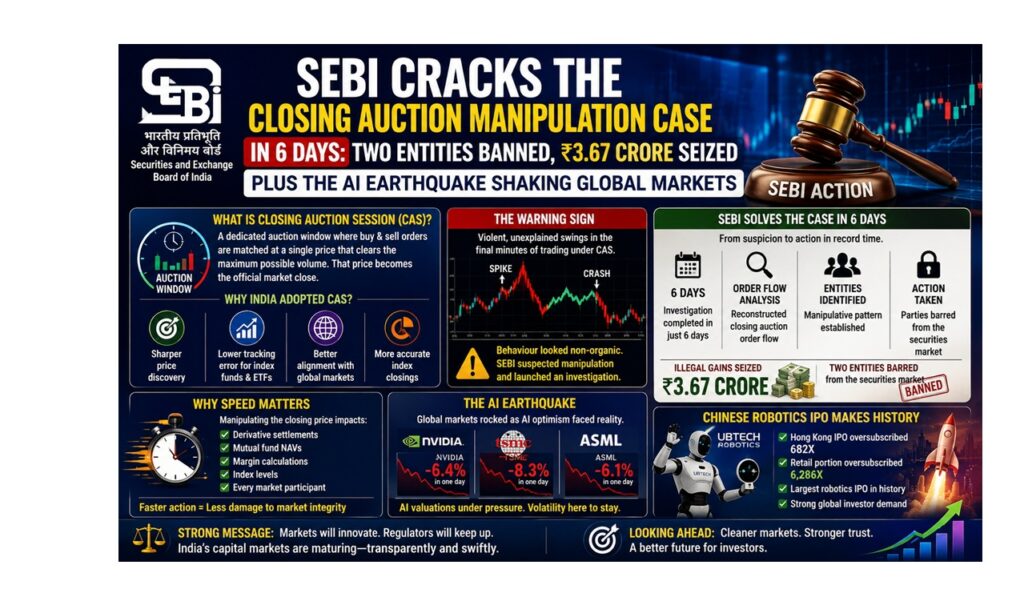
The Indian market threw up one of its most consequential regulatory stories in months, and it landed alongside a global technology sell-off that wiped billions off Asian chip giants. If you traded, invested, or simply watched the screens today, three storylines deserved your full attention: SEBI’s lightning-fast crackdown on closing price manipulation, the fresh tremor running through every AI-linked stock on the planet, and a Chinese robotics IPO that broke records so decisively it forced the whole world to look.
What Is the Closing Auction Session (CAS), and Why Did India Adopt It?
Indian exchanges recently rolled out a new mechanism for arriving at the daily closing price: the Closing Auction Session, commonly shortened to CAS.
Before this change, the closing price of a stock was calculated using a volume weighted average price (VWAP) formula applied to the final thirty minutes of the trading session. That method worked reasonably well for years, but it carried a structural weakness. A VWAP-derived closing price is an average, and an average never perfectly reflects where genuine supply and demand actually meet at the final bell.
CAS changes the logic entirely. Instead of averaging the last half hour, the exchange runs a dedicated auction window in which buy and sell orders are collected and matched at a single price that clears the maximum possible volume. That matching price becomes the official close.
The intended benefits are straightforward and, frankly, significant:
- Sharper price discovery. The closing price reflects a real auction, not a backward-looking average.
- Lower tracking error for index funds and ETFs. Passive funds must transact at or near the close to mirror their benchmark. When the official close is an average rather than a tradeable price, funds cannot execute exactly at it, and the resulting slippage shows up as tracking error. CAS gives them a genuine, executable clearing price.
- Better alignment with global markets. Most developed exchanges — including those in the US, Europe, and much of Asia — already run closing auctions. India moving to CAS brings its market microstructure in line with international practice.
- More accurate index closings. Because the index is derived from constituent prices, a cleaner stock close produces a cleaner index close.
On paper, it is a clear upgrade. In practice, the transition immediately produced something nobody wanted to see.
The Warning Sign: Violent, Unexplained Swings in the Final Minutes
From the moment CAS went live, traders started noticing behaviour that simply did not look organic.
Prices would spike sharply and suddenly in the closing window. Moments later, they would collapse just as abruptly. These were not the gentle adjustments you expect when a new mechanism settles in. They were violent, mechanical-looking moves — the kind that appear when someone is pushing a price rather than discovering it.
Anyone who has watched order flow for a few years develops an instinct for this. Genuine buying pressure builds. Manufactured buying pressure arrives all at once, achieves a specific price level, and then vanishes. What the market saw in those closing sessions belonged firmly in the second category.
The chatter grew loud enough that the regulator responded publicly on two fronts.
First, SEBI made its position on CAS itself unambiguous: the mechanism is not going anywhere. The market close will continue to be determined through the auction session. That statement mattered, because a section of the market had begun speculating that the regulator might roll back the change under pressure. It did not. The framework stays.
Second, SEBI acknowledged its own suspicion that something improper was driving the closing-window volatility, and it opened an investigation.
That investigation is where this story turns from a market-structure debate into an enforcement case.
From Suspicion to Confirmation: SEBI Solves the Case in Six Days
Here is the detail that genuinely stands out. Securities market investigations are usually slow-moving affairs. Order-book reconstruction, trade-by-trade analysis, entity mapping, beneficial ownership tracing — it typically stretches across months, sometimes years.
This one closed in six days.
SEBI reconstructed the closing auction order flow, isolated the accounts responsible, established the pattern, quantified the gains, and issued an interim order barring the parties involved. Six days from suspicion to action is an extraordinarily short turnaround for a market manipulation case, and it deserves credit regardless of what one thinks of the regulator on any other issue.
Speed matters enormously here. Manipulation of a closing price is not a victimless technicality. Closing prices determine derivative settlements, mutual fund NAVs, margin calculations, index levels, and the mark-to-market position of literally every participant holding the affected instruments. Every additional day the behaviour continues, the damage compounds and spreads further into the system.
The Two Entities SEBI Barred from the Capital Market
The interim order names two parties, one foreign and one domestic:
1. Capital Mauritius Investment — the offshore entity, routing flows into the Indian market from Mauritius.
2. Mansi Share and Stock Broking Private Limited — the India-based broking entity.
Both have been restrained from accessing the securities market until further orders. That phrasing is important. This is an interim direction, not a final judgment. The restraint stays in force until SEBI passes a subsequent order after the parties have had an opportunity to respond and the full adjudication process runs its course. Greater clarity on the eventual outcome — the duration of the ban, any additional penalties, and any expansion of the case to other entities — will come with that later order.
What we can say today is that both entities are currently locked out of the capital market, and their allegedly ill-gotten gains have been frozen.
How the Manipulation Actually Worked: A Coordinated Two-Sided Play
This is the part every serious market participant should understand, because it reveals exactly how sophisticated closing-price manipulation operates.
Step 1: Manufacture artificial spikes in the Indicative Equilibrium Price
During a closing auction, the exchange continuously publishes an Indicative Equilibrium Price (IEP) — a running estimate of where the auction would clear if it closed at that instant. Participants watch the IEP to decide whether and how to place their own orders.
SEBI’s analysis detected three sharp, artificial jumps in the Sensex-linked indicative equilibrium price. These were not gradual drifts. The IEP moved by large point values within a span of seconds — behaviour that no legitimate order flow produces.
Step 2: Flood the auction with massive one-sided buy orders
The offshore entity entered very large buy orders into the auction. Volume of that size, arriving suddenly, does exactly what you would expect: it drags the indicative clearing price sharply higher, because the auction algorithm must find a price at which that demand can be satisfied.
Step 3: Simultaneously execute heavy selling on the other side
While the buy-side pressure inflated the auction price, the domestic broking entity was placing large sell orders in the cash segment. This is what makes the case a coordinated play rather than two independent actors behaving badly. One side pushed the reference price up; the other side sold into the level that push created.
Step 4: Cancel the orders before execution — classic order spoofing
Here is the core of the fraud. The large orders that moved the indicative price were rapidly cancelled in the cash segment before they could actually be filled.
This technique is called order spoofing. The trader never intends to transact at those quantities. The orders exist purely as a signal — a fake demand or supply picture designed to move the reference price and induce a reaction from everyone else in the book. Once the price has moved to where the manipulator wants it, the phantom orders disappear.
Spoofing is explicitly prohibited under securities regulations in India and virtually every major jurisdiction, precisely because it converts the order book from an honest expression of intent into a weapon.
Step 5: Harvest the profit in the options segment
The cash market manipulation was never the profit centre. It was the tool.
The real money sat in options positions. Index and stock option payoffs settle against the closing price. If you hold a position that pays off when the underlying closes above a particular level, and you can artificially push the closing price above that level for a few seconds, you convert a losing or marginal position into a profitable one — without taking any genuine market risk on the direction of the market.
That is the entire architecture of this scheme: spend a controlled amount of effort distorting the cash-market close, and collect a much larger payoff on leveraged derivative positions that settle against it.
The Money Trail: ₹3.67 Crore Impounded
SEBI quantified the wrongful gains at approximately ₹3.67 crore and has impounded the amount.
The split, as detailed in the order:
| Entity | Approximate Wrongful Gain |
|---|---|
| Capital Mauritius Investment (offshore) | ~₹3 crore |
| Mansi Share and Stock Broking Pvt Ltd (domestic) | ~₹71.64 lakh |
| Total impounded | ~₹3.67 crore |
The seized amount has been placed in a fixed deposit, which is standard practice in impoundment cases — the funds remain preserved and earn interest while the proceedings continue, so they can eventually be disgorged, returned, or released depending on the final determination.
The lesson embedded in these numbers is worth pausing on. Roughly ₹3.67 crore in illicit gains was enough to trigger multi-day disruption in the closing prices of India’s benchmark index. Closing-price manipulation is remarkably capital-efficient for the manipulator and remarkably damaging to everyone else. That asymmetry is exactly why regulators treat it as a priority offence.
What This Means for Ordinary Traders and Investors
Three practical takeaways.
The closing auction is here to stay. Adjust your process accordingly. If you place market-on-close orders, run index-tracking strategies, or hold positions that settle against the close, the CAS mechanism now governs your outcome. Understand how the indicative equilibrium price behaves and how order imbalance is published during the window.
Anomalous closing-window volatility should now be far less frequent. With the identified entities barred and the regulator’s surveillance visibly tuned to this specific pattern, the incentive to attempt a repeat has dropped sharply. Expect the closing window to normalise progressively over the coming weeks.
Regulatory response time has improved dramatically. A six-day turnaround sets a new benchmark. For genuine participants, that is meaningfully reassuring. For anyone contemplating similar behaviour, the deterrent value is obvious.
Paytm: Block Deal Momentum and an AGM Date to Mark
Moving to individual stocks, Paytm (One97 Communications) delivered a strong session.
The stock rallied notably, and the immediate trigger was a large block deal that hit the tape. Block deals of size tend to move sentiment in both directions depending on who is buying and who is exiting, and in this instance the market read the transaction favourably.
Alongside the block deal news, the company has scheduled its 26th Annual General Meeting for 15 September. Investors tracking the stock should note the date. AGMs frequently carry commentary on strategic direction, capital allocation, and business milestones, and for a company still in the middle of a high-profile turnaround narrative, management’s tone at the AGM can matter as much as the numbers.
Netweb Technologies: ₹1,200 Crore Fundraise Pressures the Stock
Netweb Technologies moved the other way, falling around 5.5% on the session.
The pressure traced directly to the company’s announced fundraising of approximately ₹1,200 crore, with the indicative price range disclosed alongside it. This is a textbook market reaction. Equity fundraises dilute existing shareholders, and when the issue is priced at a discount to the prevailing market price, the stock typically gravitates toward the issue price in the short term. The near-term dip is the cost of the balance sheet strength the capital will provide.
The broader context on Netweb is worth holding onto, because it explains the stock’s volatility profile. The company operates in high-performance computing and AI infrastructure, with a partnership with Nvidia placing it directly in the path of India’s AI build-out. That positioning cuts both ways. When AI sentiment runs hot, Netweb runs hot. When AI sentiment cracks — as it did today — Netweb takes the hit too. The fundraise simply added a second, company-specific layer of pressure on a day when the sector was already under strain.
The AI Earthquake: Samsung, SK Hynix, and a KOSPI Collapse
Now to the story that dominated screens globally.
Artificial intelligence stocks are in the middle of another violent drawdown.
Understand the character of this trade before anything else. AI names do not move like ordinary equities. When they rise, they behave like rockets — vertical, relentless, seemingly detached from valuation. When they fall, the descent is equally brutal. High expectations built on future earnings mean small shifts in the narrative produce enormous shifts in price. Anyone holding AI exposure needs to accept both sides of that trade or hold something else.
Attention on AI usually points at the United States first. But the second focal point — and today the more dramatic one — is South Korea, home to the world’s two dominant memory chip manufacturers.
Both were hammered:
- Samsung Electronics fell roughly 8%. The stock had already been badly damaged from its highs; today’s move extended that decline further.
- SK Hynix collapsed around 10%.
When two companies of that weight fall simultaneously, the index cannot hold. The KOSPI, South Korea’s benchmark, dropped approximately 6% — a genuinely severe single-session move for a major developed-market index.
The Human Cost: A FOMO Lesson Playing Out in Real Time
The market damage is quantifiable. The damage to individual investors in Korea is harder to measure but far more serious.
Reports of retail distress there have been widespread. Investors piled into the AI and semiconductor rally near its peak, driven purely by the fear of missing out. Many did it with borrowed money. Many others committed fifteen to twenty years of accumulated savings into a trade that had already run vertically.
The pattern is not a Korean phenomenon. It is a human one.
India, Pakistan, Korea, Japan, the United States — the geography changes and nothing else does. People are people. FOMO is FOMO. Emotions are emotions. The moment a chart goes parabolic, a crowd forms that mistakes momentum for opportunity and deploys capital it cannot afford to lose, at prices it cannot justify, into a story it has not examined.
Then the correction arrives, and the leverage that amplified the gains amplifies the losses instead.
The principles that would have protected these investors are not sophisticated. Position size relative to total net worth. No borrowed capital in speculative positions. Staggered entries rather than lump-sum deployment into a vertical chart. A pre-defined exit level. None of it is complicated. All of it is abandoned the instant a chart starts moving fast enough.
Treat what is unfolding in Korea as a live case study, not a distant news item.
The Inverse Trade: Why Indian IT Stocks Turned Green on a Red Day
Here is a market relationship that confused a lot of people today, and it is worth explaining clearly.
Take a look at the sector map from the session. Almost every sectoral index was in the red. Nifty IT was green.
Not a spectacular rocket-fuelled rally — nobody should overstate it — but a distinctly positive print in an otherwise ugly tape. That divergence is not random. It reflects a structural inverse correlation between AI-native companies and legacy IT services firms.
The mechanism is simple. The bear case against traditional IT services runs like this: AI automates a large portion of the routine work that generates services revenue, compressing headcount-linked billing and eventually eroding the entire business model. That narrative is precisely why legacy IT names have been de-rated so aggressively — many are down 40–50% from their peaks.
Now flip it. When AI stocks fall hard, the market is effectively questioning that disruption narrative — the timeline, the economics, the pace of enterprise adoption. Every doubt cast on AI’s near-term monetisation is a point returned to the incumbents. So the money rotates back, at least temporarily.
Hence the pattern:
- AI names rally 10–20% → IT services stocks fall.
- AI names collapse → IT services stocks catch a bid.
This is exactly why viewers asking “why are the Wipro and Infosys ADRs rising?” have their answer. It is not company-specific news. It is the inverse trade expressing itself.
And it extends well beyond Indian names. Accenture — the largest player in the global IT services universe — jumped around 7% in the same move. When Accenture rallies that hard on an AI-negative day, Infosys, Wipro, and the rest of the Indian IT complex follow, because the market is pricing the same thesis across the entire cohort.
The forward-looking question is straightforward: how long does this AI drawdown persist? The answer will substantially determine whether the IT services recovery has legs or turns out to be a short-lived relief rally inside a longer structural downtrend.
MTAR Technologies and the Bloom Energy Linkage
MTAR Technologies also traded under pressure, and the reason follows the same AI logic.
MTAR is a key supplier to Bloom Energy, the fuel-cell company whose recent strength has been driven substantially by demand for clean, reliable power supply to AI data centres. That linkage means MTAR effectively trades as a second-order AI infrastructure play. When AI-related sentiment sours and Bloom Energy sells off, MTAR feels it almost immediately.
The reverse held true during the stock’s earlier run-up: positive AI news lifted Bloom Energy, and MTAR rallied alongside it.
If you own a stock for its exposure to a theme, you own the full distribution of outcomes for that theme. Enjoy the upside when the news flows favourably. Accept the drawdown when it does not. Selectively claiming the rally while treating the correction as unfair is not a strategy.
The same read applies to Netweb Technologies and, broadly, to every name with direct or indirect AI data-centre exposure. Today, that entire cluster was under visible strain.
The IPO Market Is Back in Form
Shifting to the primary market — activity has picked up sharply. Multiple IPOs are hitting the market, and issuer appetite is clearly strong.
Currently in focus are the Gaja Asset Management issue and the Sunshine issue. Anyone considering an application should review the fundamentals, the valuation, the objects of the issue, and the promoter track record before committing capital. Detailed IPO-specific analysis for both is available on our dedicated channel, Let’s Stock Market and Finance, with the link provided in the description.
But the IPO story that genuinely stopped the world today came from outside India.
Unitree Robotics: A 629% Intraday Move That Made Global Headlines
Unitree Robotics, the Chinese humanoid and quadruped robotics company, listed — and delivered one of the most extraordinary debut sessions in recent market history.
The numbers:
| Metric | Value |
|---|---|
| Issue price | ~¥150 per share |
| Intraday peak | ~¥1,100 per share |
| Maximum intraday gain | ~629% |
| Final closing price | ~¥845 per share |
| Final listing gain | ~460% |
From ¥150 to ¥1,100 in a single session. The stock listed and went vertical almost immediately. Some profit-taking pulled it back from the peak into the close — which is entirely normal after a move of that magnitude — but a 460% first-day gain still stands as a genuinely remarkable outcome.
What does this tell us? The appetite for AI and robotics exposure remains enormous, even on a day when established AI names were collapsing across Asia. That tension is the real signal. Investors are simultaneously dumping AI incumbents and paying extraordinary premiums for new AI-adjacent listings.
That is the signature of a market where the theme is stronger than the discipline. Capital is chasing exposure to the story, and new issues — which arrive with no trading history, no established valuation anchor, and maximum narrative appeal — become the purest expression of that impulse. Record after record is being broken in the primary market precisely because the secondary market has no consensus on what these businesses are actually worth.
Whether Unitree eventually justifies its debut valuation is a question that will take years to answer. What the listing proves today is only that demand vastly exceeded the float. Those are different things, and conflating them is how investors get hurt.
Key Takeaways from Today’s Session
- SEBI barred two entities — Capital Mauritius Investment and Mansi Share and Stock Broking Pvt Ltd — from the capital market until further orders, for manipulating closing prices through the Closing Auction Session.
- The scheme combined artificial spikes in the indicative equilibrium price, coordinated large buy and sell orders, rapid order cancellation (spoofing) in the cash segment, and profit extraction through options positions settling against the manipulated close.
- Approximately ₹3.67 crore in wrongful gains has been impounded and placed in a fixed deposit (~₹3 crore offshore, ~₹71.64 lakh domestic).
- The investigation closed in six days — an exceptionally fast enforcement turnaround.
- CAS is permanent. SEBI has confirmed the closing auction mechanism will continue to determine market closes.
- Paytm rallied on a large block deal; its 26th AGM is scheduled for 15 September.
- Netweb Technologies fell ~5.5% on a ₹1,200 crore fundraise announcement.
- AI stocks sold off globally. Samsung Electronics dropped ~8%, SK Hynix ~10%, and the KOSPI collapsed ~6%.
- Legacy IT services rallied on the inverse trade. Accenture gained ~7%; Nifty IT closed green against a broadly red tape; Infosys and Wipro ADRs firmed.
- MTAR Technologies fell through its Bloom Energy and AI data-centre linkage.
- Unitree Robotics posted a ~460% listing gain after a ~629% intraday spike, underscoring the extreme premium still attached to AI and robotics exposure.
Frequently Asked Questions
What is the Closing Auction Session (CAS)? CAS is a dedicated auction window at the end of the trading day in which buy and sell orders are collected and matched at a single clearing price. That price becomes the official close, replacing the earlier method of calculating a volume weighted average price across the final thirty minutes.
Why did SEBI move from VWAP to a closing auction? To improve price discovery, reduce tracking error for index funds and ETFs that must transact at the close, produce more accurate index closings, and align India’s market structure with global exchange practice.
What is order spoofing? Order spoofing is placing large orders with no intention of executing them, purely to create a false impression of supply or demand and move the price. The orders are cancelled before they can be filled. It is prohibited under Indian securities regulations and in most major markets.
Which entities did SEBI ban in the CAS manipulation case? Capital Mauritius Investment (offshore) and Mansi Share and Stock Broking Private Limited (India). Both are restrained from the capital market until further orders.
How much money did SEBI impound? Approximately ₹3.67 crore in wrongful gains — around ₹3 crore attributed to the offshore entity and around ₹71.64 lakh to the domestic entity. The funds have been placed in a fixed deposit.
Is the Closing Auction Session being rolled back? No. SEBI has stated clearly that the CAS framework will continue.
Why do Indian IT stocks rise when AI stocks fall? Because the market treats AI as a disruption threat to traditional IT services revenue. When AI stocks sell off, the market discounts that disruption narrative and rotates capital back toward incumbents such as Infosys, Wipro, and Accenture — and the reverse holds when AI stocks rally.
Why did Netweb Technologies fall? The company announced a fundraise of approximately ₹1,200 crore. Equity issuance dilutes existing holders and typically pulls the stock toward the issue price in the short term. Broad weakness in AI-linked names added further pressure.
This article is a rewritten, editorial summary of a market news broadcast and is intended for informational and educational purposes only. Figures reported here reflect the source material and should be independently verified against SEBI’s official orders, exchange filings, and company disclosures before being relied upon. Nothing here constitutes investment advice or a recommendation to buy or sell any security. Markets carry risk; consult a SEBI-registered investment adviser before making investment decisions.
If this breakdown helped, share it with someone who trades the close — the CAS story affects them more than they probably realise.