


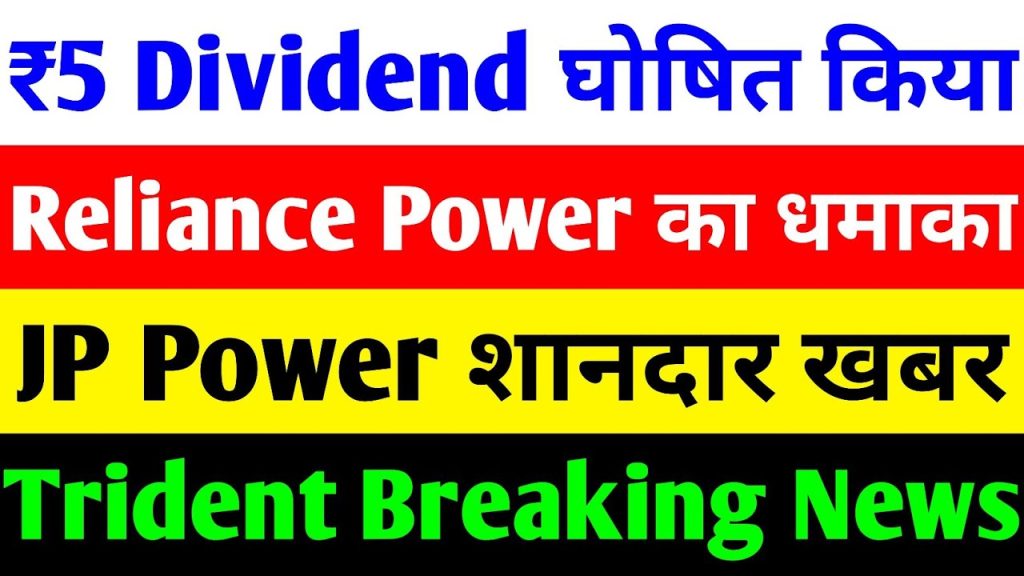
The Indian stock market is buzzing with developments from major players like Reliance Power, JP Power Ventures, Trident, and PTC India. From significant dividend announcements to groundbreaking renewable energy projects, these companies are making waves in their respective sectors. This article dives into the latest updates, financial performance, and future prospects of these firms, offering investors valuable insights for 2025. With a focus on renewable energy, textiles, and power trading, we explore how these companies are navigating challenges and seizing opportunities in a dynamic market.
Reliance Power’s Resurgence: A Game-Changing Solar Project
Anil Ambani’s Bold Comeback in Renewable Energy
Reliance Power, led by Anil Ambani, is staging a remarkable turnaround after years of financial struggles. The company recently signed a monumental 25-year Power Purchase Agreement (PPA) with the Solar Energy Corporation of India (SECI), marking a significant milestone in its revival. This agreement positions Reliance Power as a frontrunner in Asia’s clean energy landscape, with plans to develop the continent’s largest single-location solar battery project.
Details of the ₹100 Crore Solar Battery Project
The ambitious project involves a ₹100 crore investment to establish a 930 MW solar power facility integrated with a 465 MW (1,860 MWh) battery energy storage system (BESS). This initiative, spearheaded by Reliance Power’s subsidiary, Reliance NU Suntech, will supply electricity at a fixed rate of ₹3.53 per unit. The project’s scale is unprecedented, with a total solar generation capacity exceeding 1,700 MW peak to meet the contracted 930 MW.
Key highlights of the project include:
- Strategic Importance: The PPA, secured through a competitive SECI auction in December 2024, underscores Reliance Power’s ability to outbid major competitors. The company submitted a ₹378 crore performance bank guarantee, demonstrating its commitment.
- Rapid Execution: The entire process, from auction to contract signing, was completed in just five months, highlighting Reliance Power’s operational efficiency.
- Technological Innovation: The integration of advanced BESS ensures stable and reliable power supply, addressing intermittency challenges in solar energy.
Market Impact and Stock Performance
Reliance Power’s stock surged by 63% on the last trading day, closing at ₹40.24. This rally reflects investor optimism about the company’s renewed focus on renewable energy and its ability to secure high-value government contracts. The solar battery project not only strengthens Reliance Power’s portfolio but also enhances Anil Ambani’s reputation as a key player in India’s energy sector. With Asia’s largest solar project under its belt, Reliance Power is poised for significant growth in 2025.
Future Prospects for Reliance Power
The successful execution of this project could mark a turning point for Reliance Power, which has faced challenges in the past. By leveraging government support for clean energy and capitalizing on India’s renewable energy boom, the company is well-positioned to regain its market standing. Investors should monitor Reliance Power’s progress in meeting project timelines and its ability to secure additional contracts in the renewable energy space.
JP Power Ventures: Mixed Results with Promising Signs
Q4 Financial Performance: A Closer Look
JP Power Ventures recently announced its Q4 results, revealing a mixed performance. On a year-on-year basis, the company faced challenges, with revenue declining by 9.78% to ₹1,367 crore and net income dropping significantly by 73.56% to ₹155.67 crore. Diluted EPS also fell by 78.26% to ₹1, and the net profit margin contracted to 11.39%, down 70.7% from the previous year.
However, a quarter-on-quarter analysis paints a more optimistic picture:
- Revenue Growth: Revenue increased from ₹1,257 crore in Q3 to ₹1,367 crore in Q4, signaling a recovery.
- Profit Improvement: Net profit rose from ₹127 crore in Q3 to ₹156 crore in Q4, indicating a positive trend.
Strategic Positioning in the Regional Power Sector
Despite the year-on-year setbacks, JP Power Ventures remains a key player in the regional power sector. The company’s ability to improve profitability on a quarterly basis suggests effective cost management and operational adjustments. With a robust portfolio of power projects, JP Power is well-equipped to capitalize on India’s growing energy demand.
Stock Performance and Market Sentiment
JP Power’s stock closed at ₹14.25, reflecting a modest 1.9% decline. While the year-on-year results tempered investor enthusiasm, the quarterly improvements signal potential for recovery. The company’s focus on operational efficiency and its strong presence in the power sector make it an attractive option for long-term investors.
Outlook for JP Power in 2025
JP Power Ventures is at a critical juncture. The company must address the factors contributing to its year-on-year declines, such as market volatility and operational challenges. However, the quarterly gains suggest that JP Power is on the right track. Investors should watch for updates on new projects and partnerships that could bolster the company’s growth trajectory.
Trident: A Textile Giant with Dividend Strength
Dividend Track Record: A Shareholder Favorite
Trident, a leading player in the textile industry, continues to attract investors with its consistent dividend payouts. The company recently announced a ₹0.36 per share dividend for May 2024, maintaining its reputation as a reliable income stock. Trident’s dividend history is impressive, with multiple payouts in a single year during favorable market conditions:
- 2019: Four dividends totaling ₹3.60 per share.
- 2021: Two dividends totaling ₹0.72 per share.
- 2022–2024: Annual dividends of ₹0.36 per share.
While the frequency of dividends has reduced due to market challenges, Trident’s commitment to rewarding shareholders remains strong.
Financial Performance and Market Challenges
Trident’s stock closed at ₹26.65, up 0.57%, with a three-month high of ₹31.54 and a five-year high of ₹70.35. The company’s export-driven business, which accounts for 53% of its revenue, has faced headwinds due to global market uncertainties. The textile sector is currently grappling with unfavorable conditions, impacting Trident’s growth.
Key financial metrics include:
- Revenue Dependency: Exports constitute a significant portion of Trident’s business, making it vulnerable to global economic fluctuations.
- Stock Volatility: The stock has seen significant swings, from a five-year low of ₹4.45 during the COVID-19 period to a high of ₹70.35.
Shareholder Confidence: Rising Promoter and Institutional Holdings
Trident’s shareholding pattern reflects growing confidence among key stakeholders:
- Promoter Holding: Increased from 73.19% in December to 73.6% in March.
- Foreign Institutional Investors (FIIs): Holding rose from 2.83% to 3.02%.
- Domestic Institutional Investors (DIIs): Holding edged up from 0.09% to 0.10%.
- General Public: Holding increased from 22.82% to 22.89%.
The only group reducing its stake was “others,” whose holding dropped from 1.06% to 0.31%. This broad-based increase in investment signals optimism about Trident’s long-term potential.
Future Growth Opportunities
Trident’s ability to navigate global market challenges will be critical in 2025. The company’s focus on diversifying its revenue streams and strengthening its domestic market presence could mitigate export-related risks. Additionally, Trident’s consistent dividends make it an appealing choice for income-focused investors. Monitoring global textile demand and Trident’s strategic initiatives will be key to assessing its growth prospects.
PTC India: A Dividend Powerhouse with Strong Fundamentals
₹5 Dividend Announcement for 2025
PTC India, a government-backed power trading company, recently announced a ₹5 per share dividend, set to go ex-dividend on May 5, 2025. Shareholders holding the stock in their demat accounts before this date will be eligible for the payout. This announcement, made on April 28, 2025, reinforces PTC India’s position as a high-yield stock.
Company Overview and Financial Strength
Established in 1999 under a public-private partnership, PTC India is promoted by leading entities such as Power Grid Corporation of India, NTPC, and Power Finance Corporation. The company’s robust fundamentals make it a standout in the power trading sector:
- Market Capitalization: ₹5,347 crore.
- Current Price: ₹1,281.
- Price-to-Earnings (P/E) Ratio: 9.80, significantly lower than industry peers.
- Book Value: ₹179, indicating the stock is trading near its intrinsic value.
- Dividend Yield: 4.32%, among the highest in its sector.
- Return on Capital (ROC): 9.64%.
- Return on Equity (ROE): 9.57%.
Stock Performance and Market Positioning
PTC India’s stock closed at ₹1,880, reflecting a 2.32% gain. With a 52-week range of ₹128 to ₹247, the stock offers a compelling risk-reward profile. Its low P/E ratio and high dividend yield make it an attractive option for value investors seeking both income and growth.
Strategic Advantages and Growth Potential
As a government-supported entity, PTC India benefits from strong institutional backing and a stable business model. The company’s focus on power trading and its ability to maintain healthy financial metrics position it for sustained growth. In 2025, PTC India is likely to capitalize on India’s increasing energy consumption and the government’s push for infrastructure development.
Investment Considerations for 2025
Key Takeaways for Investors
The updates from Reliance Power, JP Power, Trident, and PTC India highlight the diverse opportunities within India’s stock market. Here’s a summary of the investment potential for each company:
- Reliance Power: The solar battery project marks a transformative moment, with significant upside potential if execution remains on track.
- JP Power Ventures: Quarterly improvements signal a recovery, but year-on-year challenges require careful monitoring.
- Trident: A strong dividend play with resilience in the textile sector, though global market risks persist.
- PTC India: A fundamentally strong company with high dividend yield and government backing, ideal for conservative investors.
Risk Management and Research
Investing in these companies requires a balanced approach. While each offers unique growth opportunities, market volatility and sector-specific risks must be considered. Investors should:
- Consult financial advisors to align investments with their risk tolerance and goals.
- Conduct thorough research to stay informed about company developments and market trends.
- Diversify portfolios to mitigate risks associated with individual stocks or sectors.
Conclusion: Navigating India’s Dynamic Stock Market
The developments from Reliance Power, JP Power, Trident, and PTC India underscore the dynamic nature of India’s stock market in 2025. From Reliance Power’s groundbreaking solar project to PTC India’s attractive dividend, these companies are shaping their industries and offering investors compelling opportunities. By staying informed and adopting a strategic approach, investors can capitalize on the growth potential of these firms while navigating market uncertainties.
For the latest updates on these companies and other market insights, subscribe to our newsletter and follow our channel. Share your thoughts in the comments and let us know which stock you’re most excited about in 2025!
Disclaimer: This article is for educational purposes only and does not constitute financial advice. Always consult a financial advisor before making investment decisions.