


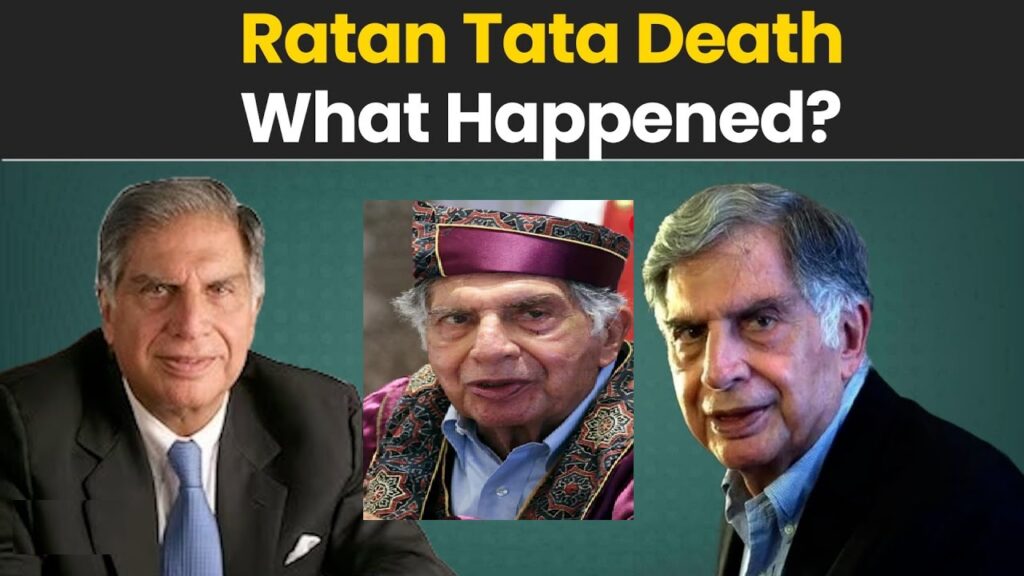
Ratan Tata, one of India’s most iconic business leaders, has left an indelible mark on the Indian corporate landscape. His visionary leadership and unparalleled contribution to the Tata Group and the nation’s economy set him apart as a giant in the world of industry. As we remember this titan, it’s essential to reflect on the immense legacy he leaves behind.

Early Life and Entry into Tata Group
In 1962, at the age of 25, Ratan Tata entered the offices of National Radio and Electronics Company Limited (NELCO) in Mumbai. Armed with a bachelor’s degree in architecture from Cornell University, he was eager to learn and rise through the ranks of the Tata Group. By 1971, he was appointed the Director-in-Charge, and a decade later, in 1981, he became the Chairman of Tata Industries. His ascent culminated in 1991 when he succeeded J.R.D. Tata as the Chairman of the Tata Group, one of India’s most revered business conglomerates.
Transformational Leadership
Ratan Tata’s tenure as Chairman of the Tata Group was a period of unprecedented growth and global expansion. His leadership was instrumental in transforming the Tata Group from a largely domestic player into a global powerhouse. Under his guidance, the group acquired iconic international brands such as Tetley Tea, Corus Steel, and Jaguar Land Rover, positioning the Tata Group as a major global entity.
The liberalization of the Indian economy in 1991 provided an opportunity for Ratan Tata to restructure the Tata Group and expand into new sectors. He exited non-core businesses such as cement, textiles, and cosmetics, while focusing on high-growth industries like software, telecommunications, finance, and retail. His ability to identify and capitalize on new opportunities helped the group generate revenues exceeding $100 billion by 2011-2012.
The Vision Behind Tata Nano
One of Ratan Tata’s most ambitious projects was the Tata Nano, a small car designed to make automobile ownership affordable for India’s growing middle class. The car, launched in 2008, was marketed as the world’s cheapest car. Although it faced several challenges, the project demonstrated Ratan Tata’s commitment to innovation and his vision to improve the quality of life for millions of Indians.
Overcoming Challenges
Ratan Tata’s journey at the helm of the Tata Group was not without challenges. Early in his leadership, he had to navigate internal power struggles within the organization. Several influential figures, such as Russi Mody of Tata Steel, Darbari Seth of Tata Chemicals, Ajit Kerkar of Indian Hotels, and Nani Palkhivala of ACC, held significant sway over their respective companies. They viewed Ratan Tata as an outsider and resisted his efforts to modernize and centralize the group’s operations. However, within six years of taking over, he successfully consolidated control, leading to the resignation of these influential leaders.
Philanthropy and Social Impact
Ratan Tata’s contributions extended beyond business. A deeply compassionate individual, he was known for his philanthropic endeavors. He chaired the Tata Trusts, one of India’s oldest and largest charitable organizations, which works in areas such as healthcare, education, rural development, and social justice. His philanthropic philosophy mirrored the values of the Tata Group, which has always been committed to giving back to society.
In 2008, Ratan Tata was awarded the Padma Vibhushan, India’s second-highest civilian honor, in recognition of his contributions to industry and philanthropy. His efforts have touched the lives of millions, and his legacy will continue to influence generations to come.
The Return of Air India
One of the proudest moments in Ratan Tata’s later years was bringing Air India back under Tata Group’s control. The airline, which had been nationalized in the mid-20th century, was reacquired by the Tata Group in 2022. This achievement held deep personal significance for Ratan Tata, as the airline was originally founded by J.R.D. Tata in 1932. The return of Air India to the Tata fold was seen as a symbolic homecoming, and it marked a fitting capstone to Ratan Tata’s illustrious career.
A Passion for Aviation and Animal Welfare
In addition to his business acumen, Ratan Tata was known for his love of aviation. He was an avid pilot and often flew planes himself. His passion for aviation was another way in which he continued the legacy of J.R.D. Tata, who was India’s first licensed pilot.
Ratan Tata was also an animal lover, and his affection for dogs was well-known. The doors of Bombay House, the Tata Group’s headquarters in Mumbai, were always open to stray dogs, reflecting his compassionate nature.
A Nation Mourns
Ratan Tata passed away on October 9, 2024, at the age of 86. He had been admitted to Breach Candy Hospital in Mumbai for age-related health issues and to stabilize his blood pressure. His death marks the end of an era, and tributes poured in from across the nation. Prime Minister Narendra Modi called him a “visionary business leader, compassionate soul, and extraordinary human being.”
Leaders from various industries and political circles expressed their sorrow at the loss of Ratan Tata. Chief Ministers from West Bengal, Jharkhand, and Odisha also mourned his passing, recognizing his immense contribution to Indian industry and society.
The End of a Remarkable Era
Ratan Tata’s passing signifies the end of a remarkable chapter in Indian industry. His contributions to the Tata Group, Indian business, and philanthropy are unparalleled. He transformed the Tata Group into a global conglomerate, championed innovative projects like the Tata Nano, and demonstrated an unwavering commitment to improving the lives of the less fortunate.
Ratan Tata’s legacy will live on through the companies he built, the lives he touched, and the countless individuals who have been inspired by his leadership, humility, and vision. As India and the world mourn the loss of this extraordinary leader, it is clear that Ratan Tata’s impact will be felt for generations to come.
A Visionary Business Leader and Compassionate Humanitarian
Ratan Tata’s death marks the end of an era for Indian industry. Prime Minister Narendra Modi led the nation in mourning, hailing Tata as a “visionary business leader, compassionate soul, and extraordinary human being.” Modi acknowledged Tata’s contributions not only to the business world but also to various social causes such as education, healthcare, and animal welfare.
Modi’s tribute encapsulated the widespread admiration for Tata’s balanced approach to leadership, combining corporate excellence with social responsibility. Under Tata’s leadership, the Tata Group expanded its global footprint, while his philanthropic endeavors made him a revered figure beyond the business world.

Political Leaders Across India Pay Their Respects
The passing of Ratan Tata prompted an outpouring of grief from political leaders across India. Congress leaders, including Rahul Gandhi and Mallikarjun Kharge, expressed their sadness, recognizing Tata as a key figure who shaped India’s corporate landscape and contributed immensely to national development. “In Ratan Tata, we have lost an invaluable son of India,” stated Kharge, emphasizing Tata’s enduring impact on both business and society.
Chief ministers of several states, including West Bengal’s Mamata Banerjee, Odisha’s Naveen Patnaik, and Jharkhand’s Hemant Soren, also offered heartfelt tributes. Each acknowledged Tata’s role in driving industrial growth in their respective regions. Jharkhand declared a one-day state mourning, honoring Tata’s legacy and his contributions to transforming underdeveloped areas into economic hubs.
The Industrial and Philanthropic Legacy of Ratan Tata
Ratan Tata’s influence stretched far beyond the boardroom. His philanthropic efforts, particularly through the Tata Trusts, touched millions of lives. His work in education, healthcare, and rural development helped uplift disadvantaged communities across India. Anand Mahindra, another prominent industrialist, said Tata’s work played a crucial role in positioning India’s economy for a historic leap forward.
Tata’s generosity and compassion made him a beloved figure. Aaditya Thackeray, a prominent political leader from Maharashtra, expressed deep sadness over Tata’s death, calling him a “rare soul” and noting that his compassion for animals and humanity was as remarkable as his business acumen. “I will always remember him not only for his contributions to business and philanthropy but also for his humility,” Thackeray added.
Tributes from India’s Top Business Leaders
India’s business community united in mourning the loss of one of its brightest stars. Mukesh Ambani, Chairman of Reliance Industries, called Tata “one of India’s most illustrious and kind-hearted sons,” highlighting his role in elevating the Tata Group to international prominence.
Gautam Adani and Anand Mahindra also paid tribute, with Adani describing Tata as an industrial giant whose influence spanned across sectors, while Mahindra credited Tata with playing a key role in the development of India’s economic landscape. The collective sorrow from India’s business elite reflects the deep respect and admiration Tata earned over his long career.
A National Icon Laid to Rest
Ratan Tata’s passing prompted the Maharashtra government to announce a state funeral in his honor. Maharashtra Chief Minister Eknath Shinde visited Breach Candy Hospital shortly after Tata’s passing and declared that the state would pay tribute to the man who had become synonymous with Indian business.
Leaders like Nitin Gadkari, India’s Minister of Road Transport, noted that Tata’s contributions transcended industry. Gadkari called Tata “an accomplished son of India,” whose work in nation-building, particularly in infrastructure, education, and healthcare, made a lasting impact on society.
Ratan Tata’s Enduring Legacy
Ratan Tata will be remembered not only for his business achievements but also for his profound influence on Indian society. He believed in using corporate power for the greater good, and his philanthropic efforts demonstrated his unwavering commitment to improving the lives of millions. His death leaves a void in the world of business, philanthropy, and humanity.
Sundar Pichai, CEO of Google, summarized the sentiment of many when he said, “He leaves an extraordinary business and philanthropic legacy.” Tata’s contributions went far beyond the industries he transformed; his vision and dedication to social causes inspired generations.
A Man of Vision and Humility
Ratan Tata’s humility and kindness are traits that stand out to those who knew him. He led with quiet determination, always striving for excellence but never losing sight of the importance of giving back. His leadership style, which combined innovation with ethics, has set a benchmark for future generations of business leaders.
The accolades from leaders like Amit Shah, India’s Home Minister, who called Tata “a man who will live on in our hearts,” and Maharashtra’s Deputy Chief Minister Devendra Fadnavis, who described Tata as the “epitome of generosity and humanity,” reflect the immense respect Tata commanded in all walks of life.