Site icon Telangana NavaNirmana Sena

Q4 Earnings from DMART, CDSL, SBI, and Kotak Bank

In today's interconnected world, geopolitical tensions and economic developments shape markets and influence investor sentiment. Recent escalations between India and Pakistan, combined with critical Q4 financial results from major Indian companies like Kotak Mahindra Bank, State Bank of India (SBI), DMart, and CDSL, have created a dynamic environment for investors. Add to this the global impact of Donald Trump's tariff policies and the Dollar Index surpassing 100, and you have a complex landscape that demands careful analysis. This article dives deep into these topics, offering insights into how they affect markets, businesses, and global trade. Geopolitical Tensions: India-Pakistan Conflict Risks Escalate Rising Threat of War and Strategic Moves Tensions between India and Pakistan have intensified, raising concerns about a potential military conflict. Recent developments indicate that India has suspended the Indus Water Treaty, a significant move that could disrupt water flow to Pakistan. This decision has prompted strong reactions, with Pakistan's Defense Minister threatening strikes on any dams or structures India builds to control water flow. Such actions could be interpreted as an act of war, pushing both nations toward a dangerous confrontation. India has also halted all trade with Pakistan, including port-based commerce, signaling a complete economic disengagement. The closure of trade routes, particularly at the Attari and Wagah borders, underscores India's firm stance. These actions follow high-level meetings where Indian armed forces were granted full operational freedom, hinting at the possibility of preemptive strikes. The situation remains volatile, with any misstep potentially triggering a broader conflict. Bangladesh's Unexpected Involvement Adding to the regional complexity, Bangladesh has issued a provocative statement, threatening to occupy India's northeastern states if India attacks Pakistan. While this claim appears ambitious given Bangladesh's internal challenges and recent political upheavals, it highlights the broader regional ramifications of India-Pakistan tensions. The statement, though unlikely to materialize, adds to the uncertainty and could further destabilize the region. Investors must monitor these developments closely, as a full-scale conflict could disrupt supply chains, inflate commodity prices, and negatively impact Indian markets. Sectors like defense, energy, and agriculture may experience heightened volatility, while safe-haven assets like gold could see increased demand. Q4 Financial Results: Indian Companies Navigate Challenges Kotak Mahindra Bank: Profit Dips Amid Higher Provisions Kotak Mahindra Bank's Q4 results reflect the challenges faced by India's private banking sector. The bank reported a net profit of ₹3,552 crore, marking a 14% year-on-year decline. The primary driver of this drop was higher provisions, which banks set aside to cover potential loan defaults. Provisions are a critical factor in banking, as they directly reduce reported profits by accounting for funds that may not be recovered. Despite the profit decline, Kotak Mahindra Bank showed resilience in its core operations. Net interest income, a key indicator of banking health, grew by 4% year-on-year, signaling steady lending activity. The bank also announced a ₹2.5 per share dividend, reinforcing its commitment to shareholders. Asset quality, measured by the non-performing asset (NPA) ratio, showed slight improvement, which is a positive sign for long-term stability. For investors, Kotak Mahindra Bank's performance highlights the importance of analyzing provisions and asset quality when evaluating banking stocks. While short-term profitability may suffer, the bank's focus on maintaining asset quality and growing interest income positions it well for recovery. State Bank of India: A Resilient Performer The State Bank of India (SBI), the country's largest public sector bank, reported a net profit of ₹18,642.59 crore in Q4, reflecting a 10% year-on-year decline. Like Kotak, SBI faced challenges from higher provisions, which impacted profitability. However, the bank's net interest income rose by 3%, underscoring its robust core business. SBI's asset quality showed significant improvement, with the gross NPA ratio dropping to 1.82%, a 42-basis-point improvement year-on-year. The net NPA ratio also improved by 10 basis points to 0.47%. These metrics highlight SBI's disciplined approach to managing bad loans, a critical factor for investor confidence. The bank announced a generous ₹16 per share dividend, signaling optimism about its financial health. Compared to other public sector banks, SBI stands out for its consistent performance and upward chart pattern, resembling top private banks like HDFC and ICICI. For investors seeking exposure to India's banking sector, SBI remains a compelling choice due to its scale and stability. DMart: Cost Pressures Weigh on Profits Avenue Supermarts, the parent company of DMart, reported a 2% decline in net profit at ₹551 crore for Q4. The retailer cited rising cost pressures as the primary reason for the dip, with expenses outpacing revenue growth. Revenue for the quarter stood at ₹14,872 crore, up from ₹12,727 crore year-on-year but down from ₹15,970 crore in the previous quarter. DMart's earnings per share (EPS) also declined, falling to ₹8.47 from ₹11.12 in the prior quarter. The company's performance reflects broader challenges in the retail sector, where inflationary pressures and supply chain disruptions have squeezed margins. Investors will be keenly watching DMart's stock reaction when markets reopen, as cost management remains a critical focus area. Despite these challenges, DMart's long-term growth story remains intact, driven by its efficient business model and expanding store network. Investors with a long-term horizon may view the current dip as a buying opportunity, provided the company addresses cost pressures effectively. CDSL: Market Downturn Hits Revenue Central Depository Services Limited (CDSL), a key player in India's capital markets infrastructure, reported a 4.3% drop in revenue and a 22.4% decline in net profit, which fell to ₹100 crore. The results were in line with expectations, as a subdued stock market environment naturally impacts CDSL's business. CDSL's revenue and profitability are closely tied to market activity. During bullish periods, such as September when markets were soaring, CDSL reported revenues of ₹322 crore and profits of ₹162 crore. In contrast, the current bearish market has dragged revenues down to ₹224 crore. This cyclicality is a hallmark of depository services, where transaction volumes drive financial performance. For investors, CDSL's results underscore the importance of market timing. While the company remains fundamentally strong, its performance is heavily dependent on broader market trends. Long-term investors may find value in CDSL's monopoly-like position in the depository space, but short-term volatility is likely. Global Economic Shocks: Trump Tariffs and Dollar Index Surge Trump Tariffs Threaten Global Trade Donald Trump's tariff policies continue to ripple through global markets, with significant implications for American and international companies. Footwear giants like Nike, Adidas, and Skechers have publicly requested exemptions from Trump's tariffs, citing the potential for skyrocketing costs and job losses. These companies rely heavily on overseas manufacturing, particularly in Asia, to produce goods at competitive prices. Tariffs on imports could force them to either raise prices or absorb higher costs, both of which could erode profitability. For example, a ₹10,000 shoe could jump to ₹15,000-₹20,000, making it less affordable for consumers. To maintain current price levels, companies may resort to cost-cutting measures, including layoffs, which could further dampen economic sentiment. Trump's response to these requests remains uncertain. While he has shown some willingness to soften his stance, the Dollar Index's recent surge above 100 may embolden him to maintain a hardline approach. Investors should brace for continued uncertainty in sectors exposed to international trade, such as consumer goods and manufacturing. Dollar Index Above 100: A Double-Edged Sword The Dollar Index, which measures the U.S. dollar's value against a basket of major currencies, has climbed back above 100, reaching 100.04. This rebound from the 98 range signals renewed strength in the dollar, driven by Trump's economic policies and global market dynamics. A stronger dollar has both positive and negative implications. For U.S. consumers, it increases purchasing power for imported goods. However, for American companies with significant overseas operations, a stronger dollar can hurt competitiveness by making exports more expensive. This dynamic could exacerbate the challenges faced by footwear companies already grappling with tariff pressures. For global investors, the Dollar Index's trajectory is a critical indicator. A sustained rise above 100 could trigger further market volatility, particularly in emerging markets like India, where currency depreciation could inflate import costs. Conversely, a stronger dollar may attract capital flows to U.S. assets, potentially pressuring Indian equities. Navigating the Market: Key Takeaways for Investors Focus on Asset Quality in Banking The Q4 results of Kotak Mahindra Bank and SBI highlight the importance of asset quality in banking investments. Both banks reported improved NPA ratios, signaling effective risk management. Investors should prioritize banks with strong balance sheets and consistent interest income growth, as these factors drive long-term value. Retail and Depository Stocks: Timing Matters DMart and CDSL's results reflect the challenges of operating in cyclical sectors. Retail investors should adopt a long-term perspective, capitalizing on dips in fundamentally strong companies like DMart. For CDSL, market recoveries typically translate into revenue growth, making it a play on broader market trends. Geopolitical Risks Demand Caution The escalating tensions between India and Pakistan, coupled with Bangladesh's provocative statements, introduce significant uncertainty. Investors should diversify portfolios to include defensive assets like gold and bonds, which tend to perform well during geopolitical crises. Monitoring news updates and official statements will be crucial for timely decision-making. Global Trade Disruptions Require Adaptability Trump's tariffs and the Dollar Index surge underscore the interconnectedness of global markets. Companies with diversified supply chains and flexible pricing strategies are better positioned to weather these disruptions. Investors should focus on firms with strong fundamentals and the ability to adapt to changing trade dynamics. Conclusion: A Complex but Navigable Landscape The convergence of India-Pakistan tensions, Q4 financial results, Trump's tariffs, and the Dollar Index surge creates a challenging yet navigable environment for investors. By focusing on companies with strong fundamentals, monitoring geopolitical developments, and staying adaptable to global trade shifts, investors can position themselves for success. Whether it's banking giants like SBI, retail leaders like DMart, or global players like Nike, understanding the interplay of these factors is key to making informed investment decisions. As markets reopen, all eyes will be on how these developments unfold. Stay informed, stay diversified, and seize opportunities in this dynamic landscape.

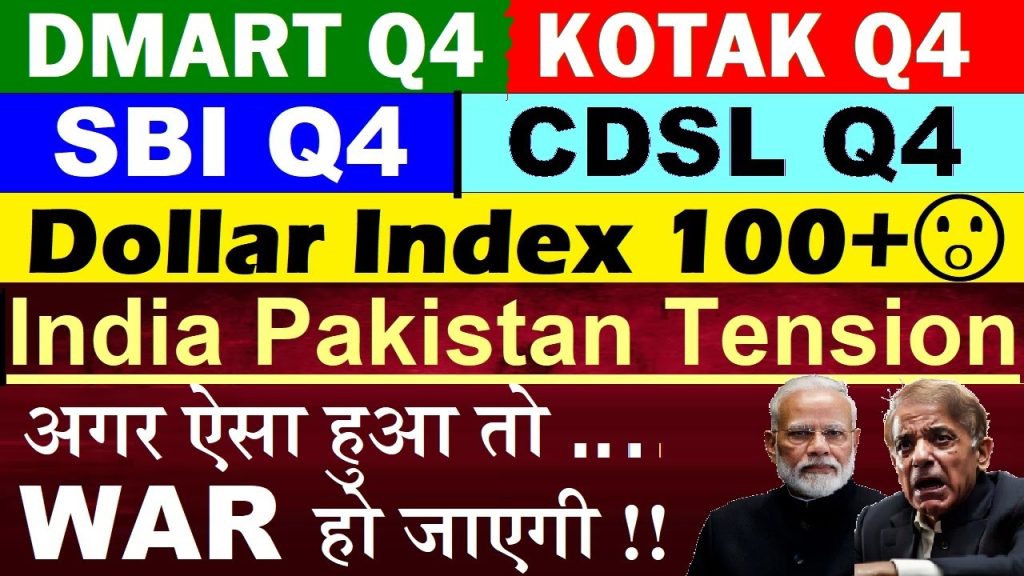
In today’s interconnected world, geopolitical tensions and economic developments shape markets and influence investor sentiment. Recent escalations between India and Pakistan, combined with critical Q4 financial results from major Indian companies like Kotak Mahindra Bank, State Bank of India (SBI), DMart, and CDSL, have created a dynamic environment for investors. Add to this the global impact of Donald Trump’s tariff policies and the Dollar Index surpassing 100, and you have a complex landscape that demands careful analysis. This article dives deep into these topics, offering insights into how they affect markets, businesses, and global trade.

Geopolitical Tensions: India-Pakistan Conflict Risks Escalate

Rising Threat of War and Strategic Moves

Tensions between India and Pakistan have intensified, raising concerns about a potential military conflict. Recent developments indicate that India has suspended the Indus Water Treaty, a significant move that could disrupt water flow to Pakistan. This decision has prompted strong reactions, with Pakistan’s Defense Minister threatening strikes on any dams or structures India builds to control water flow. Such actions could be interpreted as an act of war, pushing both nations toward a dangerous confrontation.

India has also halted all trade with Pakistan, including port-based commerce, signaling a complete economic disengagement. The closure of trade routes, particularly at the Attari and Wagah borders, underscores India’s firm stance. These actions follow high-level meetings where Indian armed forces were granted full operational freedom, hinting at the possibility of preemptive strikes. The situation remains volatile, with any misstep potentially triggering a broader conflict.

Bangladesh’s Unexpected Involvement

Adding to the regional complexity, Bangladesh has issued a provocative statement, threatening to occupy India’s northeastern states if India attacks Pakistan. While this claim appears ambitious given Bangladesh’s internal challenges and recent political upheavals, it highlights the broader regional ramifications of India-Pakistan tensions. The statement, though unlikely to materialize, adds to the uncertainty and could further destabilize the region.

Investors must monitor these developments closely, as a full-scale conflict could disrupt supply chains, inflate commodity prices, and negatively impact Indian markets. Sectors like defense, energy, and agriculture may experience heightened volatility, while safe-haven assets like gold could see increased demand.

Q4 Financial Results: Indian Companies Navigate Challenges

Kotak Mahindra Bank: Profit Dips Amid Higher Provisions

Kotak Mahindra Bank’s Q4 results reflect the challenges faced by India’s private banking sector. The bank reported a net profit of ₹3,552 crore, marking a 14% year-on-year decline. The primary driver of this drop was higher provisions, which banks set aside to cover potential loan defaults. Provisions are a critical factor in banking, as they directly reduce reported profits by accounting for funds that may not be recovered.

Despite the profit decline, Kotak Mahindra Bank showed resilience in its core operations. Net interest income, a key indicator of banking health, grew by 4% year-on-year, signaling steady lending activity. The bank also announced a ₹2.5 per share dividend, reinforcing its commitment to shareholders. Asset quality, measured by the non-performing asset (NPA) ratio, showed slight improvement, which is a positive sign for long-term stability.

For investors, Kotak Mahindra Bank’s performance highlights the importance of analyzing provisions and asset quality when evaluating banking stocks. While short-term profitability may suffer, the bank’s focus on maintaining asset quality and growing interest income positions it well for recovery.

State Bank of India: A Resilient Performer

The State Bank of India (SBI), the country’s largest public sector bank, reported a net profit of ₹18,642.59 crore in Q4, reflecting a 10% year-on-year decline. Like Kotak, SBI faced challenges from higher provisions, which impacted profitability. However, the bank’s net interest income rose by 3%, underscoring its robust core business.

SBI’s asset quality showed significant improvement, with the gross NPA ratio dropping to 1.82%, a 42-basis-point improvement year-on-year. The net NPA ratio also improved by 10 basis points to 0.47%. These metrics highlight SBI’s disciplined approach to managing bad loans, a critical factor for investor confidence.

The bank announced a generous ₹16 per share dividend, signaling optimism about its financial health. Compared to other public sector banks, SBI stands out for its consistent performance and upward chart pattern, resembling top private banks like HDFC and ICICI. For investors seeking exposure to India’s banking sector, SBI remains a compelling choice due to its scale and stability.

DMart: Cost Pressures Weigh on Profits

Avenue Supermarts, the parent company of DMart, reported a 2% decline in net profit at ₹551 crore for Q4. The retailer cited rising cost pressures as the primary reason for the dip, with expenses outpacing revenue growth. Revenue for the quarter stood at ₹14,872 crore, up from ₹12,727 crore year-on-year but down from ₹15,970 crore in the previous quarter.

DMart’s earnings per share (EPS) also declined, falling to ₹8.47 from ₹11.12 in the prior quarter. The company’s performance reflects broader challenges in the retail sector, where inflationary pressures and supply chain disruptions have squeezed margins. Investors will be keenly watching DMart’s stock reaction when markets reopen, as cost management remains a critical focus area.

Despite these challenges, DMart’s long-term growth story remains intact, driven by its efficient business model and expanding store network. Investors with a long-term horizon may view the current dip as a buying opportunity, provided the company addresses cost pressures effectively.

CDSL: Market Downturn Hits Revenue

Central Depository Services Limited (CDSL), a key player in India’s capital markets infrastructure, reported a 4.3% drop in revenue and a 22.4% decline in net profit, which fell to ₹100 crore. The results were in line with expectations, as a subdued stock market environment naturally impacts CDSL’s business.

CDSL’s revenue and profitability are closely tied to market activity. During bullish periods, such as September when markets were soaring, CDSL reported revenues of ₹322 crore and profits of ₹162 crore. In contrast, the current bearish market has dragged revenues down to ₹224 crore. This cyclicality is a hallmark of depository services, where transaction volumes drive financial performance.

For investors, CDSL’s results underscore the importance of market timing. While the company remains fundamentally strong, its performance is heavily dependent on broader market trends. Long-term investors may find value in CDSL’s monopoly-like position in the depository space, but short-term volatility is likely.

Global Economic Shocks: Trump Tariffs and Dollar Index Surge

Trump Tariffs Threaten Global Trade

Donald Trump’s tariff policies continue to ripple through global markets, with significant implications for American and international companies. Footwear giants like Nike, Adidas, and Skechers have publicly requested exemptions from Trump’s tariffs, citing the potential for skyrocketing costs and job losses.

These companies rely heavily on overseas manufacturing, particularly in Asia, to produce goods at competitive prices. Tariffs on imports could force them to either raise prices or absorb higher costs, both of which could erode profitability. For example, a ₹10,000 shoe could jump to ₹15,000-₹20,000, making it less affordable for consumers. To maintain current price levels, companies may resort to cost-cutting measures, including layoffs, which could further dampen economic sentiment.

Trump’s response to these requests remains uncertain. While he has shown some willingness to soften his stance, the Dollar Index’s recent surge above 100 may embolden him to maintain a hardline approach. Investors should brace for continued uncertainty in sectors exposed to international trade, such as consumer goods and manufacturing.

Dollar Index Above 100: A Double-Edged Sword

The Dollar Index, which measures the U.S. dollar’s value against a basket of major currencies, has climbed back above 100, reaching 100.04. This rebound from the 98 range signals renewed strength in the dollar, driven by Trump’s economic policies and global market dynamics.

A stronger dollar has both positive and negative implications. For U.S. consumers, it increases purchasing power for imported goods. However, for American companies with significant overseas operations, a stronger dollar can hurt competitiveness by making exports more expensive. This dynamic could exacerbate the challenges faced by footwear companies already grappling with tariff pressures.

For global investors, the Dollar Index’s trajectory is a critical indicator. A sustained rise above 100 could trigger further market volatility, particularly in emerging markets like India, where currency depreciation could inflate import costs. Conversely, a stronger dollar may attract capital flows to U.S. assets, potentially pressuring Indian equities.

Navigating the Market: Key Takeaways for Investors

Focus on Asset Quality in Banking

The Q4 results of Kotak Mahindra Bank and SBI highlight the importance of asset quality in banking investments. Both banks reported improved NPA ratios, signaling effective risk management. Investors should prioritize banks with strong balance sheets and consistent interest income growth, as these factors drive long-term value.

Retail and Depository Stocks: Timing Matters

DMart and CDSL’s results reflect the challenges of operating in cyclical sectors. Retail investors should adopt a long-term perspective, capitalizing on dips in fundamentally strong companies like DMart. For CDSL, market recoveries typically translate into revenue growth, making it a play on broader market trends.

Geopolitical Risks Demand Caution

The escalating tensions between India and Pakistan, coupled with Bangladesh’s provocative statements, introduce significant uncertainty. Investors should diversify portfolios to include defensive assets like gold and bonds, which tend to perform well during geopolitical crises. Monitoring news updates and official statements will be crucial for timely decision-making.

Global Trade Disruptions Require Adaptability

Trump’s tariffs and the Dollar Index surge underscore the interconnectedness of global markets. Companies with diversified supply chains and flexible pricing strategies are better positioned to weather these disruptions. Investors should focus on firms with strong fundamentals and the ability to adapt to changing trade dynamics.

Conclusion: A Complex but Navigable Landscape

The convergence of India-Pakistan tensions, Q4 financial results, Trump’s tariffs, and the Dollar Index surge creates a challenging yet navigable environment for investors. By focusing on companies with strong fundamentals, monitoring geopolitical developments, and staying adaptable to global trade shifts, investors can position themselves for success. Whether it’s banking giants like SBI, retail leaders like DMart, or global players like Nike, understanding the interplay of these factors is key to making informed investment decisions.

As markets reopen, all eyes will be on how these developments unfold. Stay informed, stay diversified, and seize opportunities in this dynamic landscape.

Exit mobile version