


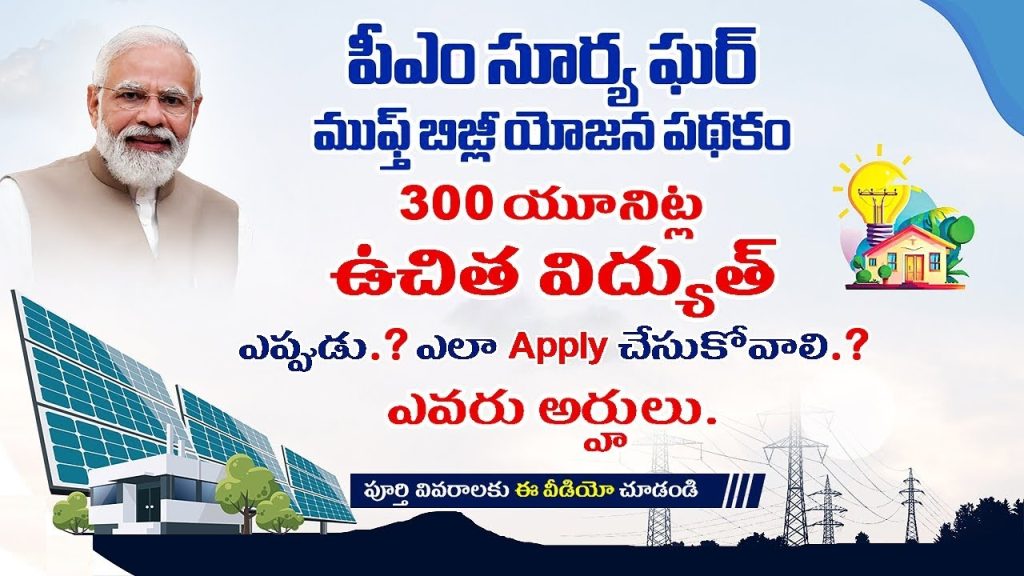
The Pradhan Mantri Suryoday Yojana (PMSY) is an innovative government initiative designed to promote sustainable energy solutions across India. Launched on January 22, 2024, this scheme aims to provide free electricity of up to 300 units per month to over one crore residential households through rooftop solar installations. Let’s explore the detailed aspects of this revolutionary scheme, its benefits, and how it compares to other solar initiatives.
What is the Pradhan Mantri Suryoday Yojana?
The PMSY is a government-led program aimed at encouraging middle and lower-income households to adopt renewable energy solutions. By installing rooftop solar systems, the government provides residents with free electricity and an opportunity to generate income by selling surplus energy back to the grid.
Key Highlights of PMSY
- Free Electricity: Households can use up to 300 units of power per month without any cost.
- Income Generation: Any unused electricity is automatically sold back to the grid, generating additional income for the household.
- Eligibility: The scheme targets middle-class and economically weaker sections (EWS), focusing on households with an annual income below ₹1,50,000.
Benefits of PMSY
1. Cost Savings
Households with solar installations can save approximately ₹15,000 to ₹18,000 annually on electricity bills. This significant cost reduction eases the financial burden on families.
2. Income from Excess Power
Unused electricity is credited to the grid, and residents receive compensation. For instance, if 300 units are produced and only 200 are consumed, the remaining 100 units are sold, creating a steady income source.
3. Environmental Impact
By shifting to solar energy, the scheme reduces dependency on non-renewable energy sources, leading to lower carbon emissions and a greener environment.
Eligibility Criteria for PMSY
To ensure that the benefits reach the intended audience, the government has established clear eligibility guidelines:
- Annual Income: Applicants must have an annual income below ₹1,50,000.
- Residential Property: Only residential properties are eligible. Commercial or industrial buildings are excluded.
- Citizenship: The applicant must be an Indian citizen.
- Employment: Government employees are not eligible, even if their income falls below the threshold.
How to Apply for PMSY
Applying for the PMSY is straightforward:
- Visit your local electricity office or designated solar vendor approved by the government.
- Submit essential documents, including:
- Aadhaar card
- Address proof (e.g., Ration card)
- Recent electricity bill
- Bank passbook
- Two passport-sized photographs
- Fill out the application form and await approval.
Once approved, the government will coordinate with registered vendors for installation.
Comparison with Rooftop Solar Scheme
The PMSY differs significantly from the general rooftop solar scheme. While the latter is open to all income groups and offers subsidies, the PMSY specifically targets low-income households with more attractive benefits, such as free electricity and income opportunities.
Subsidy Breakdown
- Up to 3 kW Capacity: 40% subsidy
- 4-10 kW Capacity: 20% subsidy
- Above 10 kW: No subsidy
Cost Example
For a 5 kW installation:
- Total cost: ₹3,50,000
- Subsidy: ₹72,000
- Final cost: ₹2,78,000
This makes rooftop solar systems more affordable and accessible.
Vendor Selection and Costs
To maintain quality and ensure transparency, the government has partnered with authorized vendors. These vendors provide complete installation services, charging approximately ₹70,000 per kW. For example:
- A 3 kW system costs ₹2,10,000 before subsidy.
- After applying a 40% subsidy (₹54,000), the net cost reduces to ₹1,56,000.
Working Mechanism of Rooftop Solar Systems
Rooftop solar systems under PMSY operate on an on-grid mechanism:
- Daytime Generation: Solar panels generate electricity, supplying it to the household. Excess power is sent to the grid.
- Nighttime Consumption: The household draws electricity from the grid, if required, ensuring uninterrupted power supply.
- Income Generation: Surplus power sent to the grid is monetized, with payments credited to the household’s bank account.
Long-Term Returns
Investing in rooftop solar systems offers substantial long-term benefits:
- Durability: Solar panels have a lifespan of over 25 years.
- Payback Period: Households can recover their investment in approximately 5-7 years through savings and income.
- Return on Investment: With a 26% annual return, this scheme is a financially sound choice.
Future of Solar Energy in India
The Pradhan Mantri Suryoday Yojana is a significant step toward achieving India’s renewable energy goals. As the government continues to refine the scheme and expand its reach, more households will benefit from sustainable energy solutions.
Conclusion
The Pradhan Mantri Suryoday Yojana is a transformative initiative that not only empowers households economically but also contributes to India’s sustainability efforts. With its blend of cost savings, income opportunities, and environmental benefits, the PMSY is set to revolutionize the energy sector.
By adopting this scheme, households can embrace a greener future while enjoying substantial economic advantages. Don’t miss the chance to be part of this solar revolution—apply today!