


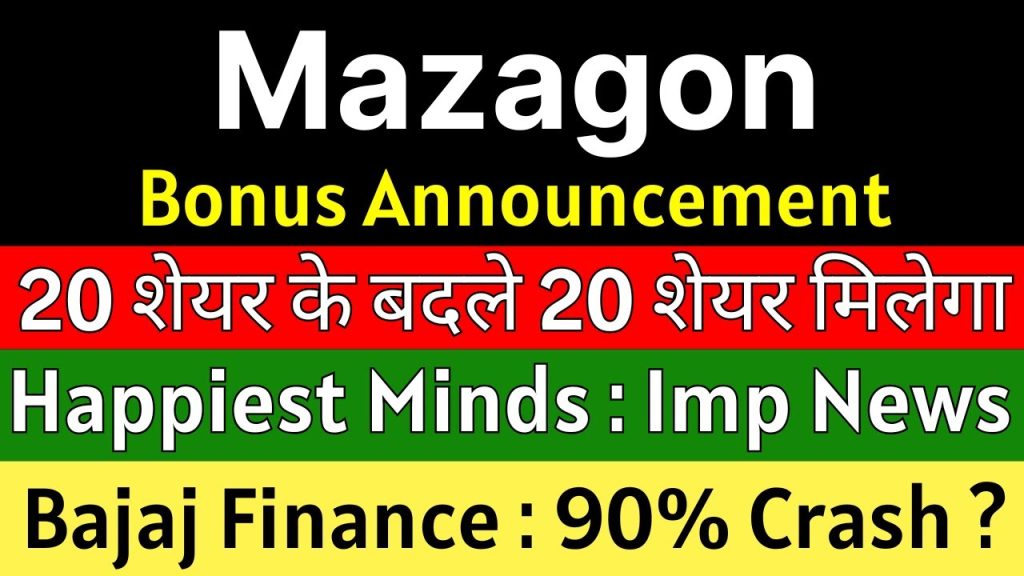
The Indian stock market is a dynamic arena, with companies like Mazagon Dock, Happiest Minds, Bajaj Finance, and Ashok Leyland making headlines in 2025. These firms, spanning defense, IT, finance, and automotive sectors, have recently announced significant updates, including bonus issues, stock splits, and performance-driven market movements. This comprehensive article delves into the latest news, analyzes key developments, and provides actionable insights for investors, all while optimizing for search engines to ensure maximum visibility.
Why These Stocks Are Trending in 2025
The Indian stock market thrives on corporate actions, quarterly results, and global economic cues. Mazagon Dock, Happiest Minds, Bajaj Finance, and Ashok Leyland have captured investor attention due to their recent announcements and market performance. From bonus shares to technical adjustments, these companies reflect diverse opportunities and challenges. Let’s explore each company’s updates, their implications, and what investors should consider moving forward.
Mazagon Dock: Riding the Defense Sector Wave
A Surge in Defense Stocks Amid Global Tensions
Mazagon Dock Shipbuilders Limited, a leading player in India’s defense sector, has been in the spotlight in 2025. The company’s stock has shown robust performance, driven by heightened geopolitical tensions, particularly the Israel-Iran conflict. Over the past 12–15 trading sessions, defense stocks, including Mazagon Dock, Garden Reach Shipbuilders, Cochin Shipyard, and Bharat Electronics, have outperformed broader market indices.
The defense sector’s resilience stems from global uncertainties, which increase demand for military equipment and naval capabilities. Mazagon Dock, known for constructing warships and submarines, benefits directly from these dynamics. Investors are drawn to the company’s strong order book and government backing, making it a focal point in the defense index’s upward trajectory.
Q4 Earnings: A Mixed Bag
Mazagon Dock’s Q4 FY25 earnings revealed steady revenue growth, albeit at a modest 2.28% year-on-year. However, net profit saw a significant decline on a quarter-on-quarter basis due to one-time provisions. This led to a drop in earnings per share (EPS), pushing valuations higher as the stock price continued to climb.
High valuations raise concerns about overvaluation. Analysts, including brokerage houses, have flagged this issue, suggesting that Q1 FY26 results will be critical. If Mazagon Dock fails to deliver impressive earnings, its stock could face downward pressure. Investors should monitor order execution and profit margins closely, as these will determine whether the stock sustains its premium valuations.
Key Takeaways for Investors
- Geopolitical Advantage: Mazagon Dock’s performance is tied to global conflicts, which drive defense spending.
- Valuation Risks: Current valuations appear stretched, warranting caution until Q1 FY26 results provide clarity.
- Long-Term Potential: With India’s focus on indigenous defense manufacturing, Mazagon Dock remains a compelling long-term bet.
Happiest Minds: IT Sector’s Dark Horse
A 10% Rally Sparks Investor Interest
Happiest Minds Technologies, a mid-cap IT services company, surged approximately 10% in a single trading session in 2025, catching the market’s eye. The rally was fueled by positive commentary from brokerage firm Anand Rathi, which highlighted the company’s inorganic growth strategy and strong performance in key segments.
Anand Rathi’s Bullish Outlook
Anand Rathi’s report emphasized Happiest Minds’ focus on the Banking, Financial Services, and Insurance (BFSI) and healthcare sectors. These two segments now contribute 42% to the company’s topline, up from 27.5% in FY24. This growth reflects Happiest Minds’ ability to capitalize on high-demand areas, positioning it for sustained revenue expansion.
The brokerage also noted the company’s attractive valuations. With a current price-to-earnings (P/E) ratio of 35, Happiest Minds trades at a 40% discount to its five-year median P/E of 57. However, this discount must be contextualized. The company’s profit growth has slowed significantly, with a 1% CAGR over the past three years and a 19% decline in profits in the last year. This sluggish growth explains the lower valuations, which analysts argue reflect a fair value rather than a discount.
Challenges in the U.S. Market
Happiest Minds derives a significant portion of its revenue from the U.S., where economic slowdown and negative GDP growth have posed challenges. However, optimism surrounds the second half of FY26, with expectations of increased IT spending and a potential recovery in high-tech, manufacturing, and BFSI segments. These sectors collectively account for 51% of the company’s revenue, making them critical to its growth trajectory.
Strategic Focus on Inorganic Growth
Happiest Minds’ inorganic growth strategy, including acquisitions and partnerships, has bolstered its capabilities in BFSI and healthcare. This approach allows the company to expand its service offerings and client base, mitigating risks associated with organic growth in a competitive IT landscape.
Investor Considerations
- Growth Potential: BFSI and healthcare segments offer robust growth opportunities, supported by inorganic strategies.
- Valuation Context: Current P/E levels are reasonable given profit growth challenges, but not a bargain.
- U.S. Recovery: A revival in U.S. IT spending could significantly boost Happiest Minds’ performance.
Bajaj Finance: Navigating Bonus and Split Adjustments
A 90% Drop? Understanding the Technical Adjustment
Bajaj Finance, a titan in India’s non-banking financial company (NBFC) sector, made waves in 2025 with a seemingly alarming 90% stock price drop. However, this was not a loss but a technical adjustment following a bonus issue and stock split announced on April 29, 2025.
The company issued a 4:1 bonus (four additional shares for every share held) and a 1:2 stock split (each share split into two). The record date for these actions was June 16, 2025, leading to the price adjustment. For every share held, investors received 10 equity shares post-split and bonus, normalizing the investment value. This adjustment confused new investors unfamiliar with corporate actions, but seasoned players recognized it as a routine event.
Why Bonus and Split?
Bonus issues and stock splits enhance liquidity and make shares more affordable for retail investors. Bajaj Finance’s move reflects confidence in its financial health and a strategy to broaden its shareholder base. The company’s robust fundamentals, including strong loan growth and diversified portfolio, continue to underpin its market leadership.
Market Implications
The technical adjustment does not alter Bajaj Finance’s intrinsic value. Investors holding shares before the record date saw their share count increase, maintaining their portfolio’s value. However, new investors entering post-adjustment benefit from lower per-share prices, potentially driving demand.
Investor Guidance
- Don’t Panic: The 90% drop was a technical adjustment, not a fundamental decline.
- Long-Term Strength: Bajaj Finance’s leadership in consumer finance ensures sustained growth potential.
- Monitor Macro Factors: Interest rate trends and RBI policies will influence NBFC performance in 2025.
Ashok Leyland: Bonus Boost for Shareholders
Q4 Results and Bonus Announcement
Ashok Leyland, a leading commercial vehicle manufacturer, announced its Q4 FY25 results alongside a 1:1 bonus issue. For every share held, investors received one additional share, rewarding shareholders and signaling confidence in future growth. This corporate action enhances liquidity and attracts new investors, reinforcing Ashok Leyland’s market position.
Commercial Vehicle Sector Outlook
India’s commercial vehicle sector is poised for growth in 2025, driven by infrastructure development, e-commerce expansion, and government initiatives like Bharatmala and Atmanirbhar Bharat. Ashok Leyland, with its diverse product portfolio spanning trucks, buses, and light commercial vehicles, is well-positioned to capitalize on these trends.
Financial Performance
While specific Q4 FY25 details were not disclosed, Ashok Leyland’s consistent focus on cost optimization, electric vehicle (EV) innovation, and export markets bodes well for its financial health. The bonus issue further underscores the company’s strong cash reserves and commitment to shareholder value.
Investor Insights
- Bonus Benefit: Existing shareholders gain additional shares, boosting portfolio value.
- Sector Tailwinds: Infrastructure and logistics growth support Ashok Leyland’s prospects.
- EV Transition: Monitor the company’s progress in electric and alternative fuel vehicles.
Broader Market Context: What’s Driving These Stocks?
Geopolitical and Economic Factors
The performance of Mazagon Dock, Happiest Minds, Bajaj Finance, and Ashok Leyland is shaped by broader market dynamics:
- Geopolitical Tensions: Conflicts like Israel-Iran bolster defense stocks like Mazagon Dock.
- U.S. Economic Recovery: A potential revival in U.S. IT spending could lift Happiest Minds.
- Domestic Growth: India’s infrastructure push and consumer demand drive Bajaj Finance and Ashok Leyland.
- Corporate Actions: Bonus issues and splits enhance liquidity and investor interest across these companies.
Valuation Concerns Across Sectors
High valuations in defense (Mazagon Dock) and IT (Happiest Minds) sectors warrant caution. Investors must balance growth prospects with fundamental metrics like P/E ratios, EPS growth, and profit margins. Bajaj Finance and Ashok Leyland, with their technical adjustments and bonus issues, offer more stable valuation profiles but require monitoring of sector-specific risks.
How to Approach These Stocks in 2025
Conduct Thorough Research
Before investing, analyze each company’s financials, sector trends, and global cues. Use resources like SEBI-registered analysts, brokerage reports, and company filings to make informed decisions. For example, Happiest Minds’ U.S. exposure requires tracking global IT spending, while Mazagon Dock’s performance hinges on defense contracts.
Diversify Your Portfolio
Spread investments across sectors to mitigate risks. Combining exposure to defense (Mazagon Dock), IT (Happiest Minds), finance (Bajaj Finance), and automotive (Ashok Leyland) creates a balanced portfolio resilient to sector-specific volatility.
Stay Updated on Corporate Actions
Bonus issues and stock splits, as seen with Bajaj Finance and Ashok Leyland, impact share prices and liquidity. Monitor record dates and ex-dates to capitalize on these events without misinterpreting price movements.
Long-Term vs. Short-Term Strategy
- Long-Term: Mazagon Dock and Ashok Leyland benefit from India’s defense and infrastructure growth, making them suitable for patient investors.
- Short-Term: Happiest Minds’ rally and Bajaj Finance’s post-split demand offer tactical trading opportunities.
Conclusion: Seizing Opportunities in a Dynamic Market
Mazagon Dock, Happiest Minds, Bajaj Finance, and Ashok Leyland represent diverse facets of India’s stock market in 2025. From defense-driven gains to IT sector recoveries, financial sector stability, and automotive growth, these companies offer unique investment prospects. However, success requires diligent research, a clear understanding of corporate actions, and a balanced approach to risk.
Investors should leverage the latest updates—such as Mazagon Dock’s geopolitical tailwinds, Happiest Minds’ inorganic growth, Bajaj Finance’s technical adjustments, and Ashok Leyland’s bonus issue—to make informed decisions. By staying proactive and diversified, you can navigate the market’s complexities and position your portfolio for growth in 2025 and beyond.
Note: This article is for educational purposes only and does not constitute buy or sell recommendations. Always conduct your own research or consult a financial advisor before investing. For real-time updates, join SEBI-registered analyst channels or follow trusted financial platforms.