


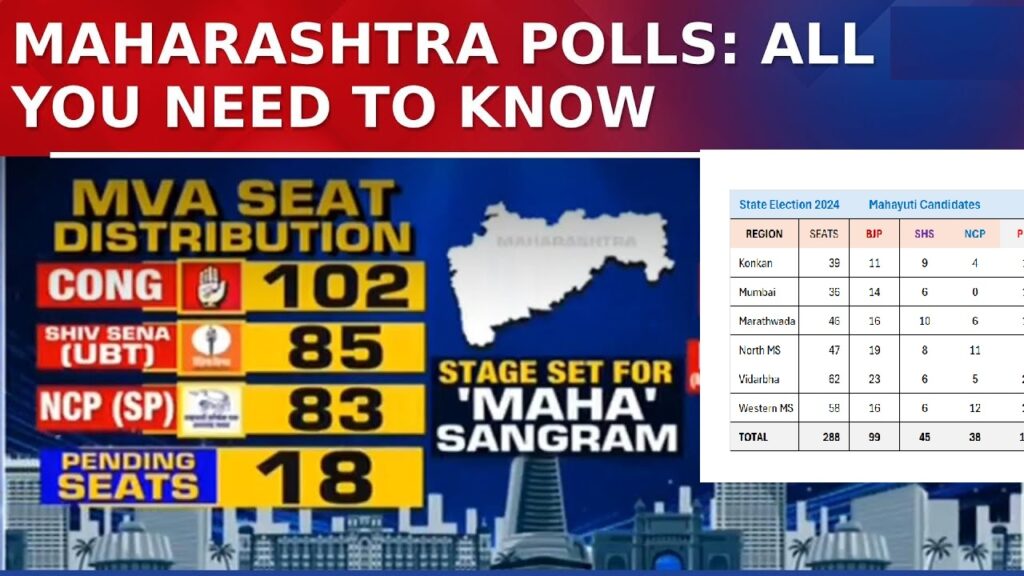
As the upcoming Maharashtra state elections draw near, political alliances like the Mahayuti and Mahavikas Aghadi (MVA) are finalizing their seat-sharing arrangements. This article breaks down the distribution and candidate fielding strategies for these coalitions, highlighting the evolving dynamics of Maharashtra’s political landscape.
Mahayuti Alliance Seat Distribution
The Mahayuti alliance, comprising the Bharatiya Janata Party (BJP), Shiv Sena led by Eknath Shinde (SHS), and the Nationalist Congress Party (NCP) led by Ajit Pawar, has almost finalized its seat distribution:
- Total Seats for Mahayuti: 286 out of 288
- BJP: 153 seats (including 4 seats from smaller allies)
- Shiv Sena (Shinde’s faction): 81 seats
- NCP (Ajit Pawar faction): 52 seats
In two constituencies—Malegaon Central and Shivadi—no candidate has been announced. The Mahayuti coalition is primarily centered around maintaining unity while balancing internal interests among its constituent parties.
Seat Sharing in the Mahavikas Aghadi Alliance
The Mahavikas Aghadi (MVA), another key coalition in Maharashtra, comprises the Congress, Shiv Sena (Uddhav Thackeray faction), and NCP (Sharad Pawar faction), alongside smaller allies such as the Samajwadi Party (SP). Here’s a breakdown of the MVA’s seat distribution:
- Total Seats for Mahavikas Aghadi: 288 out of 288
- Congress (INC): 102 seats
- Shiv Sena (Uddhav Thackeray faction): 96 seats
- NCP (Sharad Pawar faction): 86 seats
- Samajwadi Party (SP): 2 seats
- Others (OTH): 2 seats
The coalition faces some remaining ambiguities on approximately 18 seats, where final candidates are yet to be decided, hinting at potential last-minute solo contests if no consensus is reached.
Internal Disputes and Pending Decisions
One of the most notable issues within both alliances is the uncertainty surrounding certain seats. For Mahayuti, five seats remain undecided, while in the MVA, 18 seats are in flux due to internal disagreements. These unresolved seats are adding to the tension within both coalitions as they work to maintain cohesion and maximize their electoral influence.
For instance, the Samajwadi Party initially aimed to field five candidates but was ultimately allocated only two seats by the MVA, creating potential friction. Akhilesh Yadav, during a recent visit to Maharashtra, announced five potential candidates, leading to discussions over whether the party will withdraw the extra nominations or proceed independently.
Key Battles and Strategic Choices
Among the most anticipated matchups is the contest for the Bandra East seat, which has become a flashpoint between the Congress and the Shiv Sena (Uddhav Thackeray faction). Originally, Congress fielded a candidate here, despite Varun Sardesai from Uddhav Thackeray’s faction being keen on contesting. The resulting tension between Sardesai and Congress’s candidate Ashok Jadhav has led to increased friction.
Meanwhile, the Worli constituency will witness a heated contest between Aditya Thackeray from the Uddhav faction and his rival Milind Narvekar from the Shinde Sena. This matchup has been dubbed the “Worli Grudge Match,” as both candidates have strong regional support and are vying for dominance in this key area.
Mahayuti vs. MVA: Election Campaign Highlights
As the elections near, both alliances are intensifying their campaigns. From community rallies to media appearances, the coalitions are working hard to sway the public in their favor. Leaders from both alliances have expressed visions for Maharashtra’s development, focusing on issues like infrastructure, economic growth, and public welfare.
In an exclusive interview, Milind Narvekar, MP for the Shinde Sena and a prominent candidate in South Mumbai, emphasized his commitment to the people of Maharashtra and his allegiance to Chief Minister Eknath Shinde’s development-focused agenda. He voiced his vision for progress and criticized what he termed “speed-breaker politics” that, in his view, obstructs critical projects like the Mumbai Metro and road expansion.
Narvekar explained his perspective on shifting from MP to MLA, underscoring his dedication to representing South Mumbai residents and ensuring the completion of development projects. In his words, “Whether in power or out of power, my aim remains to serve the people of South Mumbai, my family.”
Potential Impact of Coalition Politics in Maharashtra’s Election
The intense candidate lineup and the high-stakes seat-sharing process reflect the depth of Maharashtra’s political rivalry. Both Mahayuti and MVA are striving for absolute dominance, with candidates bringing their visions for progress, party loyalty, and community welfare to the fore. The contrasting approaches within each alliance reveal Maharashtra’s complex political terrain, where development priorities compete with traditional allegiances and emerging political personalities.
With a backdrop of unresolved seat allocations and fierce competition in key constituencies, Maharashtra’s electorate faces an interesting decision that could reshape the state’s political landscape. Whether these alliances hold through election day or face fracturing under the weight of unresolved conflicts remains to be seen.