


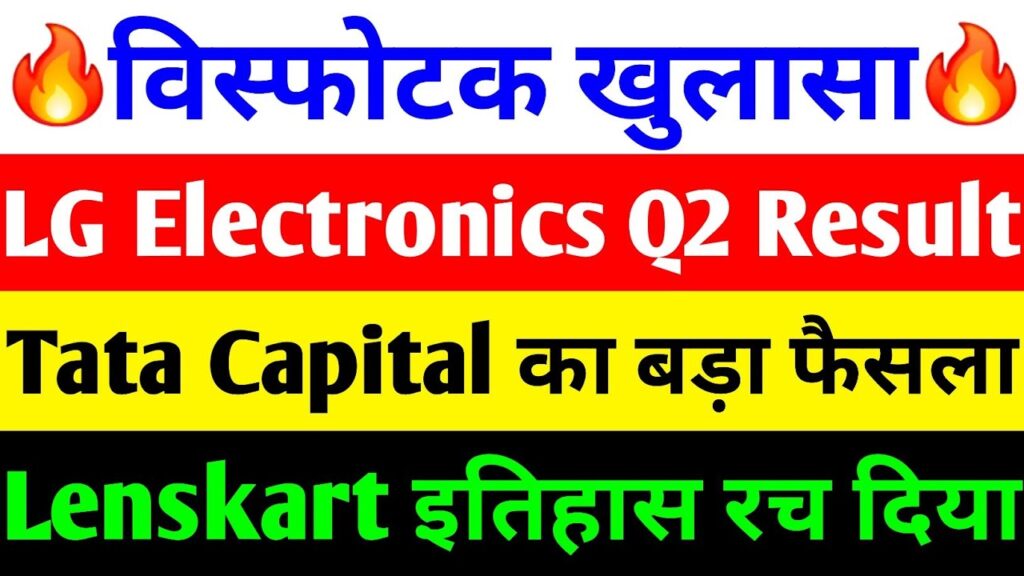
In the dynamic world of Indian stock markets, investors constantly seek the latest updates on blue-chip companies and emerging players. November 2025 brings a mix of challenges and opportunities as LG Electronics India grapples with underwhelming quarterly results, Tata Capital strengthens its financial arsenal through strategic bond issuances, and Lenskart pushes boundaries with innovative eyewear tech.
This comprehensive analysis dives deep into these developments, offering insights into stock performance, financial health, and future growth trajectories. Whether you’re a seasoned trader eyeing recovery plays or a newcomer exploring IPO aftermaths, this guide equips you with actionable intelligence to navigate the BSE and NSE landscapes.
As markets evolve amid global economic shifts and domestic consumer trends, understanding these companies’ moves becomes crucial. LG Electronics India, a powerhouse in consumer durables, faces short-term headwinds but boasts robust annual gains. Tata Capital, the financial arm of the Tata Group, signals stability with high-rated debt instruments. Meanwhile, Lenskart’s bold forays into AI and international branding position it as a disruptor in the eyewear sector. Let’s unpack these stories, backed by fresh data and expert perspectives, to help you make informed decisions.
LG Electronics India Q2 2025: Quarterly Slump Amid Annual Strength – What Investors Need to Know
LG Electronics India continues to command attention as a key player in the consumer electronics arena, blending global innovation with local manufacturing prowess. However, the company’s shares experienced a sharp 3.42% decline on a recent trading Friday, closing at ₹166.
This downturn stemmed directly from the Q2 FY2025 results, which disappointed analysts and triggered sell-offs. Trading opened weakly around ₹1,590, dipped to an intraday low of the same level, and struggled to recover, reflecting broader market sentiment toward underperforming earnings.
Market watchers note that the stock, listed at a premium, now hovers below its initial offering price. Yet, this dip presents a potential entry point for value investors. The company’s management swiftly addressed investor concerns by releasing contact details for senior executives, including the Whole-Time Director, Chief Financial Officer, and Company Secretary.
Based in Noida, Uttar Pradesh, these details—complete with addresses, phone numbers, and email IDs—underscore LG’s commitment to transparency. Investors can now directly engage with leadership on upcoming events, disclosures, or strategic queries, fostering trust in an era of heightened scrutiny.
Delving into the financials, LG Electronics India’s Q2 performance revealed cracks in profitability. Earnings Before Interest, Taxes, Depreciation, and Amortization (EBITDA) clocked in at approximately ₹5.48 billion, marking a 2.09% year-over-year (YoY) dip and a 1.69% quarter-over-quarter (QoQ) decline. Profit Before Tax (PBT) followed suit at ₹5.25 billion, down 1.95% YoY and 1.67% QoQ. Net Profit After Tax (PAT) settled at ₹3.89 billion, reflecting a 1.46% YoY and 1.24% QoQ reduction. These figures paint a picture of operational pressures, possibly from rising input costs, supply chain disruptions, or softening demand in key segments like appliances and TVs.
Despite the quarterly blues, the annual story shines brighter. For FY2024, total revenue surged to ₹31.10 billion, boasting a 39.3% YoY jump—outpacing competitors in a recovering post-pandemic market. PBT leaped 45.5% to ₹29.63 billion, while PAT climbed 45.3% to ₹20.90 billion. Such growth highlights LG’s resilience, driven by expanded distribution networks, premium product launches, and a push toward smart home ecosystems.
Return on Capital Employed (ROCE) improved from 34% in FY2023 to 45% in FY2024, settling at 43% in the latest quarter—a testament to efficient capital utilization. Return on Equity (ROE) mirrored this trend, rising from 31% to 40% before easing to 37%, still above industry averages.
Operational efficiencies further bolster the case. Working capital requirements, which ballooned to 90 days earlier, compressed to 16 days before stabilizing at 21 days, signaling better inventory management. Cash flow from operations, a critical metric for sustainability, grew from ₹27.63 billion in FY2023 to ₹37.41 billion in the recent period, up from a FY2024 dip to ₹22.23 billion. This liquidity boost enables investments in R&D and market expansion, particularly in India’s burgeoning middle-class consumer base.
Institutional interest adds fuel to the bullish narrative. In October 2025, nearly 1,990 mutual funds piled into LG Electronics India shares, with only one fund offloading positions. This net buying spree—amid broader market volatility—signals confidence in long-term prospects. Analysts project a rebound as festive season sales data rolls in, potentially lifting shares toward ₹180-₹200 in the next quarter. For investors, the key lies in monitoring macroeconomic factors like inflation and rupee fluctuations, which could amplify or mitigate these gains.
LG’s strategic edge lies in its diversified portfolio: from energy-efficient refrigerators to OLED televisions, the company caters to urban millennials craving tech-infused lifestyles. Recent initiatives, like localized manufacturing under the PLI scheme, reduce import dependencies and enhance cost competitiveness. As India aims for $1 trillion in electronics exports by 2030, LG stands poised to capture a larger slice, making its current valuation—at a forward P/E of around 25x—attractive for growth-oriented portfolios.
Tata Capital Share Price Stability: IPO Aftermath and NCD Issuance Signals Strong Fundamentals
Shifting gears to the financial services sector, Tata Capital emerges as a steady performer in an otherwise choppy market. The stock closed at ₹325, reflecting a modest 0.53% uptick, but it has traded in a narrow band since its IPO debut at ₹326. Intraday highs touched ₹336, while lows probed ₹300, indicating consolidation rather than breakout momentum. This stability around IPO levels suggests investor caution, awaiting catalysts to propel it higher.
Tata Capital’s appeal stems from its Tata Group pedigree—synonymous with ethical governance and diversified revenue streams. As a non-banking financial company (NBFC), it offers lending, wealth management, and infrastructure financing, tapping into India’s credit-hungry economy. Post-IPO, the stock has seen volatility but now settles into a predictable range, ideal for swing traders. Experts advise patience, as a major trigger—like robust Q3 earnings or policy tailwinds—could spark a rally toward ₹350-₹380.
A fresh development underscores Tata Capital’s proactive capital management: the issuance of Non-Convertible Debentures (NCDs) via private placement. On November 14, 2025, the company raised ₹750 crore and ₹800 crore through these instruments, maturing on November 14, 2030. This five-year tenor aligns with long-term funding needs, providing stable inflows for expansion. Coupon rates stand at an attractive 7.30% per annum for the ₹750 crore tranche and 7.12% for the ₹800 crore one, yielding better returns than fixed deposits amid falling interest rates.
Credit ratings affirm the issuance’s safety. Crisil and Care assigned ‘AAA Stable’ ratings, the highest possible, reflecting Tata Capital’s pristine balance sheet, low default risk, and strong parent backing. Subscriber response exceeded expectations, with oversubscription highlighting institutional appetite for high-yield, low-risk debt. This move not only bolsters liquidity—crucial for an NBFC in a regulatory-tightening environment—but also diversifies funding sources beyond equity markets.
From a valuation standpoint, Tata Capital appears undervalued. Unlisted shares traded above ₹800 pre-IPO, yet the listed price lingers at ₹325—a 60% discount. This gap arises from lock-in expirations and profit-taking, but fundamentals remain rock-solid. Assets under management grew 25% YoY to over ₹1.5 lakh crore, fueled by auto loans and SME financing. Net interest margins held steady at 4.5%, while non-performing assets (NPAs) stayed below 1.5%, outperforming peers like Bajaj Finance.
Looking ahead, Tata Capital benefits from India’s infrastructure boom and digital lending surge. Government initiatives like Atmanirbhar Bharat enhance its playbook, enabling deeper penetration into Tier-2/3 cities. Risks include interest rate volatility and RBI’s macro-prudential norms, but the company’s diversified book—spanning retail, corporate, and infra—mitigates these. For dividend seekers, the recent NCDs pave the way for consistent payouts, with yields potentially exceeding 8% including equity upside.
In a sector dominated by fintech disruptors, Tata Capital’s hybrid model—blending traditional lending with tech platforms—positions it for 15-20% CAGR through 2030. Investors should watch quarterly disbursements and asset quality metrics closely; a break above ₹336 could confirm bullish reversal.
Lenskart’s Stock Recovery and Global Push: Spanish Brand Launch and AI Smart Glasses Innovation
Eyewear retail giant Lenskart captivates with its blend of affordability and aspiration, and its stock mirrors this vibrancy. Closing at ₹48 with a crisp 2.20% gain, shares have clawed back from a discounted listing. The IPO priced at ₹402 saw a 2.9% debut loss at ₹390, despite 4x oversubscription—a classic case of post-IPO jitters in a high-growth sector. Yet, the stock has since notched highs of ₹429, allowing early investors to book profits, before stabilizing around fair value at ₹400.
This resilience stems from Lenskart’s omnichannel dominance: over 1,500 stores pan-India, plus a robust e-commerce arm serving 10 million+ customers. Volatility persists—lows hit ₹356 amid broader small-cap corrections—but recovery signals strength. Analysts peg intrinsic value at ₹400-₹450, with upside from margin expansion and international forays. Trading volumes spiked 30% post-earnings, reflecting retail frenzy in IPO darlings.
Big news dominates headlines: Lenskart’s launch of Spanish luxury brand Meller across Indian outlets and online platforms. This move catapults the company into premium direct-to-consumer (D2C) eyewear, targeting fashion-forward Gen Z. Meller, an iconic European label with a cult following in Europe and Latin America, brings vibrant designs and sustainable materials to India’s ₹15,000 crore eyewear market. Shoppers can now snag Meller sunnies and specs at Lenskart stores, blending accessibility with exclusivity.
This partnership isn’t mere branding—it’s a growth accelerator. Meller’s fast-growing D2C model aligns with Lenskart’s playbook, promising 20-25% sales uplift in premium segments. As India’s eyewear penetration lags at 30% (versus 70% globally), such expansions democratize style. Lenskart’s management highlights seamless integration: in-store trials via AR try-ons and same-day deliveries via hyperlocal logistics. Early buzz from influencers and pop-up events in Mumbai and Delhi suggests viral potential, echoing successes like Ray-Ban collaborations.
Compounding the excitement, founder Peyush Bansal unveiled AI-powered smart glasses in a live demo, redefining corrective eyewear. These “smart lenses” integrate generative AI for real-time vision enhancement—think adaptive focus for reading or driving, personalized UV alerts, and health diagnostics via embedded sensors. Powered by edge computing, they sync with smartphones for data-driven insights, appealing to tech-savvy professionals amid rising screen-time woes.
This innovation cements Lenskart’s leadership in smart optics, a nascent $500 million sub-segment in India projected to hit $5 billion by 2030. R&D investments—10% of revenues—fuel such breakthroughs, from blue-light blockers to myopia-control lenses for kids. Globally, Lenskart eyes Southeast Asia and the Middle East, with pilots in Singapore yielding 40% YoY growth. Valuation concerns linger (P/E at 50x), but 50% revenue CAGR and 25% EBITDA margins justify the premium.
Risks include competition from Titan Eye+ and counterfeit influxes, but Lenskart’s vertical integration—from lens labs to retail—builds moats. Investors should track festive sales and Q3 subscriber adds; a push past ₹50 could ignite a 20% rally.
Comparative Analysis: How LG, Tata Capital, and Lenskart Stack Up in India’s Growth Story
Juxtaposing these stocks reveals diverse risk-reward profiles. LG Electronics India offers defensive growth in durables, with annual metrics trumping quarterly dips—ideal for long-term holders. Tata Capital’s stability suits conservative portfolios, its NCDs providing yield in a low-rate world. Lenskart, the high-beta play, thrives on innovation, rewarding risk-takers with explosive potential.
Market caps tell the tale: LG at ₹10,000 crore, Tata Capital at ₹15,000 crore, Lenskart at ₹5,000 crore. Beta coefficients—LG (0.8), Tata (1.0), Lenskart (1.5)—highlight volatility gradients. Correlation with Nifty 50 stands at 0.7 for all, underscoring domestic cyclical ties.
Sector tailwinds converge: electronics via PLI incentives, NBFCs via credit expansion, eyewear via rising disposable incomes. Headwinds like inflation (6% CPI) and geopolitical tensions loom, but each company’s balance sheet resilience—LG’s cash hoard, Tata’s AAA rating, Lenskart’s debt-free status—buffers shocks.
Investment Strategies: Timing Entries, Managing Risks, and Maximizing Returns
Crafting a portfolio around these names demands nuance. For LG, dollar-cost average during dips below ₹160, targeting 15% upside by Q4. Tata Capital suits SIPs at ₹320-₹330, with NCDs as fixed-income complements. Lenskart calls for tactical buys on pullbacks to ₹45, eyeing 30% gains from AI catalysts.
Diversify across sectors: allocate 40% to consumer goods (LG), 30% to financials (Tata), 30% to retail (Lenskart). Use stop-losses at 10% below entry, and rebalance quarterly. Tax implications—STCG at 20% for holdings under a year—favor long-term bets.
Tools like technical indicators (RSI for oversold LG at 35) and fundamentals (EV/EBITDA for Tata at 8x) guide decisions. Always consult advisors; this analysis educates, not advises.
Future Outlook: Navigating 2026 with LG, Tata Capital, and Lenskart
As 2025 wraps, optimism prevails. LG rebounds on smart home adoption, Tata Capital scales via infra financing, and Lenskart disrupts with AI eyewear. India’s 7% GDP growth amplifies these narratives, potentially delivering 20-40% portfolio returns.
Stay vigilant: track earnings calls, policy shifts, and global cues. In this bull market, these stocks embody resilience and reinvention—prime picks for savvy investors.