


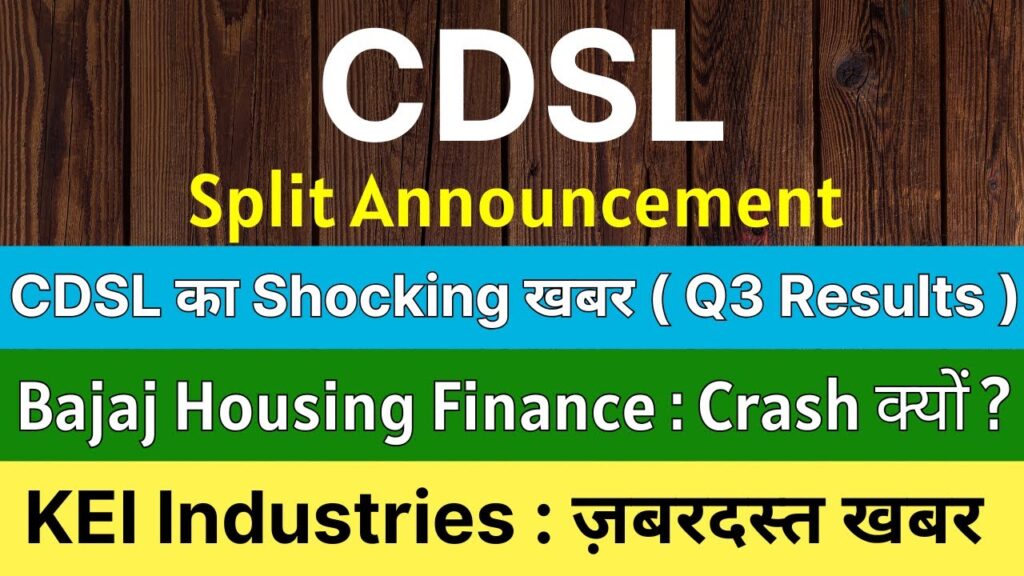
Bajaj Housing Finance grapples with a massive block deal that triggered a 9% share plunge, while KEI Industries boosts its manufacturing prowess with a new Gujarat facility. Meanwhile, Computer Age Management Services (CAMS) gears up for its inaugural stock split, and Central Depository Services (India) Ltd (CDSL) navigates softer Q3 equity turnover amid broader market volatility.
This comprehensive analysis dives deep into these events, offering actionable intelligence for savvy traders and long-term holders. Whether you’re tracking Bajaj Housing Finance share price crash or eyeing KEI Industries manufacturing expansion news, stay ahead with our expert breakdown of implications, trends, and opportunities.
Bajaj Housing Finance Faces Turbulence: Promoter Stake Sale Sparks 9% Crash to 52-Week Low
Investors in the housing finance sector woke up to a rude shock on December 2, 2025, as Bajaj Housing Finance shares nosedived nearly 9%, touching a 52-week low of ₹94.90. The culprit? A blockbuster block deal valued at ₹1,890 crore, where promoter Bajaj Finance offloaded a 2.35% equity stake—equivalent to 19.5 crore shares. This move, executed at an average price of ₹97 per share, sent ripples across Dalal Street, amplifying concerns over the stock’s post-listing trajectory.
Bajaj Housing Finance, a powerhouse in non-deposit-taking housing loans backed by the prestigious Bajaj Group, boasts a market capitalization exceeding ₹80,000 crore. Registered with the National Housing Bank since 2015, the company specializes in home loans, loans against property, and lease rental discounting, catering to a diverse borrower base from salaried professionals to self-employed individuals. Its robust asset under management (AUM) growth—clocking 26% year-on-year in Q2 FY26—underscores operational strength, with net profit surging 18% to ₹643 crore on revenues of ₹2,755 crore.
Yet, the stock’s fortunes have soured since its blockbuster IPO debut on September 16, 2024. Priced at ₹70 per share, it listed at a whopping 114% premium, reaching ₹150. Fast-forward to today, and shares have eroded 23% over the past 12 months, trading below key moving averages (50-day SMA at ₹109 and 200-day at ₹116). Technical indicators scream “oversold,” with the Money Flow Index (MFI) dipping to 23—well under the 30 threshold that signals potential rebound territory.
Unpacking the Block Deal: Regulatory Compliance or Market Signal?
At the heart of this drama lies SEBI’s minimum public shareholding (MPS) norm, mandating at least 25% of a listed company’s equity in public hands to prevent promoter dominance and ensure market liquidity. Bajaj Finance, holding a commanding 88.7% stake (over 739 crore shares as of Q2 FY26), had no choice but to trim its exposure. The divestment, announced on December 1, 2025, targets up to 2% equity through one or multiple tranches until February 28, 2026, with IIFL Capital Services as the merchant banker.
Experts view this not as a distress signal but a routine compliance step. “Promoters often dilute stakes post-IPO to meet MPS requirements, especially for subsidiaries like Bajaj Housing Finance,” notes Harish Jujare, analyst at Prithvi Finmart. Post-sale, the promoter’s holding will slide to around 86.35%, inching closer to the 75% cap. Historical precedents abound: Similar dilutions in peers like HDFC Bank and Kotak Mahindra Bank stabilized after initial volatility, paving the way for recoveries.
Market buzz suggests institutional buyers snapped up the block, potentially cushioning the downside. However, the immediate reaction highlights the stock’s sensitivity to supply overhangs. With RSI at 28 and a support cluster around ₹92-₹95, contrarian investors eye this dip as a buying window. “The fundamentals remain rock-solid—18% profit growth and 14% revenue uptick in Q2 signal resilience,” adds Jujare. “Once housing demand rebounds with RBI rate cuts, this could morph into a multibagger.”
Bajaj Housing Finance’s Growth Engine: Navigating Sector Headwinds
Despite the share price Bajaj Housing Finance crash, the company’s operational narrative shines bright. In FY25, it disbursed over ₹15,000 crore in loans, focusing on affordable housing segments where demand surges amid government initiatives like PMAY 2.0. The Bajaj Group’s ecosystem—leveraging parent Bajaj Finance’s 80 million+ customer base—drives cross-selling synergies, with 40% of new loans originating from existing relationships.
Challenges persist, though. Rising interest rates have squeezed net interest margins (NIMs) to 8.2% in Q2, down from 8.5% YoY, while asset quality holds steady at a gross NPA of 0.8%. Regulatory scrutiny on unsecured lending adds caution, but Bajaj Housing Finance’s conservative loan-to-value (LTV) ratios (averaging 65%) mitigate risks. Looking ahead, management guides for 20-25% AUM growth in FY26, fueled by digital onboarding (now 70% of applications) and geographic expansion into Tier-2/3 cities.
For investors, the block deal underscores a classic post-IPO adjustment phase. With a forward P/E of 25x—below sector peers at 30x—and a dividend yield of 0.5%, Bajaj Housing Finance presents a compelling risk-reward skew. Track upcoming Q3 results in January 2026 for NIM trajectory and disbursement momentum; a beat could ignite a 15-20% rally.
KEI Industries Powers Up: New Gujarat Greenfield Facility Signals 20% Capacity Boost
Shifting gears to the industrials arena, KEI Industries stole the spotlight with the commissioning of its ambitious greenfield manufacturing plant in Sanand, Gujarat. Trial production kicked off on December 2, 2025, with full commercial operations slated for December 10. This ₹1,000-crore multi-phase project on a 70-acre plot at Sanand Industrial Estate marks KEI’s boldest expansion yet, targeting a 20-25% uplift in overall cable production capacity.
KEI Industries, India’s second-largest cables and wires maker by market cap (₹29,900 crore as of February 2024), traces its roots to 1968 as Krishna Electrical Industries. Today, it commands a 15% CAGR over 15 years, manufacturing low-tension (LT), high-tension (HT), and extra-high-voltage (EHV) cables, alongside house wires and stainless steel wires. With five plants across India and exports to 50+ countries, KEI’s order book swelled to ₹3,531 crore by March 2024, blending domestic EPC projects (₹771 crore) and international cables (₹521 crore).
The Sanand facility, a greenfield venture (built from scratch on acquired land), focuses on LT/HT cables and EHV variants up to 400kV, in partnership with Switzerland’s Brugg Kabel AG. Phase 1, operational by November 2025 per earlier guidance, adds ₹900 crore annual capacity in EHV alone—fully utilizing existing ₹600 crore output. Total capex hits ₹900 crore in FY25, with another ₹500-600 crore in early FY26 for scaling.
Strategic Edge: Why Gujarat’s Greenfield Bet Positions KEI for Export Dominance
Gujarat’s plug-and-play industrial ecosystem—proximity to Mundra Port and skilled labor pools—makes Sanand ideal for KEI’s export ambitions. Currently, exports contribute 13% to revenues; the plant eyes a 20% share in 2-3 years by tailoring products for Middle East, Africa, and Europe markets. “This facility incorporates global standards for EHV cables, enabling us to capture high-margin overseas orders,” states Chairman Anil Gupta.
Domestically, the expansion aligns with India’s power grid modernization. Government capex on transmission lines (₹2.5 lakh crore in FY25) and renewable integration demand EHV cables, where KEI’s 9,000 MT stainless steel wire capacity complements offerings. Recent wins include Tamil Nadu Transmission Corporation orders, bolstering the ₹374 crore EHV backlog.
Financially, KEI guides 18-20% revenue growth for FY26, with EBITDA margins at 11%. Long-term, it aspires to ₹25,000 crore revenues by FY30 via 20% CAGR, driven by B2C segments (house wires) targeting 50%+ sales mix. Q2 FY26 previews showed steady traction, with dealer network expanding to 1,910 from 1,805.
Risks? Raw material volatility (copper prices up 10% YTD) and competition from Polycab/RR Kabel loom large. Yet, KEI’s integrated backwardation—70% in-house copper processing—shields margins. Shares, up 15% in the past quarter, trade at 35x forward earnings; analysts peg a ₹5,000 target on expansion fruition.
This KEI Industries Gujarat facility launch isn’t just bricks-and-mortar—it’s a launchpad for ₹5,000-crore ambitions, cementing KEI’s role in India’s $10-billion wires market.
CAMS Breaks New Ground: First-Ever 1:5 Stock Split Set for December 5 Record Date
In a move to democratize ownership, Computer Age Management Services (CAMS) announced its maiden stock split on November 18, 2025: a 1:5 ratio, subdividing each ₹10 face value share into five ₹2 shares. The record date? December 5, 2025—marking eligibility for shareholders on that Friday. With a market cap of ₹19,000 crore, this action aims to enhance liquidity and lure retail investors into India’s premier mutual fund registrar.
CAMS, listed since May 2021, dominates the RTA space with 70% market share, servicing 40+ asset management companies (AMCs) like HDFC and SBI Mutual Funds. Its tech-driven platform handles investor onboarding, transaction processing, and compliance, boasting 5 crore+ folios under management. Q1 FY26 net profit edged up 0.81% to ₹109 crore on 6.86% revenue growth to ₹354 crore, underscoring resilience amid AUM fluctuations.
The split, approved by the board in October 2025 (pending shareholder nod), follows a stellar dividend streak: ₹14 interim in November, plus ₹64.50 in CY24. Shares hit a 52-week high of ₹5,367 in December 2024 but dipped to ₹3,031 in March 2025, reflecting volatility (beta 1.4). Post-announcement, they climbed 1.67% to ₹3,718 on November 20.
Decoding the Split: Liquidity Boost or Retail Magnet?
Stock splits rarely alter fundamentals but amplify accessibility. CAMS’s 1:5 ratio slashes per-share price by 80%, potentially drawing younger investors via apps like Groww. “This widens the shareholder base, boosting trading volumes by 20-30%,” predicts an Upstox analyst. Post-split, ex-date (likely December 4) could see a 2-5% pop, mirroring peers like TCS’s 2021 split.
CAMS’s moat lies in network effects: As AMCs grow (industry AUM at ₹60 lakh crore), transaction volumes surge, lifting fee income (90% recurring). Challenges include regulatory tweaks on expense ratios, but diversification into PMS/AIF servicing (10% revenue) hedges risks. Forward P/E at 40x premiums peers, justified by 25% EPS CAGR.
For CAMS stock split record date December 5, hold if you’re in; it’s a non-event for value, but a catalyst for momentum plays.
CDSL’s Q3 Woes: Equity Turnover Dips 32%, Transaction Charges Under Pressure
Central Depository Services (India) Ltd (CDSL), Asia’s sole listed depository, faces headwinds as Q3 FY25 equity turnover slumped to ₹22.34 lakh crore in October—32% below July’s peak. November’s BSE data paints a grimmer picture: ₹1,57,000 crore, down from ₹1,60,000 crore in October and ₹1,74,000 crore in Q2’s finale. With BSE commanding just 10% market share, NSE’s trends likely mirror this softness, pressuring CDSL’s transaction charges (17% of Q2 revenue, down from 23%).
CDSL’s Q2 FY26 revenue breakup revealed 34% from annual issuer income, buoyed by IPO frenzy (expected to persist in FY26). Yet, core depository activity—issuance, demat, and trades—struggles amid lower volumes. October’s cash segment turnover (NSE+BSE) underscores the malaise, with Q3 earnings potentially “shocking” if issuer fees falter.
Revenue Streams in Flux: From Boom to Cautious Optimism
CDSL, established in 1999, manages 15.29 crore demat accounts, facilitating electronic settlements for exchanges and RTAs. Q3 FY25 net profit soared 21% YoY to ₹130 crore on robust issuer income, but sequential EBITDA dipped 19.6% to ₹160.6 crore (OPM 57.8%). Depository revenue grew marginally, offset by 6.7% YoY operations dip to ₹224 crore in Q4 FY25.
November’s ₹1,570 crore BSE turnover (vs. ₹1,700 crore Q2 average) signals Q3 struggles, potentially dragging transaction income. “If issuer fees from 50+ IPOs shine, it offsets volumes; else, total numbers suffer,” warns an ET Now analyst. Positives: Demat additions hit record 3 crore in FY25, driven by retail surge.
At 50x P/E, CDSL trades at a 10-30% premium to peers, backed by monopoly-like status. Q3 results (January 2026) will clarify; a volume rebound could lift shares 10-15%. For CDSL Q3 FY25 equity turnover update, monitor NSE data—it’s the litmus test for FY26 guidance.
Broader Market Ripples: Opportunities Amid Volatility
These updates—Bajaj Housing Finance stake dilution impact, KEI Industries capex surge, CAMS’s shareholder-friendly split, and CDSL’s turnover blues—highlight sector-specific dynamics. Housing finance weathers regulatory dilutions, industrials ride infra tailwinds, RTAs embrace accessibility, and depositories hinge on market breadth.
| Company | Key Event | Share Impact | FY26 Guidance | Analyst Target |
|---|---|---|---|---|
| Bajaj Housing Finance | 2.35% Block Deal | -9% to ₹95 | 20-25% AUM Growth | ₹120 (20% Upside) |
| KEI Industries | Gujarat Plant Launch | +2% Intraday | 18-20% Revenue | ₹5,000 (15% Upside) |
| CAMS | 1:5 Stock Split | +1.7% Post-Announce | 15% EPS CAGR | ₹4,200 (13% Upside) |
| CDSL | Q3 Turnover Slump | -1% Weekly | 15% Demat Growth | ₹1,500 (10% Upside) |
As 2025 closes, RBI’s dovish stance (repo at 6.25%) could revive volumes, benefiting all. Diversify across these themes: Allocate 30% to industrials like KEI for growth, 25% to finance for value, and monitor depositories for momentum.
In conclusion, these stories exemplify market resilience. Bajaj Housing Finance’s dip screams opportunity, KEI’s expansion fuels ambition, CAMS invites participation, and CDSL tests patience. Stay informed, research diligently—this isn’t advice, but your edge in navigating 2026’s bull run