


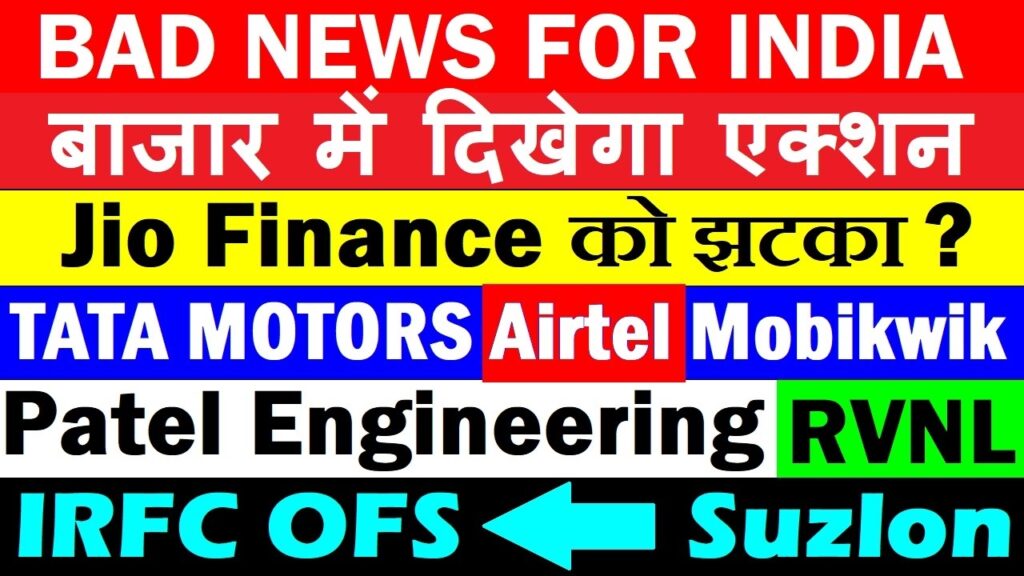
Indian stock markets move fast, and smart investors stay ahead by spotting the signals that actually matter. On February 24, 2026, fresh corporate announcements from heavyweights across infrastructure, railways, renewables, electric vehicles, telecom, and fintech sent ripples through the NSE and BSE. Whether you trade mid-caps for quick gains or build long-term portfolios in defensive sectors, these developments deserve your full attention.
Patel Engineering grabbed a solid irrigation order, RVNL added another railway contract to its bulging order book, and Tata Motors accelerated its EV ambitions through a strategic tie-up. Airtel made a bold ₹20,000 crore commitment to its NBFC arm, directly challenging Jio Financial Services in the high-margin lending space. MobiKwik’s broking subsidiary received final BSE clearance, sparking a double-digit share surge. IRFC faces an Offer for Sale that could inject fresh supply at a discount, while Suzlon Energy brought in proven leadership talent with the appointment of Ajay Kapur as Group CEO.
Yet beneath these positive headlines lurks a sharper macroeconomic reality. India’s IT sector continues to face headwinds on dollar inflows, crude oil prices hover near multi-month highs, and the rupee shows persistent weakness. These factors threaten to widen the current account gap and weigh on GDP growth. In this comprehensive 3,200-word guide, you will discover exactly what each move means for share prices, sector momentum, and your investment strategy. You will also learn why experienced traders now lean toward selective shorting in the near term while keeping a close eye on consumption-driven recovery plays.
Let’s break it all down, keyword by keyword, so you can act with confidence.
Patel Engineering Secures ₹133 Crore Irrigation Project as L1 Bidder – Strong Momentum in India’s Infrastructure Push
Patel Engineering continues to prove why it remains a favourite among investors who follow government-led capex themes. The company, along with its joint venture partners, emerged as the lowest bidder (L1) for the Tasgaon Lift Irrigation Scheme in Maharashtra’s Satara district. The total project value stands at ₹133.25 crore, with Patel Engineering’s share coming in at approximately ₹67.96 crore. Execution will span 48 months and includes headworks, pump houses, rising mains, delivery chambers, and full electromechanical works to irrigate over 2,277 hectares across six villages.
You know how critical irrigation infrastructure has become for India. With erratic monsoons and the push toward sustainable agriculture under schemes like PMKSY, states are aggressively tendering lift irrigation and canal projects. Patel Engineering already boasts deep expertise in hydropower, tunnelling, and water infrastructure. This fresh win adds meaningful revenue visibility and strengthens its order book at a time when the broader infrastructure sector enjoys policy tailwinds.
Investors reacted positively. Patel Engineering shares jumped around 3% on the announcement, reflecting renewed confidence. If you track order inflow as a leading indicator, this deal fits perfectly into the company’s core strengths. Management has consistently delivered on similar EPC projects, and the 48-month timeline aligns with healthy cash-flow generation. For long-term holders, such wins reduce execution risk and support margin expansion as the company scales.
Compare this with peers in the irrigation space. Companies that secure L1 positions early often see re-rating because the market rewards visibility. Patel Engineering now sits in a sweet spot: strong execution track record, diversified order book across hydro and irrigation, and direct exposure to state-level spending that rarely gets derailed. Watch for follow-on orders from Maharashtra and neighbouring states—analysts expect the company’s order book to cross fresh highs in FY27.
Airtel Commits ₹20,000 Crore to NBFC Arm Airtel Money – Direct Competition Heats Up Against Jio Financial Services
Bharti Airtel just signalled its serious ambition to become a full-fledged financial services player. The telecom giant announced plans to inject ₹20,000 crore into its newly licensed NBFC subsidiary, Airtel Money Limited, over the next few years. Airtel will contribute 70% of this capital, with the promoter group via Bharti Enterprises bringing in the remaining 30%. The NBFC received its RBI licence only on February 13, 2026, and this massive capital commitment shows management’s confidence in scaling digital lending rapidly.
Why does this matter so much? India’s credit gap remains huge. Millions of small businesses and individuals still lack access to formal credit at reasonable rates. Airtel brings unmatched advantages: 500 million-plus mobile subscribers, rich data on spending patterns, and a trusted brand. It can underwrite loans faster and cheaper than traditional players by leveraging alternative data and UPI-linked ecosystems.
Jio Financial Services now faces a formidable rival in the same space. Jio already disrupted payments and lending through its vast retail network, but Airtel’s scale in telecom gives it equal firepower. Bajaj Finance still leads the organised NBFC pack, yet the entry of two well-capitalised telecom giants signals intense competition ahead in personal loans, merchant lending, and BNPL products.
Remember, NBFCs cannot accept public deposits like banks. They raise funds through bonds, commercial paper, and bank lines. Airtel’s strong balance sheet and low-cost capital access give it a clear edge here. You will likely see Airtel Money roll out co-branded credit products with its telecom plans, creating stickiness and cross-sell opportunities that pure-play fintechs envy.
Market reaction was interesting. Airtel shares initially dipped on the news as investors digested the capital outlay, but the long-term strategic intent remains bullish. If Airtel executes well, its financial services vertical could contribute meaningfully to consolidated profits within 3-4 years. For Jio Financial, this development raises the competitive bar and forces faster innovation. Watch both stocks closely—valuation multiples in the NBFC space will compress temporarily, creating entry points for patient investors who believe in India’s structural credit growth story.
MobiKwik Shares Jump 13% After BSE Grants Final Approval for Stock Broking Business
One MobiKwik Systems delivered a textbook positive trigger. Its wholly-owned subsidiary, MobiKwik Securities Broking Private Limited, received final activation from the Bombay Stock Exchange effective February 24, 2026. This approval follows SEBI’s broking registration granted in July 2025 and completes all regulatory hurdles for live equity trading operations.
The stock reacted sharply, surging as much as 13% intraday to trade near ₹227 levels. Why the excitement? MobiKwik already operates in payments, lending, and mutual fund distribution. Adding stock broking turns it into a true one-stop fintech platform. Retail investors love convenience—imagine checking your wallet balance, buying mutual funds, taking a personal loan, and executing equity trades all inside one app.
MobiKwik had earlier tied up with BlackRock for asset management, giving it strong credentials on the investment side. Broking approval now lets it capture trading volumes and earn brokerage, securities transaction tax, and value-added services revenue. In a market where discount brokers dominate, MobiKwik can differentiate through its existing user base of millions of active customers who already trust the brand for payments.
Competition in broking remains fierce—Zerodha, Groww, and Upstox lead the pack—but MobiKwik enters with a clear edge in credit and payments linkage. You can expect bundled products like margin trading linked to wallet balances or instant loan against shares. The 13% surge reflects the market pricing in this expanded addressable market.
For investors, this development validates MobiKwik’s pivot toward full-stack financial services. Revenue diversification reduces reliance on any single vertical and improves unit economics over time. Keep MobiKwik on your radar if you follow high-growth fintech plays with strong regulatory momentum.
Tata Motors Partners with Shell to Roll Out 21 Mega EV Charging Hubs Across India – Solving the Biggest EV Adoption Barrier
Tata Motors’ passenger and commercial vehicle divisions continue aggressive EV expansion, but charging infrastructure has always been the Achilles’ heel. The company just removed a major roadblock by partnering with Shell India Mobility to launch 21 new TATA.ev x Shell Mega Charging Hubs. These high-speed facilities, equipped with 120 kW DC fast chargers, will come up in Bengaluru, Chennai, Mysuru, Pune, Vadodara, and strategic highway corridors.
You already know the problem: Indian EV buyers hesitate because public charging remains sparse compared to petrol pumps. Tata Motors addresses this head-on. The new hubs offer premium amenities, multiple bays, and curated in-store offers for Tata EV owners. With this addition, Tata’s Mega Charging Hub network now exceeds 130 locations nationwide. The company has publicly committed to 500 such mega hubs and over 400,000 total charging points by 2027 under its “Open Collaboration 2.0” framework.
This partnership benefits both passenger vehicles (Nexon EV, Curvv EV, Harrier EV) and commercial segments (electric buses and trucks). Faster charging reduces range anxiety for long-distance travel and supports fleet operators who need quick turnaround. Shell brings global expertise in energy infrastructure, while Tata brings deep market understanding and vehicle data.
Investors love infrastructure-led moats. Every new charging station increases the stickiness of Tata’s EV ecosystem and raises switching costs for competitors. Expect faster EV sales growth in key metros and highways. Tata Motors shares should find support from this development, especially as FAME-III expectations build and state-level EV policies gain traction.
RVNL Wins ₹270 Crore EPC Order from Central Railway for Daund-Solapur Traction Substation
Rail Vikas Nigam Limited (RVNL) keeps adding to its impressive order pipeline. The company received a Letter of Acceptance worth ₹270.22 crore (including taxes) from Central Railway for the design, supply, erection, testing, and commissioning of a 220/132/55 kV traction substation system on the Daund-Solapur section. The project follows EPC mode and will be completed within 24 months.
This order directly supports Indian Railways’ ambitious target of 3,000 MT freight loading capacity and 100% electrification. RVNL specialises in such signalling and electrification works, and the company has executed similar projects successfully in the recent past. Fresh order inflows like this provide revenue visibility and help maintain healthy execution momentum.
RVNL’s order book already stands at multi-year highs, and railway capex remains one of the most reliable growth drivers in the public sector. With dedicated freight corridors, Vande Bharat expansions, and station redevelopment, the railway theme enjoys strong policy support. This ₹270 crore win further de-risks RVNL’s growth outlook and should support margin stability as execution ramps up.
Investors who track railway stocks know that consistent order wins often lead to re-rating. RVNL shares reacted positively on the news, and analysts expect more such announcements as the ₹5.4 lakh crore railway modernisation plan unfolds through 2030.
IRFC OFS 2026: Government Plans to Divest Up to 4% Stake via Offer for Sale at ₹104 Floor Price
The government continues its disinvestment drive, and Indian Railway Finance Corporation (IRFC) is next in line. DIPAM announced an Offer for Sale of up to 4% equity (2% base + 2% greenshoe option). The floor price is set at ₹104 per share. Non-retail investors can bid from February 25, while retail participation opens on February 26.
IRFC closed the previous trading session around ₹109-110 levels, implying a roughly 5-6% discount at the floor price. OFS announcements typically create short-term supply pressure, and history shows mild correction in the stock post such events. However, IRFC remains a strong proxy for Indian Railways’ growth because it finances almost all rolling stock and infrastructure projects.
The government has a broader target of raising significant funds through PSU stake sales this fiscal. IRFC, with its steady dividend yield and monopoly-like position in railway financing, attracts long-term institutional interest. Savvy investors often view OFS discounts as attractive entry points, provided the underlying business fundamentals stay robust.
Expect some volatility around the OFS window, but the long-term outlook for IRFC remains constructive as railway capex accelerates. If the greenshoe option is fully exercised, the issue size could touch ₹5,400+ crore, making it one of the larger divestments in recent months.
Suzlon Energy Appoints Ajay Kapur as Group CEO – Major Leadership Boost for Renewable Energy Giant
Suzlon Energy signalled its ambition to evolve into a full-stack renewable energy solutions provider by appointing Ajay Kapur as Group CEO effective February 24, 2026. Kapur brings over 36 years of experience and previously served as Managing Director of Ambuja Cements (Adani Group). The company also formed a Group Executive Council to drive medium- to long-term strategy.
Leadership matters enormously in cyclical sectors like renewables. Kapur’s track record in scaling large listed entities across infrastructure, power, and heavy industries brings proven operational discipline and financial acumen. He will report to Chairman & Managing Director Vinod Tanti and focus on expanding beyond wind into solar, hybrid projects, and battery storage under the “Suzlon 2.0” vision.
Suzlon has already turned around operationally with a strong order book in wind energy. The new CEO appointment adds credibility and signals that the company is ready for the next growth phase as India targets 500 GW non-fossil fuel capacity by 2030. Renewables remain a structural mega-theme, and leadership upgrades often act as re-rating catalysts.
Investors who follow management quality will appreciate this move. Kapur’s independent leadership experience at CEO level across multiple sectors positions Suzlon well to capture the green energy transition. Watch for improved execution, better capital allocation, and potential diversification announcements in the coming quarters.
Long-Term Economic Challenges: IT Sector Slowdown, Surging Crude Prices, Weak Rupee, and Pressure on India’s GDP Growth
Not every headline brings cheer. India faces genuine headwinds that could weigh on markets and the broader economy over the next 12-24 months. The IT sector, once a star performer for dollar earnings and employment, now contends with slower client spending, especially from US and European markets. Reduced H-1B visas, delayed projects, and cautious budgets at global majors have already started reflecting in quarterly guidance.
India imports nearly 85% of its crude oil requirement. When Brent hovers above $70-75 per barrel and the rupee weakens toward 90-91 levels, the import bill balloons. Every dollar increase in crude adds direct pressure on the current account deficit. Net exports, already in negative territory, face further strain because IT services exports (which bring in valuable foreign currency) are also softening.
GDP composition tells the story clearly. Private final consumption expenditure contributes over 55-60% to India’s growth. When net exports drag and government capex alone cannot fully compensate, the onus falls on consumption. Policymakers will likely continue fiscal measures—tax cuts, subsidy rationalisation, or direct benefit transfers—to keep demand alive. Yet sustained high crude and a weak rupee create a double whammy that limits monetary easing room for the RBI.
Experienced traders already adjust their playbook. In such an environment, probability tilts toward range-bound or mildly bearish markets in the short term. Selective shorting on overvalued pockets or using hedging strategies makes more sense than aggressive buying. Defensive sectors like FMCG, pharmaceuticals, and utilities may outperform, while high-beta names in IT, metals, and autos require caution.
The silver lining? India’s structural story remains intact—demographics, digitalisation, and capex in railways, roads, and renewables. These challenges are cyclical, not secular. Investors who stay disciplined, focus on quality balance sheets, and accumulate during weakness will benefit when the cycle turns.
Key Takeaways and Smart Investor Action Plan
Today’s announcements highlight both opportunity and risk. Patel Engineering, RVNL, Tata Motors, and Suzlon deliver concrete positive triggers that support selective buying in infrastructure and renewables. Airtel and MobiKwik strengthen the fintech and digital lending theme, though competition will intensify. IRFC’s OFS offers a potential discount entry but demands patience amid near-term supply pressure.
On the macro front, prepare for volatility. Monitor crude prices, rupee movement, and IT sector commentary closely. Keep cash ready to deploy on dips in fundamentally strong names. Diversify across sectors rather than chasing momentum blindly.
If you found this detailed analysis helpful, bookmark it, share with fellow investors, and stay tuned for regular updates on India’s stock market. The market rewards those who combine timely information with disciplined execution. Trade safe, invest smarter, and let India’s growth story work for you over the long haul.