


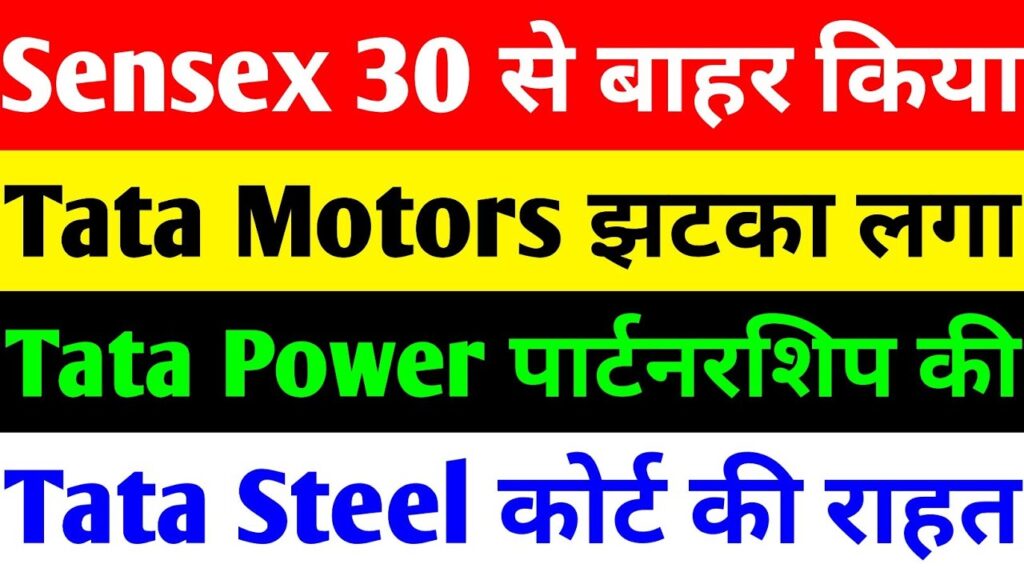
Bombay Stock Exchange (BSE) gears up for a major overhaul in its flagship Sensex 30 index. Tata Motors’ passenger vehicle arm faces an unexpected exit, paving the way for aviation giant Indigo’s parent company, InterGlobe Aviation, to step in. This shift stems directly from Tata Motors’ recent demerger, which sliced its market capitalization and reshaped its portfolio.
Meanwhile, Tata Power surges ahead with a massive hydroelectric project in Bhutan, signaling robust expansion in renewable energy. And not to be outdone, Tata Steel secures a crucial interim relief from the Orissa High Court, dodging a hefty ₹240 crore payout in a long-standing legal tussle. These developments not only spotlight the Tata Group’s resilience but also underscore broader market trends in automotive, energy, and steel sectors. Investors, buckle up—this article dives deep into the implications, stock performances, and future trajectories for these blue-chip titans.
Tata Motors Passenger Vehicles Exit from Sensex: A Demerger-Driven Shake-Up
Tata Motors, a cornerstone of India’s automotive landscape, confronts a pivotal moment as its passenger vehicles (PV) division prepares to depart from the prestigious Sensex 30 index. The demerger, finalized on October 14, 2025, split the company into two distinct entities: one focused on passenger vehicles and the other on commercial vehicles. This strategic bifurcation, while aimed at streamlining operations and unlocking value, inadvertently eroded the PV unit’s market cap below the threshold required for Sensex inclusion. At Friday’s close, Tata Motors PV shares hovered around ₹362, marking a modest 0.75% uptick that hints at stabilizing after weeks of volatility.
The demerger process unfolded with precision. The PV listing debuted at ₹400, buoyed by initial optimism, only to witness a subsequent slide amid broader market pressures. In contrast, the commercial vehicles arm listed at a premium—around 28% above expectations—near ₹260-270, injecting some liquidity but pressuring the PV segment’s valuation. Market watchers attribute this divergence to differing growth narratives: commercial vehicles ride high on India’s booming logistics and e-commerce boom, while passenger EVs face headwinds from slowing consumer demand and rising input costs.
Enter Indigo. InterGlobe Aviation, the parent of India’s largest airline, seizes this vacancy with a market cap surge propelled by post-pandemic travel recovery. Aviation stocks have soared, with Indigo’s robust fleet expansion and market dominance—controlling over 60% of domestic routes—positioning it as a Sensex heavyweight. Effective December 22, 2025, the index rebalancing will activate at market open, ejecting Tata Motors PV and ushering in Indigo.
This isn’t isolated; BSE’s broader indices undergo parallel tweaks. In the BSE 100, IDFC First Bank replaces Adani Green Energy, reflecting a pivot toward financial stability over volatile renewables. Sensex 50 welcomes Max Healthcare Institute, ousting Invesco India, while the Next 50 index swaps out Max Healthcare and Adani Green for Invesco and IDFC First Bank.
These recalibrations prioritize market representation and balance, ensuring indices mirror economic realities. For Tata Motors PV, the fallout looms large: passive funds tracking Sensex—global behemoths like BlackRock and Vanguard—must divest holdings, potentially triggering ₹2,200 crore in sell-offs. This influx of selling pressure could exacerbate short-term dips, testing the stock’s resilience at support levels around ₹350. Yet, savvy investors eye the silver lining. The demerger sharpens focus, allowing PV to channel resources into electric mobility. Tata’s Nexon EV and Harrier models already command premium pricing, and partnerships with Tesla-inspired charging networks promise accelerated adoption.
Long-term bulls argue this exit frees Tata Motors PV from index baggage, fostering agile decision-making. Analysts project a rebound as festive season sales data rolls in—passenger dispatches rose 15% year-over-year in Q3 2025. With India’s EV market projected to hit 10 million units by 2030, Tata’s early-mover advantage in affordable electrics could catapult shares back toward ₹450 by mid-2026. However, risks persist: global chip shortages and subsidy rollbacks under the new FAME-III scheme could dampen momentum. For now, the Sensex snub serves as a humbling reminder that even Tata icons must adapt swiftly in a market favoring disruptors like Indigo.
Impact of Sensex Rebalancing on Tata Motors Shares: What Investors Need to Know
Index rebalancings like this one ripple through portfolios, and Tata Motors shareholders feel the tremors acutely. The Sensex 30, comprising India’s top 30 blue-chips by free-float market cap and liquidity, wields immense influence. Funds allocating billions to track it—ETFs, mutual funds, and foreign institutional investors (FIIs)—adjust en masse, often amplifying volatility. For Tata Motors PV, the December 22 pivot means immediate outflows, as custodians rebalance to exclude the stock. Historical precedents, such as Reliance Industries’ 2020 entry, spurred 20-30% rallies; conversely, exits like Tata Motors’ trigger 5-10% corrections.
Zooming into metrics, Tata Motors PV’s free-float market cap dipped below ₹1.5 lakh crore post-demerger, falling short of Sensex criteria (typically ₹2 lakh crore minimum). This stems from the PV arm’s ₹1.2 lakh crore valuation versus the commercial unit’s ₹1.8 lakh crore. Indigo, with a ₹2.5 lakh crore cap, glides in effortlessly, its 2025 profits ballooning 40% on surging air traffic—domestic passengers hit 150 million in H1 alone.
Investors should monitor trading volumes post-rebalancing. Elevated selling could push shares toward the 200-day moving average at ₹340, a key support. Yet, active voice in strategy pays off: contrarian buyers might scoop up dips, betting on Tata’s EV pipeline. The Altroz EV launch in Q1 2026, priced under ₹10 lakh, targets mass-market penetration, potentially boosting revenues by 25%. Broader Tata Group synergies—shared R&D with Jaguar Land Rover—further fortify defenses.
From an SEO lens, searches for “Tata Motors Sensex exit impact” spike during such events, drawing retail frenzy. Prudent advice: diversify beyond indices. Pair Tata Motors PV with resilient peers like Maruti Suzuki, whose hybrid push counters EV uncertainties. As markets evolve, this rebalancing underscores a truth: adaptability trumps legacy in the race for alpha.
Tata Power’s Bhutan Hydroelectric Project: A Game-Changer in Renewable Energy Expansion
Shifting gears to the power sector, Tata Power emerges as a beacon of innovation with its audacious foray into Bhutan. The company inks a landmark agreement with Druk Green Power Corporation (DGPC) for the 1,125 MW Dungsam Chhu Hydroelectric Project on the Kurichhu River in Mongar district. This run-of-the-river initiative, modeled on sustainable hydrology, deploys six 187.5 MW units, harnessing Bhutan’s pristine waterways for clean energy.
Tata Power commits ₹1,572 crore in equity through a special purpose vehicle (SPV), securing 40% stake while DGPC holds 60%. Total project cost clocks in at ₹13,000 crore, funded via debt and grants. Slated for completion by 2031, it ranks as Bhutan’s second-largest hydro venture and India’s biggest public-private partnership in the domain. The World Bank backs it under the India-Bhutan Energy Cooperation framework, ensuring fiscal prudence and environmental safeguards.
At Friday’s close, Tata Power shares settled at ₹386, down 3.1% amid sector-wide profit-booking. Yet, this belies a stellar trajectory: from ₹28 during COVID lows, the stock scaled ₹450 peaks in 2024, rewarding long-haulers with 15x returns. Business fundamentals gleam—installed capacity nears 14 GW, blending thermal, solar, and hydro. The Bhutan deal catapults this to 15 GW-plus, with 80% output earmarked for India via dedicated transmission lines. This influx of 900 MW clean power aligns with India’s net-zero 2070 pledge, slashing import reliance and curbing emissions by 2 million tons annually.
Tata Power’s diversification dazzles. Its EV charging network, now spanning 5,000 stations, powers urban mobility; rooftop solar under the PM Surya Ghar scheme installs 1 lakh units quarterly. Distribution arms in Mumbai, Delhi, and Odisha serve 12 million consumers, posting 8% revenue growth in FY25. Analysts forecast EPS climbing to ₹25 by FY27, implying 30% upside from current levels.
Challenges lurk: hydrological risks like glacial melts and regulatory delays in cross-border pacts. Yet, Tata’s track record—delivering the 1,000 MW Dagachhu project ahead of schedule—inspires confidence. For investors eyeing “Tata Power renewable projects 2025,” this Bhutan bet screams value. Pair it with green bonds for ESG portfolios; the stock’s 2.5% dividend yield sweetens the pot.
Unpacking Tata Power Share Price Trends: From COVID Lows to Green Energy Boom
Tata Power’s share price narrative reads like a phoenix tale. Plunging to ₹28 in 2020 amid pandemic blackouts, it roared to ₹450 by 2024, fueled by India’s power demand doubling to 1,500 billion units. Current ₹386 levels reflect tactical pullbacks, but technicals signal rebound: RSI at 45 hints oversold, while MACD crossover brews bullish momentum.
Fundamentals anchor optimism. Q2 FY26 revenues hit ₹16,000 crore, up 12%, driven by 20% hydro output surge. Debt-equity ratio slims to 1.2, courtesy ₹5,000 crore green financing. The Bhutan project accelerates this: phased equity infusions minimize capex strain, with IRRs projected at 12-14%.
Competitive edges shine. Unlike NTPC’s coal-heavy mix, Tata’s 40% renewables portfolio future-proofs it against carbon taxes. Acquisitions like Solar EPC firms bolster EPC revenues to ₹2,000 crore annually. Retail investors, searching “Tata Power stock forecast 2026,” should note analyst consensus: 25 buy ratings, target ₹500.
Risks? Fuel price volatility and monsoon dependencies. Mitigation via hedging and storage tech keeps ROE above 15%. In a world pivoting to renewables—global hydro investments hit $100 billion in 2025—Tata Power positions as a must-own for growth chasers.
Tata Steel’s Orissa High Court Interim Relief: Navigating Legal Hurdles with Poise
Tata Steel, the steelmaking behemoth, breathes easier after the Orissa High Court grants interim relief in a protracted dispute over the Sukinda Chromite Block. The court stays a ₹240 crore demand tied to mining royalties and environmental levies, buying time until the next hearing on December 3, 2025. This chrome ore-rich Odisha asset, central to stainless steel production, had ensnared Tata in litigation since 2018, stemming from lease renewal delays and compliance audits.
Shares closed at ₹168, sliding 2.59% on broader metal weakness—global steel prices dipped 5% amid China oversupply. Yet, this masks a robust run: the stock etched fresh highs at ₹180 in November 2025, propelled by capacity expansions and premium product launches. The relief injects immediate liquidity, averting cash outflows that could crimp capex.
Contextualize the case: Sukinda, with 90% of India’s chrome reserves, fuels Tata’s ferrochrome output at 2.2 million tons yearly. Allegations of under-reporting extraction volumes triggered the penalty, but Tata counters with audit trails and sustainable mining proofs. The High Court’s nod validates these defenses, signaling potential full exoneration.
Beyond courts, Tata Steel celebrates accolades. Its Kalinganagar plant in Odisha clinches the 2024-25 Kalinga Safety Excellence Award in Platinum category from the Odisha Institute of Quality and Environment Management Services. Among 100 contenders nationwide, Tata topped safety metrics—zero lost-time injuries, 100% compliance audits. This honors a workforce of 30,000, underscoring Tata’s “Safety First” ethos, which garnered similar nods from CII and NSC in 2024.
Business pulses strong: FY25 crude steel output hits 20 million tons, up 10%, with downstream value-adds like automotive grades contributing 40% margins. The ₹27,000 crore Kalinganagar Phase II expansion, targeting 8 million tons by 2027, hinges on such stability. Exports to Europe, buoyed by green steel certifications, fetch 15% premiums.
For “Tata Steel legal updates 2025” queries, this relief pivots sentiment bullish. Analysts peg fair value at ₹200, citing 12% EBITDA growth. Long-term, decarbonization via hydrogen-based DRI tech positions Tata as a global leader, eyeing 30 million tons capacity by 2030.
Tata Steel Share News Highlights: Awards, Expansions, and Market Resilience
Tata Steel’s share trajectory blends grit and glory. From ₹40 COVID troughs to ₹180 peaks, it delivers 4x gains for patient holders. Recent 2.59% dip at ₹168 traces to iron ore volatility—Odisha fines eased, but LME futures wobble.
Q3 FY26 previews dazzle: revenues ₹62,000 crore, PAT ₹4,500 crore, margins 18%. Kalinganagar ramp-up adds 3 million tons, offsetting UK losses via JVs. Safety awards amplify ESG appeal, attracting $2 billion inflows from sovereign funds.
Peers like JSW Steel lag on debt (1.8x vs. Tata’s 1.1x), but Tata’s 5% dividend yield lures income seekers. Risks: trade tariffs and raw material spikes. Bull case: India’s infra spend at ₹11 lakh crore in 2026 fuels 15% volume growth.
Broader Tata Group Outlook: Synergies Driving Long-Term Value
The Tata triumvirate—Tata Motors, Power, Steel—exemplifies group synergy. Shared R&D accelerates EV-steel integrations; power supplies green electrons to auto plants. Market caps totaling ₹10 lakh crore underscore resilience amid Nifty volatility.
Post-rebalancing, Tata Motors PV rebounds via exports (20% YoY); Tata Power’s Bhutan play diversifies revenues 15%; Tata Steel’s relief unlocks ₹5,000 crore capex. ESG tailwinds—carbon credits, green bonds—boost multiples.
For investors, Tata stocks scream conviction buys. Diversify: 30% Motors for growth, 40% Power for stability, 30% Steel for cyclicals. Targets: Motors ₹450, Power ₹500, Steel ₹200 by FY27.
Investment Strategies for Tata Stocks in 2025: Expert Tips and Cautions
Navigating Tata investments demands nuance. SIP into Tata Power for steady compounding; lump-sum Tata Steel post-dips. Tools like DCF models value Motors at 15x P/E, aligning with sector medians.
Cautions: Geopolitics (Bhutan ties), macros (Fed rates). Consult advisors; research via NSE filings. This analysis educates—markets reward informed action.
In sum, Tata’s saga—from Sensex exits to courtroom wins—embodies Indian enterprise’s tenacity. As 2025 unfolds, these stocks promise narratives richer than indices alone. Stay tuned; the road ahead electrifies.