


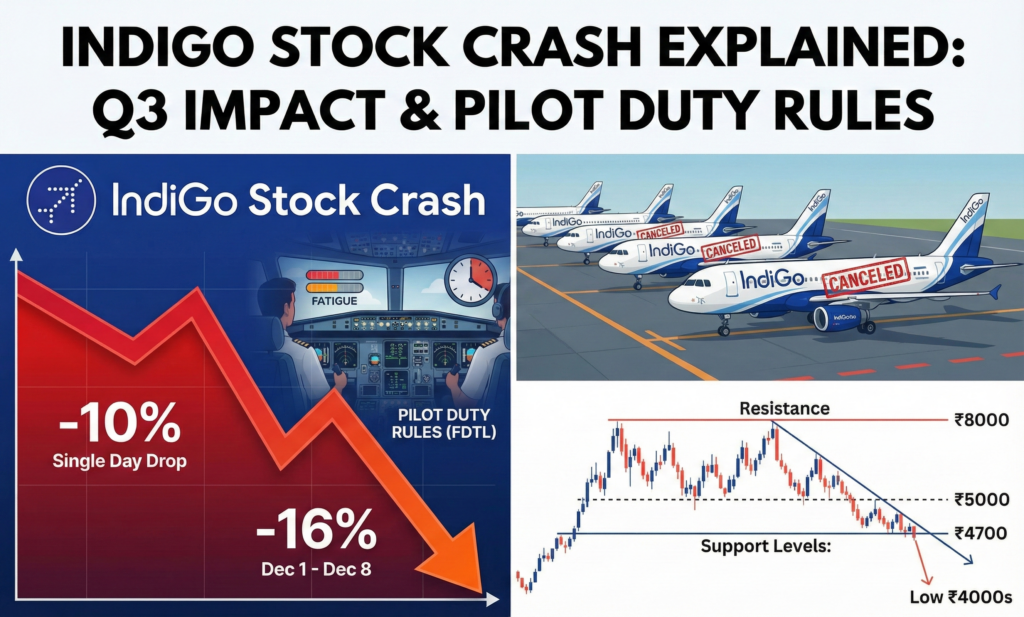
IndiGo’s sharp stock decline in early December has left many investors anxious and confused. The share price fell almost 10% in a single trading session and roughly 16% from 1 December to 8 December, raising urgent questions about what went wrong with India’s largest airline by market share. In this in-depth article, you will understand why the crisis was not sudden, how regulatory changes around pilot work hours triggered large-scale flight cancellations, what this means for IndiGo’s Q3 financial performance, and how the stock’s technical chart levels may guide investors in the coming months. Written with a strong SEO and GEO focus for Indian and global aviation investors, this comprehensive analysis presents the entire story in clear, active-voice English, with fully reworked and original phrasing.
Understanding IndiGo’s Sudden Stock Fall
A Steep Decline That Shocked Investors
In early December, the IndiGo share price experienced a dramatic correction, slipping nearly 10% in just one day of trading. Over the span from 1 December to 8 December, the stock had already lost close to 16% of its value. For a company that commands more than 60% of the Indian aviation market, such a rapid drawdown naturally sparked fear among retail and institutional investors.
Many market participants had been loosely tracking news about IndiGo’s operational disruptions and pilot-related issues. However, the intensity of the stock market reaction led to a widespread perception that something had suddenly gone “terribly wrong” with the airline. In reality, the roots of this crisis stretch back months, tied to regulatory reforms and strategic decisions that gradually built up to a breaking point.
Was IndiGo’s Crisis Really Sudden?
The Role of New Pilot Duty Time Regulations (FDTL)
To understand IndiGo’s troubles, we must start with regulatory changes introduced earlier. In January 2024, new rules on Flight Duty Time Limitations (FDTL) were announced. These rules were designed to address pilot fatigue, which is a critical safety concern in aviation. Fatigued pilots do not just endanger themselves; they also risk the safety of cabin crew and passengers.
Regulators compared global and Indian standards and finally implemented stricter norms to ensure that pilots receive adequate rest, especially during night operations. These rules were not targeted at IndiGo alone; they apply across the Indian aviation sector. However, their practical impact on each airline depends on staffing levels, network design, and operational strategies.
Key Changes in Night-Time and Landing Limits
Several important FDTL modifications reshaped how airlines schedule their pilots and flights:
- The definition of “night time” was extended. Previously, night time was considered from 00:00 to 05:00. Under the new norms, the period was broadened to 00:00 to 06:00.
- Weekly landing limits for pilots were reduced dramatically. Earlier, a pilot could perform up to six landings per week. Under the revised rules, this limit was cut to just two landings per week.
These are only some of the changes, but they illustrate the core idea: pilots must be better rested and less overworked. While perfectly sensible from a safety perspective, these restrictions have far-reaching operational consequences. If pilots are allowed to fly fewer hours or execute fewer landings, airlines need more pilots to maintain the same number of flights.
Implementation Timeline: Not Just a One-Day Shock
Although the regulations were announced in January 2024, they were not enforced immediately at full scale. The pilot association and other stakeholders naturally wanted clarity on the exact implementation dates. Eventually, a phased rollout was communicated:
- Phase 1 implementation: 1 July 2025
- Phase 2 implementation: 1 November 2025
This timeline is crucial. On paper, the rules existed from early 2024, but their full operational impact began to be felt only after the two phases went live. As each phase kicked in, the mismatch between the number of available pilots and the number of scheduled flights grew more acute. This structural gap set the stage for the wave of cancellations and the broader crisis observed in late 2025.
How IndiGo’s Operating Model Increased Its Vulnerability
Lean Staffing: A Strength That Turned into a Weakness
IndiGo is widely known for its lean cost structure and efficient operations. Unlike some industries where companies keep a large “bench” of employees, IndiGo historically did not maintain a big pool of idle pilots waiting to be deployed. Instead, the airline operated with tightly optimized manpower levels to keep costs low and margins healthy.
In normal times, this lean staffing model enhances profitability. However, when new FDTL rules suddenly reduce the hours each pilot can fly, a lean system becomes highly fragile. Without enough pilots in reserve, IndiGo struggled to reconcile the new duty limits with its aggressive flight schedule. What is normally a competitive advantage turned into a major vulnerability.
Why Didn’t IndiGo Hire More Pilots in Time?
A natural question arises: if the rules were announced in January 2024, why did IndiGo not significantly ramp up pilot hiring between that date and the final implementation phases in 2025? After all, most professionals in other industries have a notice period of around 30 days; it might seem logical that airlines could react quickly.
However, pilots typically have a notice period of about six months. Training, certification, and transition between airlines or aircraft types can be lengthy processes. This long lead time required IndiGo to plan well in advance. The scale of disruptions in late 2025 suggests that the airline did not recruit a sufficient number of pilots to fully offset the stricter FDTL constraints.
Increasing Flights Despite a Pilot Shortage
Perhaps the most surprising element in this entire story is that IndiGo actually added more flights for the Winter 2025 schedule. Despite knowing that it had a limited pool of pilots and stricter duty rules, the airline increased its winter schedule by around 900 additional flights.
This decision meant that:
- The number of flights kept climbing.
- Pilot capacity per flight was effectively falling due to tighter rules.
The imbalance between scheduled flights and available, well-rested pilots grew wider. Ultimately, the system reached a breaking point, leading to mass cancellations that captured national attention and triggered investor panic.
IndiGo’s Flight Cancellations: From Cracks to a Full-Blown Fiasco
Early Cracks: July to October 2025
Once Phase 1 of the FDTL norms took effect on 1 July 2025, IndiGo managed to handle its operations, but cracks slowly began to appear. The airline was still able to keep most flights running, but internal pressure on pilot scheduling likely intensified. The mix of limited pilot availability, a growing flight schedule, and stricter rest requirements started to strain the system.
While there were no instant collapses in this period, the stress in the operating model was steadily building. By the time Phase 2 arrived in November 2025, IndiGo’s room for error had narrowed dramatically.
November 2025: Cancellations Begin to Surge
The real pain began in November 2025, when second-phase implementation of the FDTL rules came into force. IndiGo had to deal with both phases in effect, and the pilot-to-flight ratio became highly unfavorable.
In November alone, around 1,232 flights were cancelled, largely due to the new rest rules and the imbalance between the number of pilots and the airline’s ambitious flight schedule. These cancellations disrupted passengers, strained brand perception, and hinted that a larger crisis might be brewing if corrective action was not taken.
December 2025: A Dark Chapter in Indian Aviation
The situation escalated dramatically in December. From 2 December to 4 December, cancellations continued to climb, and operational issues were compounded by reports of technical glitches. But the most damaging blow came on 5 December 2025, which is now regarded as one of the worst days in Indian aviation history in terms of disruptions.
On that single day, more than 1,000 flights were cancelled. For a carrier that holds over 60% market share, this was not just IndiGo’s problem; it impacted the entire movement of people across the country. Passengers were stranded, airports were overwhelmed, and public sentiment turned sharply negative.
This chain of events—underpinned by regulatory changes, staffing shortages, and aggressive scheduling—formed the backdrop for the sharp correction in IndiGo’s share price in early December.
IndiGo’s Operational Metrics During the Crisis
IndiGo’s Typical Flight Volume Versus Crisis Levels
To understand the scale of disruption, it is important to compare IndiGo’s normal operations with its performance during the crisis period:
- Under typical conditions, IndiGo operates 400-plus aircraft executing around 2,300 flights per day.
- In early December, the airline issued press releases explaining how the number of daily flights temporarily fell to around 1,650 flights per day.
Let us look at three important dates and figures:
- 5 December: More than 1,000 flights cancelled in a single day.
- 6 December: IndiGo reported that it had managed to increase operations to roughly 1,500 flights.
- 7 December: The airline claimed it had operated 1,650-plus flights, and indicated that operations would stabilize by about 10 December.
From a passenger and policy perspective, the key concern was whether these disruptions were a short-term shock or a sign of deeper structural issues. From an investor perspective, the immediate focus shifted to how such cancellations would affect Q3 financial results.
How Will IndiGo’s Q3 Results Be Affected?
Estimating the Impact on Revenue
To gauge the possible impact on Q3 (third quarter) results, we can perform an approximate, high-level calculation using simple assumptions rather than complex financial modeling.
IndiGo typically operates about 2,300 flights per day. Over a 90-day quarter, that amounts to: 2,300 flights/day×90 days=207,000 flights in a quarter (approximately)
According to the rough estimates discussed, around 5,000 flights were cancelled within the quarter due to these disruptions. Now consider that for the previous comparable quarter (Q3 of the prior year), IndiGo had roughly the same number of total flights (about 207,000 flights), and generated a top-line revenue figure that we will call baseline Q3 revenue.
If we simply remove 5,000 flights from a total of around 207,000, the cancellation share is relatively small. When translated into revenue, the decline appears to be in the range of 2–3%, or at most 2–4%, assuming no significant increase in average ticket prices. If IndiGo manages to raise fares or improve yields, the revenue drop could be cushioned even further and might be negligible.
Thus, even under a conservative assumption, the Q3 revenue decline due to cancellations might remain in the low single digits—likely between 2% and 4% at worst, assuming no pricing adjustments.
Why Profitability May Suffer More Than Revenue
While the revenue impact seems modest at first glance, profitability is likely to face a much sharper hit. This is where operating leverage comes into play.
IndiGo, like most airlines, incurs substantial fixed costs, such as:
- Aircraft lease rentals
- Hangar and parking fees
- Salaries of crew and ground staff
- Maintenance infrastructure
- Overheads for operations and administration
When revenue drops even slightly, these fixed costs do not automatically fall in proportion. The company still has to pay salaries, lease charges, and airport-related fees regardless of how many flights it cancels. As a result, a small fall in revenue can lead to a larger percentage drop in operating profit or net profit.
In simple terms:
- A 2–4% decline in revenue might translate into a much steeper decline in profit, due to fixed costs remaining constant.
- The more cancellations occur while fixed costs stay unchanged, the more profitability gets “negatively magnified.”
Therefore, while the top line might show only a mild dip, the bottom line for Q3 could look significantly weaker than Q3 of the previous year. This prospect likely contributed to the negative sentiment and intense selling pressure in IndiGo’s stock.
Profitability and Operating Leverage: The Real Danger
The true financial danger lies not in lost revenue, but in retained costs. Airlines are a high-fixed-cost business. Regardless of whether a plane takes off, the airline must pay:
- Hangar and parking fees.
- Lease rentals for the aircraft.
- Salaries for the crew and ground staff.
- Administrative overheads.
Understanding Operating Leverage: Operating leverage acts as a magnifier. When revenue rises, profits rise disproportionately fast because fixed costs stay the same. Conversely, when revenue falls, profits crash disproportionately hard because those high fixed costs must still be paid.
In Indigo’s case, they are not only losing the revenue from the cancelled flights, but they also incur:
- Refund Liabilities: Cash outflow to passengers.
- Compensation Costs: Penalties for last-minute cancellations.
- Wasted Fixed Costs: Paying for pilots and planes that are sitting idle.
Compensation, Refunds, and Additional Costs
On top of the lost revenue and fixed costs, IndiGo must deal with:
- Passenger refunds and rebooking expenses.
- Possible compensation or vouchers.
- Additional crew positioning, hotel, and disruption-related costs.
All these factors weigh further on profitability and dent investor confidence, especially when they occur in a cluster over a short period. The stock market, being forward-looking, started pricing in these anticipated pressures, leading to the sharp correction in early December.
Technical Analysis of IndiGo’s Stock: Key Price Levels to Watch
Swing Highs Turning into Support Levels
From a technical analysis perspective, certain price zones on IndiGo’s chart have historically acted as resistance and later converted into support once the stock broke above them.
The key concept is:
- A previous swing high, once decisively broken to the upside, often becomes a support level when the price later declines.
On IndiGo’s chart, one such important level is around ₹5,000. In earlier periods, this zone acted as a resistance barrier where rallies would stall. When the stock finally broke through, that region turned into a strong support area.
The technical question now is whether the recent decline has caused the price to break below this ₹5,000 support or whether the stock is still holding above it. If this support is intact, it may serve as a base for a potential recovery once the panic subsides. If it has been broken decisively, the next lower levels become more relevant.
Watching the ₹4,700 Level
Another notable swing high–turned–support level lies around ₹4,700. The stock has interacted with this zone multiple times in the past, using it as resistance initially and then as support after rallies.
From a medium-term technical standpoint, traders and investors may monitor the ₹4,700 area closely, especially if ₹5,000 fails to hold. This level can act as a secondary support where buyers might step in, assuming overall fundamentals remain intact and operational issues show signs of stabilization.
Trendline Support from Joined Lows
Beyond horizontal price levels, technical analysts often draw trendlines by connecting previous lows. By joining multiple low points on IndiGo’s chart and extending that line forward, one can estimate a dynamic support region.
At a past cursor date, such a trendline might have passed near ₹4,300, though the exact value at the current date would change depending on how the line extends. This trendline can function as a deeper, more long-term support zone.
To apply this practically, one should:
- Plot the chart with historical lows.
- Draw a line connecting these lows.
- Extend that line to the current period to see where the approximate price support lies now.
If prices approach this trendline during panic-driven selling, technically oriented investors may reassess risk–reward and judge whether the long-term uptrend is still intact.
Regulatory Lag in Charts and Data
One important point for retail investors: charts available on many platforms may show data with a lag, sometimes up to three months, depending on regulatory guidelines and data dissemination rules. Therefore, a steep fall that happened very recently may not be fully visible on some publicly available charts yet.
Investors must rely on updated platforms and cross-check real-time prices to make sure they are not basing decisions on stale data. Technical analysis is a powerful tool, but it must be applied on current, accurate charts.
Investor Takeaways: Is IndiGo’s Pain Temporary or Structural?
Short-Term Pain Versus Long-Term Franchise Strength
The situation at IndiGo is undoubtedly painful in the short term—for passengers, employees, and shareholders. However, the root trigger is a structural regulatory change aimed at improving long-term safety through better-managed pilot fatigue. Over time, once airlines adjust their staffing, scheduling, and systems to the new norms, operations should stabilize.
IndiGo still retains its structural advantages:
- A strong national network and leading market share.
- Experience in low-cost, efficient operations.
- Brand recognition and a wide customer base.
The current crisis stems from under-preparation and aggressive scheduling in the face of stricter FDTL norms, not from a collapse of its business model. With careful recalibration—hiring more pilots, rationalizing schedules, and improving planning—IndiGo has the potential to restore normal operations.
What Q3 Numbers Might Signal
Based on the simple estimations discussed earlier, the market is likely to see:
- A limited revenue decline in Q3, possibly in the range of 2–4%, assuming no major fare hike.
- A larger hit to profitability, driven by fixed costs, refunds, and disruption-related expenses.
If IndiGo communicates clearly about corrective steps, hiring plans, and schedule rationalization, investors may begin to look beyond the one-quarter impact and focus on medium- to long-term growth. On the other hand, if disruptions continue beyond the near term without a clear roadmap, sentiment could remain fragile.
Technical Levels as Sentiment Barometers
From a chart perspective, the key zones to track are:
- ₹5,000: A major support derived from a former resistance level.
- ₹4,700: A secondary support from another swing high turned support.
- Trendline support around the low-₹4,000s: A dynamic, longer-term line formed by connecting previous lows.
If these supports are respected and the airline demonstrates operational stability, the stock could gradually recover from oversold levels. If they are broken decisively with heavy volumes and persistent negative news, further downside cannot be ruled out.
Conclusion
IndiGo’s sharp stock fall in early December was not an overnight accident but the result of a series of regulatory and strategic developments. Stricter Flight Duty Time Limitation rules, designed to reduce pilot fatigue and enhance safety, demanded more pilots per flight schedule. IndiGo, operating with a lean staffing model, did not fully ramp up pilot hiring in time and simultaneously increased its flights for the Winter 2025 season. The resulting imbalance triggered large-scale flight cancellations, culminating in over 1,000 cancellations on a single day—5 December 2025—one of the most disruptive days in Indian aviation.
Financially, the impact on Q3 revenue may be limited to a low single-digit decline, but profitability is likely to suffer more due to fixed costs, refunds, and additional disruption-related expenses. Operating leverage, which usually boosts profits when volumes rise, works in reverse when volumes fall but fixed costs stay constant. This profitability shock, more than the modest revenue decline, is what the market appears to be pricing in.
Technically, investors should watch whether the stock holds key levels around ₹5,000 and ₹4,700, along with a broader trendline support in the low-₹4,000 range. Breaches of these supports could signal deeper pessimism, while successful tests may indicate potential stabilization.
Ultimately, just as a temporary physical ailment heals with time and proper care, IndiGo’s current crisis can also be resolved if management takes decisive steps: adjusting schedules, hiring adequate pilots, and aligning operations to the new regulatory reality. For long-term investors, the challenge is to separate short-term turbulence from the airline’s underlying franchise strength and to make informed decisions based on both fundamentals and technicals—rather than pure fear driven by headlines.