


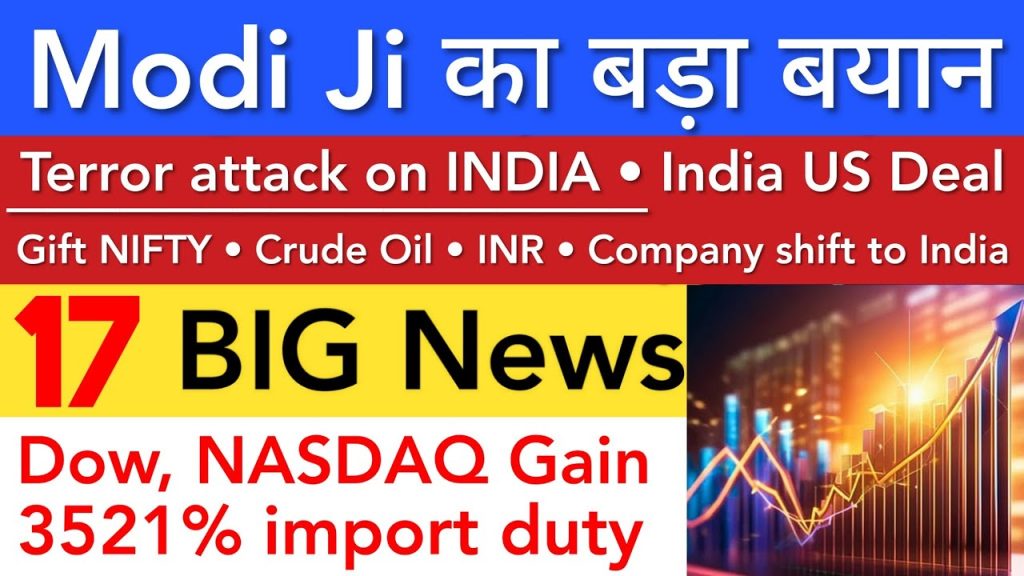
India’s stock market is soaring, with the Nifty 50 and Bank Nifty hitting remarkable levels in April 2025. Investors are buzzing with optimism, fueled by strong market sentiment, strategic global trade deals, and robust economic data. This comprehensive guide dives into the latest market trends, expert analyses, and geopolitical developments shaping India’s financial landscape. From Prime Minister Modi’s bold international moves to technical market patterns, we uncover what’s driving the market and what to expect next. Whether you’re a seasoned investor or a curious beginner, this article equips you with actionable insights to navigate the dynamic Indian stock market.
Why India’s Stock Market is Thriving in April 2025
India’s stock market is experiencing a historic rally, with the Nifty 50 consistently holding above 24,000 and the Bank Nifty nearing record highs. This upward trajectory reflects a confluence of domestic resilience, global trade opportunities, and strategic policy moves. Analysts are optimistic, citing strong support levels and favorable macroeconomic data as key drivers. Let’s explore the factors propelling this growth and what lies ahead for investors.
Nifty 50’s Stellar Performance: A Technical Breakdown
The Nifty 50, India’s benchmark index, closed at 24,167 on April 2, 2025, with a modest gain of 0.17%. This marks a significant milestone, as the index has held above the critical 24,000 level for two consecutive days. Analysts from LKP Securities highlight 24,000 as a newly established support level, up from the previous 23,850. Meanwhile, a resistance zone looms at 24,500, presenting the next hurdle for bullish investors.
Technical analysts point to a Doji-like candlestick pattern on the charts, signaling potential consolidation. This pattern suggests the market may pause to digest recent gains before its next move. For traders, the immediate focus is on whether the Nifty 50 can breach the 24,250 resistance, a level that has historically posed challenges, as seen in January 2025. A breakout above this could propel the index toward 24,500, while a drop below 24,000 might test support at 23,850.
Bank Nifty’s Overbought Rally: Opportunities and Risks
The Bank Nifty index, a barometer of India’s banking sector, has been a standout performer, touching an intraday high near 56,000. However, analysts warn that the index is in overbought territory, as indicated by the Relative Strength Index (RSI). This suggests that sustaining these levels could be challenging without a healthy correction. The index closed slightly below its peak, raising questions about its ability to maintain momentum.
For tomorrow’s session, key levels to watch include:
- Support: 55,000, a critical floor for the index.
- Resistance: 56,000, where the index has faced selling pressure.
Given the upcoming monthly expiry on Thursday, volatility may spike, urging traders to exercise caution. Investors should monitor banking stocks like HDFC Bank and ICICI Bank, which have shown resilience with their American Depository Receipts (ADRs) gaining approximately 1.5% in U.S. trading.
Global Trade Dynamics: India’s Strategic Advantage
India’s stock market isn’t thriving in isolation; it’s capitalizing on global economic shifts. Prime Minister Narendra Modi’s recent diplomatic engagements and trade agreements are positioning India as a powerhouse in international markets. Let’s unpack the key developments driving investor confidence.
Modi’s Saudi Arabia Deal: A Game-Changer for Energy Stocks
During his visit to Saudi Arabia, Prime Minister Modi announced a landmark deal to explore a joint refinery and petrochemical project. This agreement is a boon for India’s energy sector, particularly for companies like Reliance Industries, HPCL, BPCL, and IOCL. Analysts predict that this deal will enhance India’s energy security and boost the profitability of oil and gas companies. For investors, stocks in the oil and petrochemical space are poised for significant gains, making them a focal point in portfolios.
Defying China’s Threats: India’s Bold Trade Moves
China recently issued warnings to nations engaging in trade deals with the United States, indirectly targeting India. Undeterred, India finalized a trade agreement with the U.S., strengthening economic ties and signaling its independence in global trade. This move aligns with India’s broader strategy to capitalize on the U.S.-China trade war, attracting companies shifting manufacturing from China to India.
The Production Linked Incentive (PLI) scheme is a key driver here, encouraging global firms, including Chinese companies, to set up operations in India. Sectors like electronics manufacturing services (EMS) are expected to benefit significantly, with companies like Dixon Technologies and Amber Enterprises emerging as potential winners. This shift not only boosts India’s economy but also enhances its appeal as a global investment destination.
U.S. Tariff Shock and India’s Resilience
The global markets faced turbulence following U.S. tariff announcements in early April 2025. However, India’s stock market defied the downturn, surpassing previous highs and setting new records. Analysts attribute this resilience to India’s diversified economy and strategic trade policies. Unlike other emerging markets, India’s indices have not only recovered but are charting new territory, underscoring the country’s growing influence in global finance.
Economic Data Fueling Optimism
India’s macroeconomic indicators are painting a positive picture, further bolstering market sentiment. Here’s a closer look at the data driving investor confidence.
RBI’s Liquidity Push and Banking Sector Rally
The Reserve Bank of India (RBI), under Governor Sanjay Malhotra, has injected liquidity into the banking system, sparking a rally in banking stocks. This move, coupled with expectations of potential rate cuts, has fueled optimism. Key data points include:
- CPI and WPI Data: Inflation metrics are trending favorably, supporting expectations of monetary easing.
- Core Growth Data: Robust economic activity signals sustained growth.
These factors suggest that the RBI may adopt a more accommodative stance, benefiting sectors like banking and real estate.
IMF’s Growth Forecast: A Balanced Outlook
The International Monetary Fund (IMF) recently revised India’s growth forecast for FY26 to 6.2%, a slight downgrade but still among the highest globally. This projection reflects India’s ability to navigate global uncertainties, from trade wars to geopolitical tensions. The RBI echoes this sentiment, noting that global challenges present opportunities for India to strengthen its economic position.
Rising Rupee Valuation
The Indian rupee continues to strengthen against the U.S. dollar, moving from 85.4 to 85.15 in a single day. This appreciation enhances India’s purchasing power and makes Indian assets more attractive to foreign investors. A stronger rupee also supports sectors reliant on imports, such as technology and pharmaceuticals.
Geopolitical Risks: A Sobering Reminder
While India’s economic outlook is bright, geopolitical risks pose challenges that could impact market sentiment. A tragic terrorist attack in Pahalgam, Jammu & Kashmir, claimed over 28 lives, including foreign tourists, on April 2, 2025. This incident has drawn condemnation from Prime Minister Modi and Home Minister Amit Shah, who vowed swift action.
The attack could have short-term implications for the market, particularly if international media coverage amplifies the incident. Investors should monitor developments, as any decisive response from the Indian government could influence sectors like defense and tourism. Historically, such events have triggered temporary market dips, but India’s long-term growth story remains intact.
Global Market Cues: What to Watch
Global markets are sending mixed signals, and their performance will influence India’s opening on April 3, 2025. Here’s a snapshot of key indicators:
- U.S. Markets: The Dow Jones Industrial Average rose 2.55%, and the NASDAQ gained 3.14%, signaling a recovery from recent declines. A strong U.S. close could lead to a gap-up opening for Indian indices.
- Gift Nifty: Trading at 24,350, approximately 180 points above the Nifty 50’s close, Gift Nifty suggests a positive start.
- U.S. 10-Year Bond Yields and Dollar Index: Both have weakened slightly, supporting emerging markets like India.
- Brent Crude: Prices rose 2.5%, potentially benefiting India’s energy stocks.
Indian IT stocks, including Wipro and Infosys, saw their ADRs gain 1.47% and 1.5%, respectively, in U.S. trading. This bodes well for the IT sector, which could see a recovery in the coming sessions.
Sectoral Opportunities: Where to Invest
With the market at a pivotal juncture, certain sectors are primed for growth. Here’s a breakdown of opportunities:
- Energy: The Saudi deal and rising crude prices make Reliance Industries, HPCL, and BPCL attractive picks.
- Banking: Despite overbought conditions, HDFC Bank and ICICI Bank remain strong due to RBI’s liquidity measures.
- IT: Wipro and Infosys are showing signs of recovery, driven by global tech demand.
- Electronics Manufacturing: The PLI scheme positions companies like Dixon Technologies for long-term growth.
Investors should also keep an eye on defense stocks, as government action following the Pahalgam attack could drive interest in companies like Bharat Dynamics and HAL.
Trading Strategies for April 3, 2025
With the Nifty 50 and Bank Nifty at critical levels, traders need a disciplined approach. Here are some strategies:
- Intraday Trading: Focus on stocks with strong momentum, like HDFC Bank and Reliance Industries, but avoid overleveraging due to potential volatility.
- Swing Trading: Target stocks near support levels, such as 24,000 for the Nifty 50, for potential breakouts.
- Options Trading: With monthly expiry approaching, avoid aggressive call/put buying and opt for hedged strategies like spreads.
Analysts advise against excessive risk in F&O trading, given the market’s uncertainty and overbought conditions.
Long-Term Outlook: Why India Remains a Top Investment Destination
India’s stock market is not just a short-term success story; it’s a long-term growth engine. The country’s strategic trade policies, robust economic data, and ability to navigate global challenges make it a standout among emerging markets. As U.S.-China tensions persist, India is emerging as a preferred manufacturing hub, attracting foreign investment and boosting domestic industries.
The government’s focus on infrastructure, digitalization, and renewable energy further enhances India’s appeal. For investors, this translates to opportunities across sectors, from traditional banking to cutting-edge technology. While short-term volatility is inevitable, India’s structural growth story remains compelling.
Conclusion: Seize the Moment in India’s Bull Market
India’s stock market is at a defining moment in April 2025, driven by strong fundamentals, global trade wins, and resilient investor sentiment. The Nifty 50’s hold above 24,000, coupled with the Bank Nifty’s record-breaking run, signals a market ripe with opportunities. However, traders must navigate overbought conditions, geopolitical risks, and upcoming expiries with caution.
By focusing on key sectors like energy, banking, and electronics, and leveraging technical levels like 24,250 and 56,000, investors can position themselves for success. Prime Minister Modi’s bold trade moves and India’s economic resilience underscore its potential as a global investment powerhouse. Stay informed, trade smart, and capitalize on India’s unstoppable rise.