


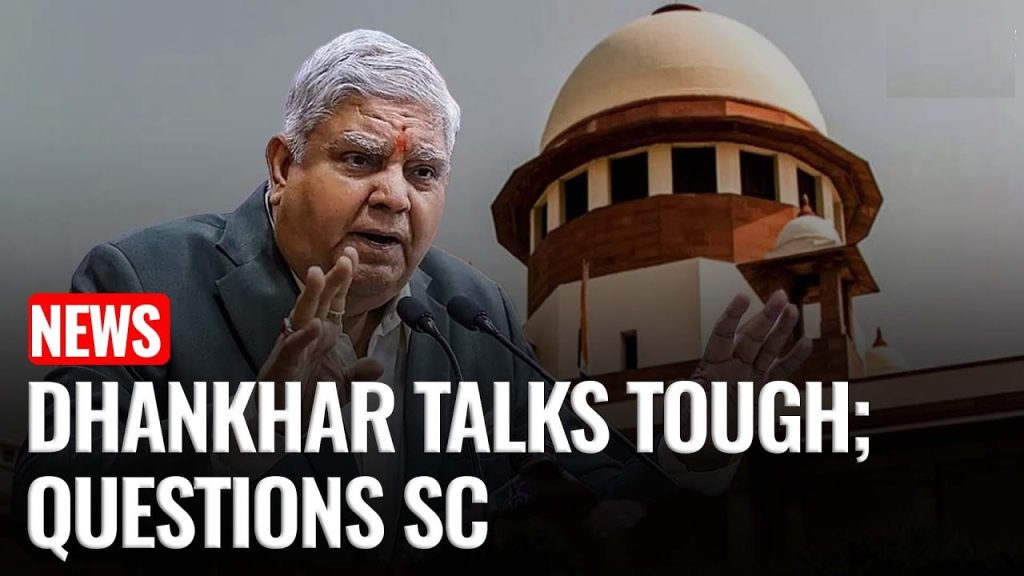
The recent speech by India’s Vice President Jagdeep Dhankhar on April 17, 2025, has ignited a nationwide debate about the powers of the Supreme Court, particularly its use of Article 142, and the roles of constitutional figures like the President, Vice President, and Governors. Dhankhar’s remarks, describing Article 142 as a “nuclear missile” wielded by the judiciary, have raised critical questions about the balance of power in India’s democracy. This article explores the controversy, dissects the constitutional provisions at play, and analyzes the implications of Dhankhar’s statements, offering a comprehensive perspective for readers seeking clarity on this complex issue.
Understanding Article 142: The Supreme Court’s Unique Power
Article 142 of the Indian Constitution grants the Supreme Court extraordinary powers to deliver justice in cases where existing legal frameworks may fall short. This provision allows the court to issue orders or judgments that ensure “complete justice,” even if such actions go beyond the strict letter of the law. While this power has been instrumental in landmark cases, its application has sparked debates about judicial overreach.
The Scope of Article 142
Article 142 empowers the Supreme Court to act unilaterally when justice demands it. For instance, in the historic Ayodhya verdict, the court used this provision to allocate five acres of land to the Sunni Waqf Board, aiming to balance competing interests and resolve India’s longest-running land dispute. Similarly, in environmental cases like the Hyderabad Central University verdict, the court invoked Article 142 to halt deforestation, demonstrating its ability to address urgent public interest issues.
Why Article 142 Matters
The flexibility of Article 142 allows the judiciary to adapt to unique circumstances, ensuring justice in situations where rigid legal provisions might fail. However, critics, including Vice President Dhankhar, argue that its unchecked use risks undermining democratic principles by allowing the judiciary to override legislative and executive authority.
Jagdeep Dhankhar’s Critique: A Call for Judicial Restraint
As Vice President and Chairman of the Rajya Sabha, Jagdeep Dhankhar’s speech on April 17, 2025, highlighted concerns about the Supreme Court’s application of Article 142. A former lawyer himself, Dhankhar’s remarks carry weight, reflecting his deep understanding of constitutional law.
Article 142 as a “Nuclear Missile”
Dhankhar described Article 142 as a “nuclear missile” available to the judiciary “24/7,” suggesting that its frequent use threatens democratic forces. He argued that the provision allows the Supreme Court to act as a “super parliament,” overriding laws passed by elected representatives without sufficient accountability.
Violation of Article 145(3)
Dhankhar also pointed out that Article 145(3) mandates a minimum of five judges for significant constitutional cases. He criticized recent judgments, such as the Tamil Nadu case, where smaller benches issued key rulings, potentially violating this requirement. He further noted that when Article 145(3) was framed, the Supreme Court had only eight judges, making five a majority. With the court now comprising 30 judges, Dhankhar questioned whether a five-judge bench still constitutes a majority for major decisions.
The Need for Accountability
Dhankhar emphasized that unchecked judicial power risks creating a system where Supreme Court judgments cannot be questioned, even if flawed. He argued that while the judiciary exists to oversee laws and protect fundamental rights, it should not encroach on the roles of the legislature or executive, which are separate pillars of democracy.
The Tamil Nadu Case: A Catalyst for Controversy
Dhankhar’s remarks were partly inspired by a recent Supreme Court judgment in a case involving the Tamil Nadu state government and Governor R.N. Ravi. This case exemplifies the tensions between constitutional authorities and the judiciary’s role in resolving disputes.
Background of the Tamil Nadu Dispute
Between January 2020 and April 2023, the Tamil Nadu Assembly passed 12 bills, including those related to state university governance. These bills proposed that the state government, rather than the Governor, appoint vice-chancellors for universities. Governor R.N. Ravi, a former IPS officer and National Security Advisor, withheld assent to 10 of these bills, citing constitutional concerns, and referred two to the President.
The Supreme Court’s Intervention
Frustrated by the delay, the Tamil Nadu government filed a writ petition in the Supreme Court on October 31, 2023. The court, in a bench led by Justices R. Mahadevan and J.B. Pardiwala, ruled on April 8, 2025, that the Governor’s withholding of assent was “arbitrary.” Invoking Article 142, the court ordered the implementation of the 10 bills through a gazette notification, effectively bypassing the Governor’s veto power.
Implications of the Ruling
This landmark judgment has far-reaching consequences. It sets a precedent that could influence how Governors in other states, such as West Bengal or Kerala, handle bills. Critics argue that the ruling undermines the constitutional powers of Governors and the President, as outlined in Articles 200 and 201, which allow them to withhold assent or refer bills for reconsideration.
Constitutional Powers: President, Governor, and Judiciary
To fully grasp the controversy, it’s essential to understand the roles and powers of key constitutional figures as defined by the Indian Constitution.
The President’s Role
Under Article 74, the President acts on the advice of the Union Cabinet, led by the Prime Minister. The President appoints Governors (Article 155) and can reserve bills for consideration (Article 201). However, the Supreme Court’s Tamil Nadu ruling effectively bypassed the President’s authority, raising questions about the balance of power.
The Governor’s Authority
Governors, appointed by the President, serve as the central government’s representatives in states. Article 200 allows Governors to assent to bills, withhold assent, or reserve them for the President’s consideration. Critics argue that Governors, like R.N. Ravi, sometimes use “pocket vetoes” to delay bills indefinitely, frustrating state governments.
The Judiciary’s Oversight
The judiciary, particularly the Supreme Court, acts as the guardian of the Constitution. Article 142 empowers it to deliver justice, while Article 145(3) ensures significant cases are heard by larger benches. Dhankhar’s critique focuses on the judiciary’s potential overreach, particularly when smaller benches issue major rulings.
Political Reactions: A Divided Response
Dhankhar’s speech has elicited strong reactions from political leaders and legal experts, reflecting the polarized nature of the debate.
Opposition Criticism
- Congress Leader Randeep Singh Surjewala: Praised the Supreme Court’s Tamil Nadu ruling, arguing that Governors’ delays hinder state development. He accused Dhankhar of undermining the judiciary’s authority.
- TMC MP Kalyan Banerjee: Called Dhankhar’s remarks “contempt of court” and demanded his resignation, labeling his statements as “highly objectionable.”
- DMK MP Tiruchi Siva: Described Dhankhar’s critique as “unethical,” defending Article 142 as a necessary tool to address legal loopholes exploited by Governors.
Support for Dhankhar
- Senior Advocate Mahesh Jethmalani: Argued that the Supreme Court overstepped by overriding bills sent to the President, questioning the legality of the Tamil Nadu ruling.
- BJP Spokesperson Shahzad Poonawala: Accused critics of hypocrisy, noting that the same parties now defending Article 142 opposed its use in cases like Ayodhya when it didn’t suit their interests.
- Kerala Governor Rajendra Vishwanath: Questioned the court’s imposition of deadlines on Governors’ constitutional powers, supporting Dhankhar’s call for restraint.
The Broader Implications for Indian Democracy
Dhankhar’s speech and the Tamil Nadu ruling highlight a critical tension in India’s democratic framework: the balance between judicial activism and the separation of powers.
Judicial Activism vs. Overreach
Article 142 has been a cornerstone of judicial activism, enabling the Supreme Court to address pressing issues like environmental protection and human rights. However, its frequent use raises concerns about overreach, particularly when it overrides elected bodies’ decisions.
The Role of Governors
The Tamil Nadu case underscores ongoing conflicts between state governments and Governors, often seen as agents of the central government. The Supreme Court’s intervention may curb Governors’ ability to delay bills, but it also risks diminishing their constitutional role.
Amending Constitutional Provisions
Dhankhar’s call for amending Article 145(3) to reflect the Supreme Court’s expanded bench size has sparked debate. A larger bench requirement could ensure broader consensus in major rulings but may slow down judicial processes.
Case Studies: Article 142 in Action
To illustrate the power and controversy of Article 142, let’s examine its application in key cases:
The Ayodhya Verdict (2019)
The Supreme Court’s ruling allocated the disputed land to Lord Ram’s trust while granting alternative land to the Sunni Waqf Board. Article 142 ensured a balanced resolution, but critics argued it set a precedent for judicial intervention in sensitive religious disputes.
Hyderabad Central University Case (2023)
The court used Article 142 to halt deforestation on university land, acting suo motu to protect the environment. This decision was widely praised, including by leaders like K.T. Rama Rao, but it reinforced concerns about the judiciary’s expansive powers.
Unnao Rape Case (2017)
Article 142 enabled the Supreme Court to transfer the case to Delhi and expedite justice, showcasing its ability to address systemic failures. However, such interventions fuel debates about judicial consistency.
The Path Forward: Balancing Power and Justice
The controversy surrounding Article 142 and Dhankhar’s speech underscores the need for a nuanced approach to constitutional governance.
Strengthening Judicial Accountability
To address concerns about unchecked power, the judiciary could establish clearer guidelines for Article 142’s use, ensuring it aligns with democratic principles. Larger benches for significant cases, as Dhankhar suggests, could enhance legitimacy.
Reforming Governor-State Relations
The Tamil Nadu case highlights the need for clearer protocols governing Governors’ interactions with state governments. Time limits for bill assent or referral could prevent undue delays while preserving constitutional checks.
Encouraging Public Discourse
Dhankhar’s speech has opened a vital conversation about democracy’s pillars. Public forums, like those on social media, can foster healthy debates, allowing citizens to engage with complex constitutional issues.
Conclusion: Navigating India’s Constitutional Landscape
Jagdeep Dhankhar’s critique of the Supreme Court’s use of Article 142 has sparked a pivotal debate about the balance of power in India’s democracy. While the judiciary’s ability to deliver justice through Article 142 is undeniable, its application must respect the roles of the legislature and executive. The Tamil Nadu case, with its far-reaching implications, underscores the need for clarity in constitutional roles, from Governors to the President.
As India navigates this complex landscape, citizens must engage with these issues, understanding the powers that shape their democracy. Whether you view Article 142 as a vital tool for justice or a potential threat to democratic checks, the conversation is far from over. Share your thoughts in the comments below, and let’s foster a healthy discussion about the future of India’s constitutional framework.
Multiple Choice Question: Which schedule of the Indian Constitution contains provisions related to anti-defection laws?
A) First Schedule
B) Second Schedule
C) Fourth Schedule
D) Tenth Schedule
Post your answer in the comments, and let’s continue this knowledge-sharing journey together!