


In a historic development, India Pakistan Stoppage of fire Agreement, marking a significant step toward de-escalating tensions along their shared border. Announced on May 10, 2025, this decision follows intense diplomatic and military engagements, with both nations committing to halt all firing and military actions across land, air, and sea. This article delves into the intricacies of the ceasefire, its implications for South Asian geopolitics, and the diplomatic nuances shaping this pivotal moment.
India Pakistan Stoppage of fire Agreement: A Diplomatic Breakthrough
The ceasefire agreement was formalized after a critical phone call between the Directors General of Military Operations (DGMOs) of India and Pakistan at 15:35 hours on May 10, 2025. Both sides agreed to cease all military actions effective from 17:00 hours Indian Standard Time on the same day. India’s Ministry of External Affairs officially confirmed the development, with the Foreign Secretary emphasizing the mutual commitment to halting hostilities.
This announcement comes after months of heightened tensions, including cross-border skirmishes and military posturing. The agreement stipulates that both nations’ military leadership will reconvene on May 12, 2025, at 12:00 hours to discuss further steps, signaling a structured approach to sustaining the truce.
Key Details of the Stoppage of fire Agreement
- Effective Immediately: The ceasefire took effect at 17:00 hours IST on May 10, 2025, covering all domains—land, air, and sea.
- Bilateral Commitment: Instructions have been issued to military units on both sides to ensure compliance with the agreement.
- Follow-Up Talks: Scheduled discussions between the DGMOs on May 12 aim to solidify the ceasefire and address operational concerns.
The Role of U.S. Mediation: Fact or Fiction?
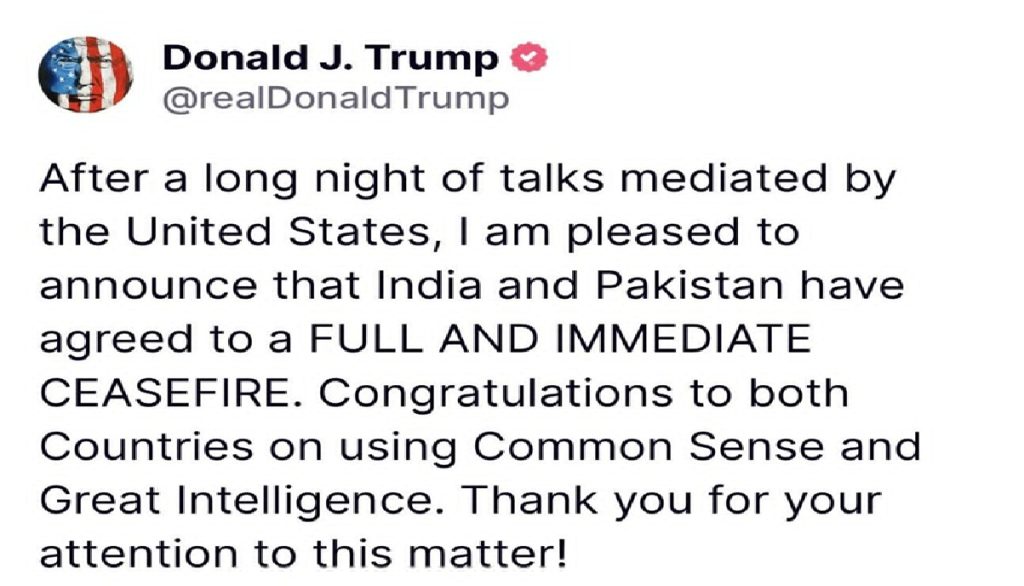
A notable aspect of the ceasefire announcement was former U.S. President Donald Trump’s claim of American mediation. In a post on Truth Social, Trump stated that India and Pakistan had agreed to a “full and immediate ceasefire” under U.S. facilitation. He underscored America’s role in brokering the deal, a narrative echoed by U.S. Secretary of State Mark Rubio, who detailed extensive discussions with Indian and Pakistani leaders, including Prime Minister Narendra Modi, Pakistan’s Prime Minister, and military officials.
However, India’s official statement conspicuously omitted any mention of U.S. involvement. The Foreign Secretary’s announcement focused solely on the bilateral communication between the DGMOs, raising questions about the extent of American influence. This discrepancy highlights the diplomatic tightrope both nations navigate, with India keen to project the ceasefire as a bilateral achievement rather than a third-party intervention.
Diplomatic Nuances in U.S. Involvement
- Trump’s Preemptive Claim: Trump’s announcement preceded official statements from both India and Pakistan, suggesting U.S. eagerness to claim credit.
- India’s Silence on Mediation: By avoiding references to U.S. mediation, India reinforces its stance on resolving bilateral issues without external interference.
- Rubio’s Broader Agenda: Rubio’s mention of neutral venue talks on “broad issues” was not endorsed by India, indicating differing expectations about future negotiations.
Ceasefire vs. Stoppage of Fire: A Semantic Distinction
An intriguing element of the announcement is the terminology used by Indian officials. While the Press Information Bureau (PIB) referred to the agreement as a “ceasefire” in its X post, the Foreign Secretary deliberately used “stoppage of fire.” This distinction is more than semantic—it carries significant diplomatic weight.
In diplomatic parlance, a “ceasefire” implies a formalized, long-term agreement, often with structured conditions. In contrast, “stoppage of fire” suggests a temporary or operational pause, leaving room for flexibility. India’s choice of words signals a cautious approach, avoiding the impression of a permanent resolution until further talks clarify the path forward.
Why the Terminology Matters
- Diplomatic Caution: By avoiding “ceasefire,” India maintains strategic ambiguity, keeping the door open for robust responses to future provocations.
- Temporary Measure: “Stoppage of fire” aligns with the operational nature of the DGMO-level talks, which focus on immediate de-escalation rather than long-term peace.
- Future Formalization: Post-May 12 discussions may lead to a formal ceasefire, depending on the outcomes of military and diplomatic engagements.
The Context: Recent Tensions and Triggers
The ceasefire follows a series of escalatory incidents, notably the Pahalgam attack, which prompted India to suspend the Indus Water Treaty and halt trade with Pakistan. Both nations also closed their airspace to each other’s flights, further straining relations. Over the past 48 hours, Pakistan conducted strikes on Indian air bases and civilian targets, prompting retaliatory attacks by India on Pakistani military installations.
This tit-for-tat escalation underscored the urgency of de-escalation. The ceasefire halts these mutual military actions, silencing the “guns, bombs, missiles, and fighter jets” that dominated the region’s soundscape. However, non-military measures, such as trade suspensions and airspace restrictions, remain in place, indicating that the truce is narrowly focused on military de-escalation.
Key Triggers Leading to the Ceasefire
- Pahalgam Incident: A terrorist attack in Pahalgam sparked a chain of retaliatory measures, including India’s suspension of bilateral agreements.
- Cross-Border Strikes: Recent Pakistani attacks on Indian targets, followed by Indian counterstrikes, heightened the risk of full-scale conflict.
- International Pressure: The looming threat of broader conflict likely prompted global actors, including the U.S., to push for de-escalation.
Implications for India-Pakistan Relations
The ceasefire represents a rare moment of alignment between India and Pakistan, two nations with a history of mistrust and conflict. While the immediate cessation of hostilities is a positive step, the path to sustained peace remains fraught with challenges. Key issues, such as terrorism, territorial disputes, and economic cooperation, remain unaddressed in the current agreement.
India’s firm stance on terrorism adds another layer of complexity. The government has declared that future terrorist attacks will be treated as acts of war, signaling a low tolerance for provocations. This policy could deter Pakistan from supporting cross-border terrorism but also raises the stakes for any violations of the ceasefire.
Potential Outcomes of the Ceasefire
- Short-Term Stability: The immediate halt in military actions reduces the risk of escalation, providing breathing space for diplomacy.
- Long-Term Challenges: Without addressing root causes, such as Kashmir and terrorism, the ceasefire may remain fragile.
- Regional Dynamics: A stable India-Pakistan border could enhance South Asia’s geopolitical stability, attracting investment and fostering cooperation.
The Operational Nature of the Talks
The ceasefire stems from operational-level talks between the DGMOs, not high-level political or diplomatic negotiations. This distinction is critical, as it limits the scope of the agreement to battlefield de-escalation rather than broader strategic or political resolutions. The Line of Contact (LoC) communication channel, a long-standing mechanism between the two militaries, facilitated these discussions, underscoring the importance of military-to-military dialogue in crisis management.
Operational vs. Strategic Talks
- Operational Focus: The DGMO talks prioritize immediate de-escalation, ensuring that frontline forces adhere to the truce.
- Limited Scope: Unlike political talks, these discussions do not address broader issues like Kashmir or trade, which require higher-level engagement.
- Future Negotiations: The May 12 talks may pave the way for more strategic discussions, depending on the ceasefire’s success.
The IMF Factor: Economic Leverage in Diplomacy
An intriguing subplot is the International Monetary Fund’s (IMF) approval of a $1 billion bailout package for Pakistan, announced within 24 hours of the ceasefire. This timing raises speculation about whether economic incentives played a role in Pakistan’s decision to agree to the truce. While no official confirmation links the IMF package to the ceasefire, the coincidence suggests that economic pressures may have influenced Pakistan’s calculus.
Economic Diplomacy at Play
- Pakistan’s Economic Woes: Facing severe financial strain, Pakistan’s reliance on IMF support makes it vulnerable to external influence.
- U.S. Leverage: As a key IMF stakeholder, the U.S. may have tied economic aid to Pakistan’s commitment to de-escalation.
- Unconfirmed Speculation: Without concrete evidence, the IMF’s role remains a subject of debate, but the timing is noteworthy.
India’s Strategic Posture: A Message to Pakistan
India’s response to the ceasefire reflects a blend of pragmatism and assertiveness. By agreeing to the truce, India demonstrates its commitment to regional stability. However, its declaration that future terrorist attacks will be treated as acts of war sends a clear message to Pakistan: any breach of the ceasefire will invite swift and proportionate retaliation.
This posture aligns with India’s broader strategic doctrine, which emphasizes a strong defense while maintaining diplomatic flexibility. The decision to maintain non-military measures, such as trade suspensions, further underscores India’s resolve to keep pressure on Pakistan until tangible progress is made on issues like terrorism.
India’s Key Messages
- Zero Tolerance for Terrorism: India’s policy of treating terrorist attacks as acts of war raises the cost of Pakistan’s support for militancy.
- Proportional Response: India’s commitment to responding in the “same domain and intensity” ensures deterrence without escalation.
- Diplomatic Independence: By downplaying U.S. mediation, India asserts its sovereignty in bilateral matters.
Challenges to Sustaining the Ceasefire
While the ceasefire is a positive development, its longevity depends on several factors. Pakistan’s track record of violating ceasefires, coupled with its support for terrorist groups, raises skepticism about its commitment. Similarly, India’s hardline stance on terrorism could lead to rapid escalation if provocations occur.
External actors, including the U.S. and China, will also influence the ceasefire’s trajectory. While the U.S. appears invested in de-escalation, China’s strategic partnership with Pakistan could complicate matters. Moreover, domestic political pressures in both nations may limit their flexibility in future negotiations.
Key Challenges Ahead
- Pakistan’s Compliance: Ensuring Pakistan adheres to the ceasefire, particularly on terrorism, will be critical.
- India’s Vigilance: India must balance its commitment to peace with the need to respond decisively to violations.
- External Influences: The involvement of global powers could either stabilize or destabilize the truce, depending on their agendas.
The Broader Geopolitical Context
The India-Pakistan ceasefire occurs against the backdrop of a volatile global landscape. Conflicts in regions like Gaza highlight the challenges of sustaining ceasefires in politically charged environments. In South Asia, the ceasefire could reshape regional dynamics, potentially fostering cooperation on issues like climate change, trade, and counterterrorism.
For India, the ceasefire aligns with its broader goal of positioning itself as a global leader. A stable border with Pakistan enhances India’s image as a responsible power, capable of managing complex regional challenges. For Pakistan, the truce offers a chance to address domestic economic issues and rebuild international credibility.
Global Implications
- South Asian Stability: A sustained ceasefire could unlock economic and diplomatic opportunities in the region.
- India’s Global Role: By managing the ceasefire effectively, India strengthens its case for a permanent UN Security Council seat.
- Pakistan’s Crossroads: Pakistan faces a choice between continued militancy and a path toward economic recovery and regional integration.
Conclusion: A Fragile but Hopeful Step Forward
The India-Pakistan ceasefire of May 10, 2025, is a landmark moment in South Asian geopolitics. By halting military actions and committing to further talks, both nations have taken a pragmatic step toward de-escalation. However, the truce’s success hinges on mutual trust, compliance, and the ability to address underlying issues like terrorism and territorial disputes.
As India and Pakistan navigate this delicate phase, the world watches closely. The ceasefire offers a rare opportunity to break the cycle of conflict, but it requires sustained effort, diplomatic finesse, and a shared vision for peace. For now, the guns are silent, and the hope for a peaceful South Asia burns brighter than ever.