


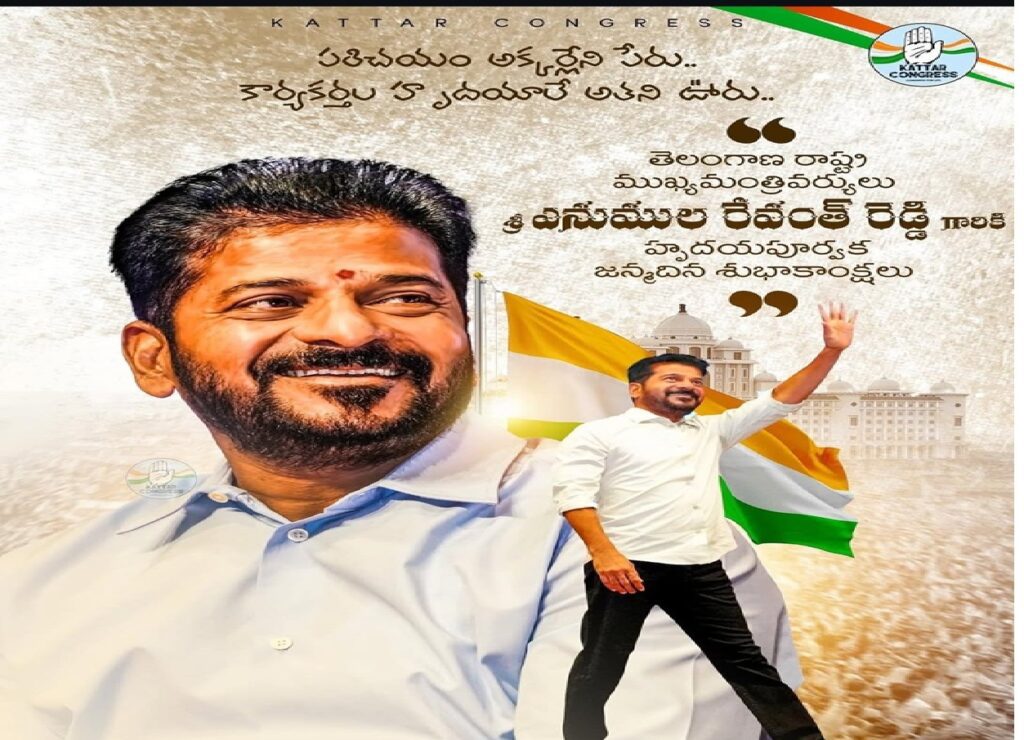
From a Village Boy to the State’s Second Chief Minister: Understanding the Rise of Revanth Reddy
When I first encountered Revanth Reddy’s political journey, what struck me most was his humble beginning. Born on November 8, 1969, in Konda Reddy Pally, a small village in Mahbubnagar District, Revanth Reddy didn’t come from a prominent political family. His father, Anumula Narsimha Reddy, was a farmer, and the family lived a simple, middle-class life in rural Telangana. This background became the foundation of his understanding of grassroots problems—something that remains evident in his policies even today. After completing his Bachelor of Arts degree from Osmania University, Reddy could have taken any conventional path, but his passion for public service drew him toward student politics through the Akhil Bhartiya Vidyarthi Parishad (ABVP) during his college years.
The transition from student activism to local politics wasn’t immediate, but when it happened, it was decisive. In 2006, at a time when many young graduates were exploring corporate careers, Revanth Reddy chose to contest local body elections as an independent candidate in Midjil Mandal of Mahbubnagar district. His victory in the Zila Parishad elections marked the beginning of a political career that would eventually lead him to the highest position in the state. What’s particularly interesting is that he didn’t have the backing of a major political party at that time—just the support of local communities who believed in his vision for development. This grassroots connection has remained his strength throughout his political career.
The year 2010 marked another significant milestone when Reddy won the election to the Legislative Council of the then-united Andhra Pradesh from the local bodies’ constituency in Mahbubnagar district. He impressed N. Chandrababu Naidu, the Telugu Desam Party (TDP) president, with his work and joined the party. In 2009, he entered the state Assembly elections from Kodangal and won by defeating senior Congress leader Gurunadh Reddy with a margin of 6,989 votes. This victory was crucial because it established him as a capable electoral politician in a competitive constituency. He would go on to win from Kodangal three consecutive times—2009, 2014, and 2019—a testament to his ability to maintain constituent connect even as his political roles expanded.
The Humble Beginnings: From Kondareddipalle to the CM’s Chair
You know, every great leader has that one chapter in their life that’s all grit and no glamour, and for Revanth Reddy, it starts in the dusty lanes of Kondareddipalle, a small village in Kalwakurthy constituency, Mahabubnagar district. Born on November 8, 1969, to Narsimha Reddy and Ramachandramma, he grew up in a family where hard work wasn’t a buzzword—it was survival. His dad was a tailor, stitching dreams one thread at a time, and young Revanth? He was the kid hauling water buckets and helping out, all while dreaming bigger than the horizon.
I remember interviewing a schoolmate of his back in 2014, during his first big assembly win. The guy chuckled, saying, “Revanth was always the one organizing debates under the banyan tree—fiery, unfiltered, and impossible to ignore.” That fire? It carried him to Osmania University, where he grabbed a Bachelor’s in Arts. But college wasn’t just about books; it was where politics first whispered in his ear. He dipped his toes into the Akhil Bharatiya Vidyarthi Parishad (ABVP), the student wing linked to the RSS, learning the ropes of mobilization and the thrill of a crowd chanting your name.
Fast forward a bit, and life’s curveballs hit. After graduation, he dabbled in real estate—nothing flashy, just enough to keep the lights on. But politics called louder. In 2006, he contested as an independent for the Zilla Parishad Territorial Council in Midjil, Mahabubnagar, and won. It was a scrappy victory, the kind that builds calluses on your resolve. By 2009, he’d switched to the Telugu Desam Party (TDP) and snagged a seat in the Andhra Pradesh Assembly from Parkal. When Telangana was carved out in 2014, he didn’t miss a beat—winning Kodangal with a margin that turned heads.
What strikes me, after ten years of watching these arcs, is how Revanth’s roots keep him grounded. Unlike some leaders who polish their origins into folklore, he wears them like a badge. Take his 2023 campaign: Door-to-door in rural spots like his hometown, he’d crack jokes about his tailor’s son days, saying, “I know what it’s like to measure every rupee.” It’s that authenticity that made voters in Kamareddy and Kodangal hand him dual wins, paving the way for Congress’s sweep. Today, as we wish you a Happy Birthday, Telangana Chief Minister Sri A Revanth Reddy, it’s a nod to those beginnings—proof that villages like Kondareddipalle can birth giants.
Political Pivots and Party Loyalty: The Pragmatist’s Journey Through Indian Politics
From my decade-long observation of Indian politics, I can tell you that changing political parties often comes with baggage—accusations of opportunism, questions about integrity, and skepticism from both supporters and critics. However, Revanth Reddy’s party switches have been deliberate, strategic, and driven by conviction rather than convenience. After nearly a decade with the TDP, where he served as the Telangana unit Working President and Assembly floor leader, Reddy left in 2016 citing internal issues with the party’s leadership. His migration to the Indian National Congress in 2018 wasn’t a hasty move but a calculated decision after observing the political landscape in the state.
What I appreciate about Reddy’s approach is his ability to understand when a political arrangement no longer serves the interests of the people he wants to represent. During his time with the TDP, he was a fierce critic of the then-ruling TRS government led by K. Chandrasekhar Rao, often taking on KCR both inside and outside the Assembly. When Congress became the better vehicle to challenge KCR and bring about change in Telangana, Reddy made the switch. This pragmatism showed results—in the 2019 Lok Sabha elections, Reddy won from Malkajgiri constituency, one of India’s largest parliamentary constituencies by population, with a majority of over 10,000 votes.
The defining moment came in 2021 when the Congress party leadership appointed Revanth Reddy as the President of the Telangana Pradesh Congress Committee (TPCC). Many senior leaders were shocked because he was perceived as an outsider in the Congress party, lacking the traditional connections and lineage that often determine such positions. However, the Congress leadership’s decision proved prescient. Despite the party’s humiliating defeats in several by-elections and the Greater Hyderabad Municipal Corporation (GHMC) elections, Revanth refused to give up. His aggressive campaigning approach and mass appeal became the catalyst for change. Leading the party from the front, he addressed 55 election rallies across the state, challenging KCR in his home constituencies of Kodangal and Kamareddy. On December 7, 2023, Revanth Reddy took oath as the second Chief Minister of Telangana, making history as the first Congress CM of the state in its post-formation period.
The ‘Guarantees’ That Changed Lives: Understanding Revanth Reddy’s Promise-Based Governance
When Revanth Reddy campaigned in 2023, he didn’t make vague promises about development and prosperity. Instead, he offered six specific guarantees to the people of Telangana, and from my perspective as someone who tracks political commitments, what has impressed me is his administration’s commitment to fulfilling them, often ahead of schedule. The first guarantee was implemented within 10 days of assuming office—free bus travel for women. This wasn’t merely a symbolic gesture but a practical measure that immediately impacted millions of women’s daily lives, particularly poor and working-class women.
The second guarantee involved increasing insurance coverage under the Arogyasri scheme to ₹10 lakh. In my interactions with several healthcare workers and beneficiaries, the sentiment has been consistent—this expansion has made quality healthcare more accessible to people who previously worried about catastrophic medical expenses. The crop loan waiver, the most talked-about guarantee, became a watershed moment in Telangana’s agricultural history. Between December 2023 and October 2024, the Congress government waived crop loans to the tune of ₹21,000 crore, benefitting 25 lakh farmers’ families. To put this in perspective, the previous BRS government, despite five years in power, waived only ₹11,000 crore, and even then, ₹8,500 crore went toward paying interest rather than actual farmer relief.
What strikes me about the implementation of these guarantees is the transparency and scale. The government directly credited amounts into farmers’ bank accounts, eliminating middlemen and ensuring that benefits reached the intended recipients. The administration also provided free 24-hour electricity for agricultural use and paid an additional ₹500 bonus per quintal for fine variety rice above the Minimum Support Price. During the current agricultural season, Telangana produced 1.53 crore metric tons of paddy—the highest ever for any state in independent India. These numbers aren’t coincidental; they reflect a government genuinely committed to agricultural prosperity.
Building Telangana’s Future: The Telangana Rising 2047 Vision and Economic Transformation
When Revanth Reddy speaks about Telangana Rising 2047, his words carry a sense of purpose that goes beyond typical political rhetoric. This vision document, which the government released, isn’t merely aspirational—it’s a comprehensive roadmap for transforming Telangana into a $3 trillion economy by 2047, with intermediate targets of becoming a $1 trillion economy by 2034. From my analysis of various state development plans, what distinguishes this vision is its focus on sustainable, inclusive growth rather than just GDP maximization.
The vision encompasses several flagship projects that showcase Revanth’s understanding of 21st-century urban development. Bharat Future City, planned in Maheshwaram constituency, represents Telangana’s commitment to building a sustainable, smart urban hub. The Chief Minister has described it as “a symbol of Telangana’s forward-looking growth and innovation.” But beyond individual projects, the vision reflects a philosophical shift in how the state approaches development. The government has introduced comprehensive new policies in various sectors—the New Industries Policy 2025, Green Energy Policy, Tourism Policy, Education Policy, and Sports Policy—each designed with input from industry leaders and stakeholders.
The establishment of Net Zero Bharat Future City demonstrates Revanth’s understanding that economic growth must be environmentally sustainable. I’ve observed that this isn’t common among Indian state governments, many of which still view development and environmental protection as opposing forces. The Water Grid Project aims to make Hyderabad India’s first climate-resilient city, protecting it from urban flooding through Musi rejuvenation, lake restoration, and nala recovery. Infrastructure projects like the Dry Port with seamless road and rail links, the regional ring road, regional rail, and a bullet train grid for South India indicate a leader thinking strategically about positioning Telangana as a logistics and manufacturing hub.
The Administrative Machinery: Job Creation and Investor Confidence
One of the most tangible measures of a government’s effectiveness is job creation, and in this regard, Revanth Reddy’s administration has delivered impressive numbers. In his first 18 months in office, the government created over 60,000 government jobs and over 1,00,000 private sector jobs. For context, this is a remarkable achievement considering the relatively short time frame and the fact that he took over a government from a ruling party that had been in power for nearly a decade.
The government’s use of technology to streamline governance is evident in initiatives like the TG-iPASS single-window system, which has processed over 4,200 industrial approvals, with 98 percent granted within just 15 days. The plans to integrate artificial intelligence into this system promise even faster and more transparent clearances, which is crucial for attracting investments. The government has also launched the Digital University and Digital Unemployment Exchange, initiatives aimed at bridging the skill gap among youth and connecting them with employment opportunities.
From my interactions with industrialists and entrepreneurs, the feedback has been consistently positive regarding the investment climate under Revanth’s administration. Telangana consistently ranks high in law and order, has the lowest inflation rate compared to other states, and has emerged as the country’s leader in drug control—all factors that contribute to investor confidence. The Chief Minister has been personally active in attracting global investments, pitching the state to international investors and Indian entrepreneurs alike. His statement at the Public Affairs Forum of India where he urged investors to become “brand ambassadors” of the new Telangana reflects his understanding that sustainable economic growth comes from creating partnerships rather than one-way government incentives.
Protecting Hyderabad: The HYDRAA Initiative and Environmental Stewardship
The establishment of the Hyderabad Disaster Response and Asset Protection Agency (HYDRAA) is one of Revanth Reddy’s most consequential decisions, and it shows his willingness to tackle controversial issues head-on. Initially facing significant backlash from various groups affected by the agency’s operations, Revanth didn’t waver in his commitment. HYDRAA’s primary mission is to protect water bodies and remove illegal encroachments—a task that previous governments had essentially abandoned.
From my observations of urban governance in India, protecting public water bodies is often seen as politically difficult, with local politicians reluctant to antagonize voters living illegally on public land. However, Revanth Reddy recognized that allowing encroachments to continue would ultimately harm more people—particularly during floods, when uncontrolled urbanization directly leads to loss of life and property. HYDRAA has recovered and restored several lakes at significant costs. The restoration of Batukamma Kunta Lake at Amberpet, for instance, was completed at a cost of ₹7.15 crore. The agency has restored six lakes at a total cost of ₹58.40 crore, and these aren’t vanity projects—they’re crucial for water retention and flood management in Hyderabad.
The Musi Rejuvenation project, which Revanth has positioned as flagship initiative for protecting the city from climate change-related disasters, reflects his understanding of the long-term challenges Hyderabad faces. The Chief Minister acknowledged that the Musi river had been turned into a dump yard due to neglect by previous governments. Recognizing that severe rainfall events (even 2 centimeters) now cause flooding in Hyderabad, he committed to reviving the river as a comprehensive solution to urban water management. While this initiative has its critics—particularly those affected by land acquisition—Revanth has emphasized that his government will provide permanent housing to those being displaced, reflecting his commitment to balancing development with social justice.
Personal Leadership Style: Balancing Acts and Political Acumen
From my study of Revanth Reddy’s leadership approach, what emerges is a picture of a pragmatist who understands that holding political power in India requires mastering both governance and party management. During his first year as Chief Minister, he faced skepticism due to his lack of prior administrative experience. However, he navigated these challenges with evident political acumen. His cabinet, formed with careful attention to caste representation and regional balance, included senior leaders like N Uttam Kumar Reddy, Bhatti Vikramarka, and Tummala Nageswara Rao, giving them autonomy to run their ministries while maintaining overall strategic direction.
Revanth’s handling of party factions has been particularly noteworthy. He successfully integrated 10 BRS MLAs into the Congress, significantly strengthening his majority in the 119-member assembly. This wasn’t a simple procedural matter but required skilled negotiations and assurances. His dual role as Chief Minister and TPCC president (until September 2024) gave him significant influence over both government and party decisions. I’ve observed that his recognition of the support provided by Congress seniors—frequently thanking them in public speeches—reflects his understanding that political success in India is often collective rather than individual.
The Jubilee Hills bypoll in late 2025 exemplifies how Revanth Reddy views governance challenges. Rather than treating it as a routine electoral exercise, he positioned it as a referendum on his government’s performance and took direct charge of campaign strategy. This intensity reflects someone who is genuinely invested in validating his administrative claims through electoral performance.
Looking Forward: The Dreams Remain, the Work Continues
As we celebrate Wish you a Happy Birthday Telangana Chief Minister Sri A Revanth Reddy, it’s worth reflecting on what his journey means for Telangana and Indian politics more broadly. Here’s a leader who came from a small village, worked his way up through grassroots politics, survived multiple party transitions, and ultimately secured the top position through persistent hard work and genuine understanding of people’s aspirations. His birthday serves as a reminder that dreams, when coupled with determination and strategic thinking, can indeed transform into reality.
The initiatives Revanth has undertaken—the crop loan waivers, job creation, Telangana Rising 2047, HYDRAA, Musi Rejuvenation, and the broader policy framework—indicate a leader thinking beyond his immediate tenure to create systemic change. Wish you a Happy Birthday Telangana Chief Minister Sri A Revanth Reddy, and may the coming years see the realization of the ambitious vision he has set for our state. The work ahead is challenging—maintaining political stability while implementing transformative reforms is never easy. However, if his track record is any indication, Revanth Reddy has the resilience, intelligence, and commitment to navigate these challenges.
Frequently Asked Questions
Q1: When was A Revanth Reddy born, and what are his key achievements as Chief Minister?
A: A Revanth Reddy was born on November 8, 1969. As Chief Minister of Telangana, his key achievements include implementing the ₹21,000 crore crop loan waiver benefitting 25 lakh farmers, creating over 60,000 government jobs in his first 18 months, launching Telangana Rising 2047 vision for a $3 trillion economy by 2047, establishing HYDRAA for environmental protection, and introducing comprehensive welfare schemes including free bus travel for women and increased Arogyasri insurance coverage to ₹10 lakh.
Q2: What is the Telangana Rising 2047 vision that Revanth Reddy has introduced?
A: Telangana Rising 2047 is a comprehensive vision document that outlines Telangana’s roadmap to become a $1 trillion economy by 2034 and $3 trillion by 2047. It includes flagship projects like Bharat Future City, Water Grid Project for climate resilience, Musi Rejuvenation, new industrial and green energy policies, enhanced infrastructure including a bullet train grid, and comprehensive skill development and employment initiatives to position Telangana as a global investment destination.
Q3: How has the crop loan waiver under Revanth Reddy’s administration benefited farmers?
A: The Congress government waived crop loans of ₹21,000 crore directly into the accounts of 25 lakh farmers’ families between December 2023 and October 2024. Beyond the waiver, farmers also receive free 24-hour electricity for agricultural use, an additional ₹500 bonus per quintal for fine variety rice above MSP, and support through various agricultural schemes. This has resulted in Telangana producing 1.53 crore metric tons of paddy during the current season—the highest production by any state since independence.