


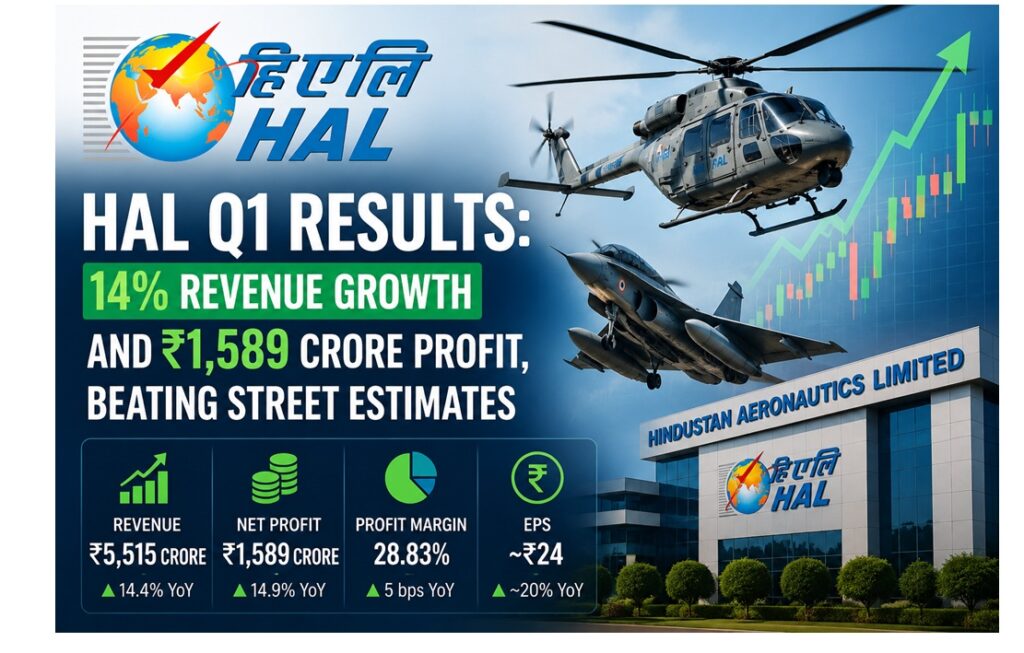
Hindustan Aeronautics Limited has released its Q1 numbers, and the defence PSU has once again given the market something to chew on. Revenue climbed. Profit climbed. Margins held their ground. And both the topline and the bottom line landed above what analysts had pencilled in.
But the quarter also carries a headline that looks alarming at first glance — a roughly 60% sequential collapse in revenue. If you only read that number and stopped there, you would come away with completely the wrong impression of how HAL performed.
This detailed breakdown walks through every line of the HAL Q1 results — revenue from operations, total expenses, net profit, operating margin, and earnings per share — and explains why year-on-year comparison, not quarter-on-quarter comparison, is the only sensible way to judge a defence manufacturer like Hindustan Aeronautics.
HAL Q1 Results at a Glance
Here is the full picture in one table before we break each item down.
| Metric | Q1 (Current Year) | Q1 (Previous Year) | Previous Quarter (Q4) | YoY Change |
|---|---|---|---|---|
| Revenue from operations | ₹5,515 crore | ₹4,819 crore | ₹13,942 crore | +14.4% |
| Total expenses | ₹4,655 crore | ₹3,964 crore | ₹10,194 crore | +17.4% |
| Net profit | ₹1,589 crore | ₹1,383 crore | ₹4,196 crore | +14.9% |
| Profit margin | 28.83% | 28.78% | 22.84% | +5 bps |
| Earnings per share | ~₹24 | ~₹20 | ~₹62 | ~+20% |
Street estimates going into the quarter stood at approximately ₹5,146 crore in revenue and ₹1,520 crore in net profit. HAL cleared both bars.
Revenue From Operations: HAL Delivers ₹5,515 Crore
Start with the topline, because that is where the story begins.
Hindustan Aeronautics generated ₹5,515 crore in revenue from operations during the quarter. In the same quarter last year, the company reported ₹4,819 crore. That works out to growth of roughly 14.4% year on year — a solid, unspectacular, entirely healthy number for a company of this size operating in a sector where order execution runs on multi-year timelines.
Analysts had modelled around ₹5,146 crore. HAL came in about ₹369 crore ahead of that figure, a beat of roughly 7%. In a sector where execution slippage is the norm rather than the exception, delivering ahead of consensus on revenue counts as a genuine positive.
What makes this number worth paying attention to is the consistency behind it. HAL has been steadily converting its order book into recognised revenue, quarter after quarter, and a double-digit year-on-year expansion suggests the delivery machine is turning over as expected. For a defence public sector undertaking, revenue growth is essentially a proxy for execution capability. You do not get topline growth without physically delivering aircraft, engines, spares, and overhaul services to the customer.
The 60% Sequential Drop: Why It Looks Worse Than It Is
Now for the number that sets off alarm bells.
In the immediately preceding quarter, HAL posted ₹13,942 crore in revenue from operations. Against that, this quarter’s ₹5,515 crore represents a fall of roughly 60%.
That is a genuinely dramatic sequential decline. On paper, it looks like the business fell off a cliff.
It did not.
Hindustan Aeronautics runs a seasonal business, and that seasonality is baked into the structure of how Indian defence procurement works. The company’s revenue is not spread evenly across four quarters. It clusters heavily in the fourth quarter — the January to March window — for reasons that have everything to do with government budgeting cycles and nothing to do with the underlying health of the company.
Defence contracts are settled against annual budget allocations. Deliveries get accepted, milestones get signed off, and payments get processed in a rush as the financial year draws to a close. The result is a topline that bulges in Q4 and then normalises sharply in Q1.
This pattern repeats every single year. It is not new information, it is not a warning sign, and it is not something the market reads as a deterioration. Anyone who has tracked HAL through even two or three annual cycles recognises the shape of it immediately.
The practical takeaway: for HAL, sequential comparison is close to meaningless. Year-on-year comparison is the only measurement that tells you anything real. And on that basis, the company grew 14.4%.
Understanding HAL’s Seasonal Revenue Cycle in More Detail
It is worth spending another moment on this, because the sequential-versus-annual distinction is the single most common source of confusion around defence PSU earnings.
Consider how a typical HAL contract actually works. The company signs a multi-year agreement to supply, say, a batch of aircraft or to carry out repair and overhaul on an existing fleet. Revenue does not get recognised when the contract is signed. It gets recognised as delivery milestones are met and accepted by the customer — which in HAL’s case is overwhelmingly the Indian Air Force, Navy, and Army.
Those acceptances tend to bunch up. Inspection teams complete their sign-offs, documentation clears, and a large chunk of the year’s deliveries formally land in the books during the closing quarter. Meanwhile the first quarter of the new financial year starts from a relatively clean slate, with production lines ramping back up and fresh milestones only beginning to mature.
So the Q4 spike and the Q1 dip are two halves of the same accounting rhythm. Judging HAL on the basis of that rhythm is like judging a retailer’s health by comparing January sales to December sales.
What actually matters is whether the annual trajectory is improving. Here, ₹4,819 crore rising to ₹5,515 crore in the comparable quarter answers that question clearly.
Total Expenses: Costs Rose Faster Than Revenue
Every earnings analysis that skips the expense line is incomplete, so let us look at what HAL spent to generate those revenues.
Total expenses for the quarter came in at ₹4,655 crore, up from ₹3,964 crore in the same period last year. That is an increase of roughly 17.4%.
Compare that against revenue growth of 14.4% and a nuance emerges: expenses grew faster than revenue this quarter.
The arithmetic makes the implication clear. Last year, revenue of ₹4,819 crore minus expenses of ₹3,964 crore left a gap of ₹855 crore. This year, revenue of ₹5,515 crore minus expenses of ₹4,655 crore leaves ₹860 crore. In absolute terms, the operating gap barely moved.
That does not make this a bad quarter — the expense base remains firmly under control, and there is no evidence of costs spiralling. But it does mean the profit growth we are about to discuss did not come purely from operational leverage. Other income, treasury gains on HAL’s substantial cash pile, or a favourable tax position likely contributed. Investors who want to understand the quality of this quarter’s earnings should read the detailed results statement to see exactly where the additional profit originated.
Sequentially, expenses fell from ₹10,194 crore to ₹4,655 crore — a drop of about 54%, which mirrors the revenue seasonality discussed above and carries no independent signal.
Net Profit: ₹1,589 Crore, Up Nearly 15%
Now to the bottom line.
HAL reported a net profit of ₹1,589 crore for the quarter, against ₹1,383 crore in the same quarter of the previous year. That is growth of approximately 14.9% year on year — almost perfectly matched to the pace of revenue growth.
Analysts had projected around ₹1,520 crore. HAL exceeded that by roughly ₹69 crore, a beat of about 4.5%. Not a blowout, but a beat is a beat, and consistently landing slightly ahead of consensus builds credibility with institutional investors over time.
Against the preceding quarter’s ₹4,196 crore, this quarter’s profit is down around 62%. Once again — same seasonality, same non-signal. The Q4 profit figure carries the compressed weight of the year-end delivery surge. Comparing it to Q1 tells you about the calendar, not the company.
The clean read: profit grew nearly 15% year on year and cleared the street’s number. That is the sentence that matters.
Profit Margin Analysis: Steady at 28.83%
Margins are where defence PSUs often reveal stress that the headline numbers hide, so this line deserves close attention.
HAL’s profit margin came in at 28.83% for the quarter. In the corresponding quarter last year, it stood at 28.78%. The change is five basis points — statistically flat, effectively identical.
Flat margins on 14% revenue growth is a respectable outcome. It tells you the company scaled its topline without sacrificing profitability per rupee of sales, which is not a given in a business exposed to raw material inflation, imported component costs, currency fluctuation, and a customer base that negotiates hard on pricing.
Sequentially, the margin improved meaningfully — from 22.84% in the preceding quarter to 28.83% now, an expansion of roughly 600 basis points. Higher-margin quarters in HAL’s cycle often reflect a favourable mix skewed toward repair, overhaul, and spares services rather than lower-margin manufacturing and delivery volume. That sequential improvement is a modest positive, though it should be read with the same seasonality caution applied everywhere else in this analysis.
The broader point: HAL is holding its margin profile while growing. For a company whose share price has been re-rated substantially on the back of defence indigenisation optimism, protecting margins is arguably as important as growing revenue.
Earnings Per Share: Approximately ₹24
EPS moved from roughly ₹20 in the year-ago quarter to approximately ₹24 this quarter — growth of around 20%.
The preceding quarter’s EPS stood at approximately ₹62, again reflecting the concentrated Q4 profit.
EPS growth running slightly ahead of net profit growth is worth a brief note. It typically points to a stable or marginally reduced share count, meaning existing shareholders are capturing the full benefit of the profit expansion without dilution. For long-term holders, that is exactly the pattern you want to see.
HAL Q1 Results vs Street Estimates: A Clean Beat on Both Lines
Consolidating the comparison against consensus:
| Line item | Reported | Estimated | Beat |
|---|---|---|---|
| Revenue | ₹5,515 crore | ₹5,146 crore | +₹369 crore (~7%) |
| Net profit | ₹1,589 crore | ₹1,520 crore | +₹69 crore (~4.5%) |
Two beats, no misses, and a margin that held firm. By the standard scorecard, this is a good quarter.
It is worth being precise about the size of the beat, though. A 7% revenue surprise and a 4.5% profit surprise are meaningful but not transformative. They are the kind of numbers that validate existing expectations rather than force a wholesale re-rating of the stock. Nobody is going to rip up their model over this quarter — but nobody has to defend a disappointment either.
What These Numbers Say About HAL’s Operational Health
Step back from the individual line items and a coherent picture emerges.
Execution is on track. Double-digit revenue growth in the seasonally weakest quarter of the year indicates that HAL’s production and delivery pipeline is functioning. Order books mean nothing until they convert, and this quarter shows conversion happening.
Cost discipline is adequate but not improving. Expenses growing at 17.4% against revenue at 14.4% is the one line in this result that deserves ongoing monitoring. It is not a problem yet — the absolute operating gap held steady — but a second or third consecutive quarter of the same pattern would start to matter.
Profitability is stable. Flat year-on-year margins alongside growth is a genuinely good sign, particularly given the input cost environment defence manufacturers have been navigating.
Earnings quality warrants a closer look. Since operating profit was essentially flat in absolute terms while net profit grew 15%, the detailed statement will reveal how much came from below-the-line items. That is not a red flag — HAL’s large cash balance legitimately generates substantial other income — but it is a reason to read past the headline.
How HAL Shares Typically React to Results
Here is something long-time HAL watchers understand well: the stock rarely does anything dramatic on results day.
Historically, HAL has traded within a roughly 2% band around earnings announcements. There is no reliable pattern of sharp rallies on good numbers or steep sell-offs on soft ones. The reason is structural. HAL’s investment case rests on a visible multi-year order book, government procurement policy, and India’s defence indigenisation programme — none of which changes materially based on a single quarter’s revenue recognition timing.
Institutional investors who own HAL are underwriting a decade-long thesis about domestic defence manufacturing. A quarterly beat or miss of a few percentage points does not disturb that thesis. What moves the stock instead tends to be order announcements, contract signings, policy decisions on procurement, production milestones on flagship platforms, and supply chain developments affecting key programmes.
So while these results are solid, do not expect fireworks. The most likely outcome, based on how the stock has behaved historically, is a muted reaction well within the usual range.
The 52-Week High Context
One additional factor shapes how the market is likely to receive these numbers: HAL shares have been trading near their 52-week high going into the announcement.
That matters for a specific reason. When a stock approaches the upper end of its range, expectations are already elevated. Good results are, to some extent, priced in. A modest beat — which is what this is — may not be enough to drive a fresh leg up, simply because the market had already positioned for strength.
The flip side is equally true. A stock near its highs going into results with a strong balance sheet, a visible order pipeline, and now a confirmed earnings beat has genuine fundamental support underneath the price. There is a difference between a stock that is expensive on hope and one that is expensive on delivery. This quarter puts HAL closer to the second category.
Whether the valuation is justified is a separate conversation that depends on your view of India’s defence capital expenditure trajectory over the next five to ten years — well beyond the scope of a single quarterly result.
What Investors Should Watch in Coming Quarters
Based on what this quarter revealed, here are the specific things worth tracking:
1. The expense growth trend. Costs outpaced revenue this quarter. One quarter is noise. Three quarters is a trend. Watch whether operating leverage reasserts itself.
2. The composition of profit. Determine how much of the profit growth came from core operations versus other income. Higher-quality earnings come from the former.
3. Order book conversion. Revenue growth is the visible output of order execution. Continued double-digit expansion suggests the pipeline is converting on schedule.
4. New order inflow. For HAL, fresh contracts are the primary long-term stock driver — considerably more important than any single quarter’s numbers.
5. Margin sustainability. Holding near 29% while growing is the current standing. Any drift below that band would warrant investigation.
6. Supply chain and component availability. Aerospace manufacturing lives and dies on component supply. Any commentary from management on this front carries outsized significance.
Frequently Asked Questions
What revenue did HAL report in Q1? Hindustan Aeronautics reported ₹5,515 crore in revenue from operations, up from ₹4,819 crore in the same quarter last year — growth of approximately 14.4%.
What was HAL’s net profit this quarter? HAL posted a net profit of ₹1,589 crore, compared to ₹1,383 crore a year earlier, representing growth of roughly 14.9%.
Did HAL beat analyst estimates? Yes, on both lines. Revenue of ₹5,515 crore exceeded the estimated ₹5,146 crore, and net profit of ₹1,589 crore came in ahead of the projected ₹1,520 crore.
Why did HAL’s revenue fall 60% compared to the previous quarter? Because HAL’s business is seasonal. Defence deliveries and payments concentrate heavily in the January-to-March quarter, aligned with government budget cycles. The sequential drop reflects that calendar pattern, not any deterioration in the business. Year-on-year comparison is the appropriate measure for HAL.
What is HAL’s current profit margin? The profit margin stood at 28.83%, essentially unchanged from 28.78% in the corresponding quarter last year and improved from 22.84% in the preceding quarter.
What was HAL’s earnings per share? Approximately ₹24, up from roughly ₹20 in the same quarter last year.
Should you buy HAL shares based on these results? That decision depends on your investment horizon, risk tolerance, entry valuation, and overall portfolio construction — none of which a quarterly result can determine. These numbers confirm that the business is executing, but they are one data point in a much longer story. Consult a registered financial adviser before making any investment decision.
The Bottom Line
Hindustan Aeronautics delivered a clean, competent quarter. Revenue grew 14.4% year on year to ₹5,515 crore. Net profit grew 14.9% to ₹1,589 crore. Both figures cleared consensus estimates. Margins held steady at 28.83%, and EPS improved to roughly ₹24.
The 60% sequential decline in revenue is a function of HAL’s seasonal delivery calendar and carries no negative signal whatsoever. Anyone treating it as a red flag has misread the business.
The one genuine watch item is the expense line, which grew faster than revenue and left the absolute operating gap flat year on year. That single detail is worth tracking across the next couple of quarters to confirm whether it reflects timing or something more structural.
For a defence PSU trading near its 52-week high, this quarter does the job it needed to do: it validates the execution story without introducing new concerns. Market reaction is likely to be measured — HAL has rarely swung sharply on results day, and there is little in these numbers to change that pattern.
Disclaimer: This article is intended for informational and educational purposes only. It does not constitute investment advice, a recommendation, or an offer to buy or sell any security. All financial figures are based on the company’s disclosed quarterly results as reported. Stock market investments carry risk, including possible loss of principal. Please consult a SEBI-registered investment adviser before making any investment decision.