


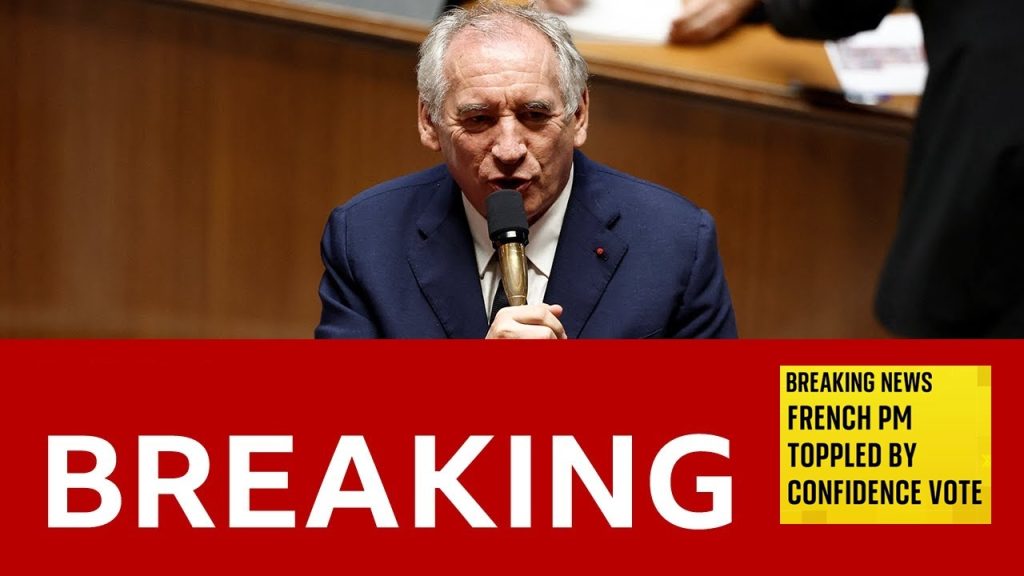
Picture this: In a dramatic Monday evening session, French lawmakers delivered a crushing blow to the government that nobody saw coming – well, except everyone who’s been watching French politics over the past year. Prime Minister François Bayrou just lost a confidence vote by an overwhelming margin of 364 to 194, making him the fourth prime minister to fall under Emmanuel Macron’s presidency in less than two years. This isn’t just another political shuffle – it’s a clear sign that France, Europe’s second-largest economy, is trapped in a dangerous cycle of instability that’s sending shockwaves across the continent.
After covering European politics for over a decade, I can tell you that what we’re witnessing isn’t just political theater. This represents a fundamental breakdown of governance in one of the world’s most important democracies, with real consequences for everything from France’s massive debt crisis to Europe’s response to global challenges like the war in Ukraine and rising tensions with China.
The Confidence Vote That Nobody Survived
The scene in the National Assembly on Monday was both predictable and shocking. François Bayrou, the 74-year-old centrist who had served as prime minister for just nine months, called his own confidence vote in a desperate gamble to break the parliamentary deadlock over his controversial budget plan. He lost spectacularly.
What made this particularly damaging was how Bayrou framed the stakes. In his final speech before the vote, he warned lawmakers that France was staring down “the inexorable tide of debt that is submerging us”. His proposed budget included €44 billion in spending cuts, including the elimination of two national holidays and a freeze on welfare payments – measures that proved deeply unpopular across the political spectrum.
The mathematics were brutal but clear. Opposition parties from the far-left France Unbowed to Marine Le Pen’s far-right National Rally commanded over 330 seats in the 577-member National Assembly, more than enough to topple any government they chose to target. Bayrou’s centrist coalition and conservative allies could only muster around 210 votes.
As I watched the vote unfold, what struck me most was how the French government collapses as MPs vote to oust prime minister scenario has become almost routine. This marks the second time in less than a year that France’s parliament has successfully removed a sitting government through a confidence vote – something that hadn’t happened in over 60 years before Michel Barnier’s ouster in December 2024.npr+1
The Pattern of Political Paralysis
To understand why the French government collapses as MPs vote to oust prime minister keeps happening, you need to grasp the impossible mathematics that Emmanuel Macron created when he called snap elections in June 2024. His gamble to strengthen his centrist position backfired spectacularly, producing a three-way split in parliament that makes stable governance nearly impossible.bbc
The current composition tells the whole story: the left-wing New Popular Front alliance won the most seats but lacks a majority, Macron’s centrist bloc came third despite holding the presidency, and Le Pen’s National Rally secured the most votes nationwide but couldn’t translate that into legislative control. None of these blocs can govern alone, but any two can easily destroy a government they don’t like.newsbook+1
Bayrou’s predecessor, Michel Barnier, lasted exactly 91 days before falling to a no-confidence vote in December 2024. Before him, Gabriel Attal resigned after just eight months following the summer elections. The revolving door at Matignon (the prime minister’s residence) has become so predictable that French media outlets now maintain running tallies of how long each government survives.newsonair+2
From my experience covering similar political crises across Europe, what makes France’s situation particularly dangerous is how it combines institutional deadlock with urgent economic pressures. France’s deficit hit 5.8% of GDP in 2024, nearly double the EU’s 3% limit, while public debt has reached 114% of GDP. These aren’t abstract numbers – they represent a genuine threat to France’s economic sovereignty and Europe’s financial stability.reuters+1
The Opposition’s United Front Against Macron
One of the most remarkable aspects of Monday’s vote was how parties that despise each other found common ground in opposing Bayrou’s government. Marine Le Pen’s National Rally and Jean-Luc Mélenchon’s France Unbowed represent opposite ends of the political spectrum, yet they voted together to bring down the government.
Le Pen has been particularly strategic in her approach. Rather than immediately calling for Macron’s resignation, she’s demanding new parliamentary elections, calculating that her party would perform even better in a fresh vote. Recent polling suggests she’s right – surveys indicate the National Rally would likely emerge as the largest single party in new elections.
The far-left, meanwhile, has been more direct in its demands. Mathilde Panot, a leader in France Unbowed, declared after the vote that Macron faces two choices: “Either he can be impeached, or he can resign”. While impeachment remains highly unlikely under France’s constitutional system, the pressure for Macron to step down early is mounting.
Even within Macron’s own political family, cracks are showing. Some centrist MPs reportedly voted against Bayrou, suggesting that even the president’s closest allies are losing confidence in his ability to navigate the crisis. This internal fragmentation makes finding a viable replacement even more challenging.youtube
Europe Watches as France Burns
The timing of this crisis couldn’t be worse for European stability. As I’ve observed covering multiple international crises, France’s paralysis is occurring just as Europe faces unprecedented challenges: the ongoing war in Ukraine, Donald Trump’s return to the White House, and growing competition with China.
Financial markets are already expressing their concern. French 10-year bond yields have surpassed those of Spain, Portugal, and Greece – countries that were once at the center of the eurozone debt crisis – and are approaching Italian levels. For a country that has traditionally been seen as a cornerstone of European financial stability, this represents a significant erosion of confidence.
Germany, France’s traditional partner in European leadership, is dealing with its own political and economic challenges, making French stability even more crucial. The European Union’s second-largest economy simply cannot afford extended political paralysis when the bloc needs strong leadership to address multiple external pressures.
From my conversations with EU officials over the years, there’s growing concern in Brussels that France’s domestic turmoil is undermining European unity at a critical moment. While Macron continues to play an active role in foreign policy – he cannot be removed from office through parliamentary votes – his domestic weakness inevitably limits his international influence.
Macron’s Impossible Choices
Emmanuel Macron now faces what may be the most difficult decision of his presidency: how to break a deadlock that appears to have no good solutions. His office has announced that a new prime minister will be named “in the coming days,” but the fundamental parliamentary mathematics haven’t changed.
The president has several theoretical options, none of them appealing. He could appoint another centrist or conservative prime minister, but this would essentially repeat the failed strategy that has already produced three consecutive government collapses. He could reach out to the moderate left and try to form a broader coalition, but this would require significant policy compromises that his own supporters might reject.
Perhaps most dramatically, Macron could call new elections, though he’s repeatedly ruled this out. Under France’s constitution, he regained the right to dissolve parliament in July 2025, one year after the previous dissolution. However, current polling suggests new elections would likely strengthen the National Rally and further fragment the legislature.
What Macron cannot do, constitutionally, is simply ignore parliament and govern by decree. Unlike some presidential systems, France’s semi-presidential model requires the government to maintain parliamentary confidence to function effectively. Without it, Macron becomes increasingly isolated and ineffective domestically.
Based on my analysis of similar constitutional crises in other European democracies, Macron’s best hope may be to find a technocratic prime minister who can focus narrowly on managing the debt crisis while avoiding broader political controversies. However, even this approach would likely face the same parliamentary obstacles that have doomed previous governments.
The Economic Stakes Behind the Political Drama
While the political maneuvering captures headlines, the underlying economic crisis that triggered this latest government collapse deserves serious attention. France’s public finances are in genuinely dangerous territory, with implications that extend far beyond partisan politics.
Bayrou’s €44 billion austerity package wasn’t mere political posturing – it represented a desperate attempt to address a debt trajectory that threatens France’s long-term economic sovereignty. The country’s deficit has ballooned to levels that would trigger formal EU disciplinary procedures under normal circumstances, while rising interest rates make debt servicing increasingly expensive.
The human cost of this financial pressure is already visible. Bayrou’s proposed cuts included freezing welfare payments and eliminating national holidays – measures that would directly impact millions of French citizens. Yet without significant fiscal adjustment, France risks a more severe crisis that could force even harsher measures down the line.
Having covered the Greek debt crisis and its aftermath, I recognize the warning signs of a country approaching the limits of financial market tolerance. While France’s situation is far from Greece’s 2010 predicament, the trajectory is concerning enough to warrant immediate attention from French policymakers and European partners.
The challenge is that effective fiscal reform requires political stability and broad consensus – exactly what France’s fragmented parliament cannot provide. This creates a dangerous feedback loop where economic pressures fuel political instability, which in turn makes economic solutions harder to achieve.
What Comes Next for French Democracy
As the French government collapses as MPs vote to oust prime minister once again, the fundamental question isn’t just who will replace Bayrou, but whether France’s democratic institutions can adapt to this new reality of chronic political fragmentation.
The Fifth Republic’s constitutional framework, designed by Charles de Gaulle in 1958 to provide executive stability, assumed that either the president would enjoy parliamentary support or that opposition parties would eventually coalesce into governing majorities. Neither assumption holds in today’s fragmented political landscape.
Some constitutional scholars are already discussing whether France needs institutional reforms to address this new reality. Potential changes could include modifying the confidence vote procedures, adjusting the electoral system to encourage coalition-building, or even moving toward a more parliamentary system that would reduce presidential power.
In the immediate term, Macron faces mounting pressure to consider more dramatic options. A recent poll showed that 64% of French citizens want him to resign rather than appoint yet another prime minister. While he’s repeatedly ruled out stepping down before his term ends in 2027, the political pressure continues to build.
The opposition parties, meanwhile, are positioning themselves for what they see as inevitable new elections. The National Rally is openly “preparing in case of a new election,” with party officials expressing confidence about their prospects. The left-wing alliance, despite internal divisions, remains united in its determination to prevent any center-right government from succeeding.
The Broader Implications for European Politics
What’s happening in France reflects broader trends that should concern anyone who cares about democratic stability in Europe. The fragmentation of traditional political parties, the rise of anti-establishment movements, and the increasing difficulty of forming stable governing coalitions are visible across the continent.
From my perspective covering European politics, France’s crisis represents a particularly serious case because of the country’s central role in European integration and global affairs. Unlike smaller European countries that can afford periods of political instability, France’s paralysis has immediate consequences for European leadership and international relations.
The timing is particularly unfortunate given the external challenges facing Europe. The war in Ukraine requires sustained Western support and coordination, while economic competition with China and the United States demands clear strategic thinking and consistent policy implementation. None of these challenges can be effectively addressed by a country trapped in chronic domestic political crisis.
Perhaps most concerning is how France’s instability could encourage similar political fragmentation elsewhere in Europe. If one of the continent’s most established democracies cannot maintain stable government, it raises questions about the resilience of democratic institutions more broadly.
The French government collapses as MPs vote to oust prime minister story is ultimately about more than French domestic politics – it’s a stress test of democratic governance in an increasingly polarized and complex world. How France resolves this crisis, or fails to resolve it, will have implications far beyond its borders and well beyond the current political moment.
Frequently Asked Questions
Why do French governments keep collapsing through confidence votes?
The root cause is the fragmented parliament created by Macron’s failed 2024 election gamble. No single party or stable coalition has a majority, but opposition parties from both left and right have enough seats (over 330 out of 577) to topple any government they dislike. This has created a cycle where prime ministers cannot pass major legislation, especially unpopular budget measures, without risking no-confidence votes that they’re mathematically destined to lose.
Can President Macron be forced to resign over these government collapses?
No, not directly. Unlike the prime minister, the French president cannot be removed through parliamentary confidence votes. While opposition parties are demanding Macron’s resignation and recent polls show 64% of citizens want him to step down, he can constitutionally remain in office until his term ends in 2027. However, continued government instability significantly weakens his domestic authority and international influence.
What would happen if France held new parliamentary elections?
Current polling suggests new elections would likely strengthen Marine Le Pen’s far-right National Rally, which already leads in voter preferences. However, this could make forming a stable government even more difficult, as other parties refuse to work with the far-right. The left-wing alliance would likely remain the second-largest bloc, while Macron’s centrists could face further losses, potentially creating an even more fragmented and ungovernable parliament than the current one.