


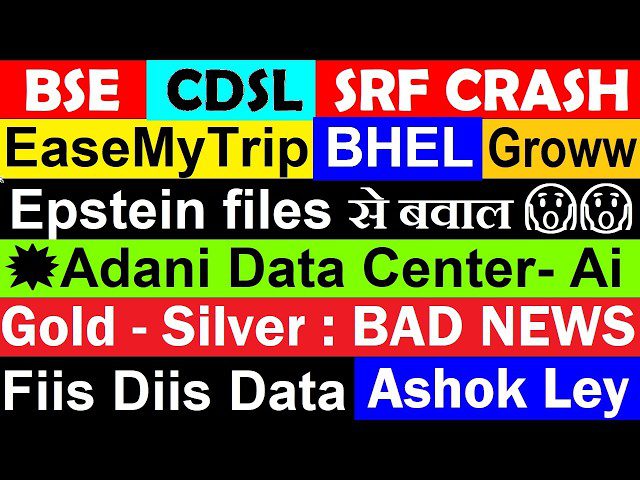
The global financial landscape is currently navigating a period of intense volatility, driven by macroeconomic shifts and high-profile controversies. From the market fluctuations in the United States to massive infrastructure commitments in India, the investment climate demands a strategic and informed approach. This comprehensive report analyzes the primary drivers affecting global markets, including the fallout from the Epstein file disclosures, Adani Group’s ambitious data center roadmap, and critical updates across the technology, defense, and commodity sectors.
Global Market Volatility: US Indices and the Epstein File Controversy
The American stock markets, including the Dow Jones Industrial Average and the Nasdaq, continue to exhibit significant intraday volatility. While some sessions show recovery attempts, the overarching sentiment remains cautious. A major contributor to this unease is the ongoing release of the “Epstein Files,” which has reportedly implicated several high-profile global figures.
Notably, speculation regarding Bill Gates’ attendance at recent AI summits has dominated headlines. Contradictory reports about his participation have fueled market gossip, with many linking the uncertainty to the mention of his name in the unsealed documents. This social and political drama often spills into the financial realm, as investors weigh the potential reputational risks for major tech conglomerates and their leadership.
Adani Group’s $5 Billion Commitment: Building the Future of AI Data Centers
Infrastructure giant Adani Group has made a massive strategic pivot toward the digital future. The group has committed a staggering $5 Billion USD to build robust data center infrastructure across India. This investment is not merely about storage; it is a foundational play for the Artificial Intelligence (AI) revolution.
Key Highlights of the Adani Data Center Roadmap:
- Green Energy Integration: Adani plans to power these massive data hubs using green energy and sustainable power backups, aligning with global ESG (Environmental, Social, and Governance) standards.
- Capacity Expansion by 2035: The group aims for a multi-fold increase in data capacity by the year 2035, positioning India as a global hub for AI processing and data sovereignty.
- Infrastructure Synergy: By leveraging its existing strengths in energy and construction, Adani seeks to create a closed-loop system that reduces operational costs for data management.
Railway and Telecommunications: Texmaco Rail and HFCL Secure Major Orders
The Indian industrial sector continues to show strength through consistent order inflows, which act as a leading indicator for future quarterly earnings.
- Texmaco Rail & Engineering: The stock recently witnessed a sharp rally following the acquisition of new orders totaling ₹240 crore. This influx of business confirms the company’s strong position in the domestic railway infrastructure expansion.
- HFCL Limited: The telecommunications player secured an order worth ₹61 crore for the supply of optical fiber cables. This reflects the ongoing nationwide push for 5G infrastructure and high-speed broadband connectivity.
National Infrastructure: Hazoor Multi Projects and NHAI Partnerships
Hazoor Multi Projects Limited (HMPL) recently secured a significant toll collection contract from the National Highways Authority of India (NHAI) valued at approximately ₹44.23 crore. Such contracts provide steady, predictable cash flows, which often lead to positive re-ratings for mid-cap infrastructure companies.
Macroeconomic Data: India’s Unemployment Trends
Recent data for January indicates a slight uptick in India’s unemployment rate. The figures moved from 4.8% to 5.0%, representing a 25% relative increase in certain segments. While the broader economy remains on a growth path, these labor market statistics suggest that job creation in the formal sector remains a challenge that policymakers must address to sustain long-term consumption.
Global Trade and Commodities: The $400 Billion Opportunity
Two major “good news” stories are emerging on the international front that could redefine India’s agricultural and energy landscape:
- Agri-Sector Boom: Potential trade deals between India, the European Union, and the United States could unlock a market worth $400 Billion for India’s agricultural sector. This would provide Indian farmers and agri-tech companies unprecedented access to Western markets.
- Crude Oil Softening: Global crude oil prices have seen a significant decline of over 2%, primarily due to shifting geopolitical dynamics between the US and Iran. Since India is a major oil importer, lower crude prices directly help in controlling domestic inflation and reducing the current account deficit.
Commodity Pressure: Gold, Silver, and Cryptocurrencies
While equity markets remain volatile, the commodity and crypto sectors are facing intense downward pressure.
- Gold & Silver: International gold prices have slipped towards the $1,900 per ounce range, marking a 2.5% decline. Silver has performed even worse, tumbling over 5.5% and breaking crucial support levels at $20.
- Cryptocurrencies: The digital asset market is witnessing a “lower-low” pattern. Bitcoin has slipped below the $60,000 threshold, while Ethereum has struggled to maintain its position above $2,000.
- FII & DII Activity: Despite the global gloom, both Foreign Institutional Investors (FIIs) and Domestic Institutional Investors (DIIs) were marginal buyers in the latest sessions, though the overall “enthusiasm” in the market remains muted.
Regulatory Shifts: Zerodha and the End of “Cheap Leverage”
Zerodha co-founder Nithin Kamath recently flagged a significant shift in the Indian trading ecosystem. Following new RBI mandates requiring 100% collateral, the era of “cheap leverage” for intraday trading is effectively over.
This regulatory tightening increases the cost of trading for retail investors and may lead to a temporary dip in market volumes. While this move is intended to safeguard the financial system from systemic risks, it places immediate pressure on discount brokers and high-frequency traders.
Defense and Aviation: India-France Partnership and H125 Helicopters
The visit of the French President to India has yielded significant results in the defense sector. A key highlight is the partnership to establish an H125 helicopter assembly line in India. This move towards domestic assembly of world-class aviation hardware strengthens India’s “Aatmanirbhar Bharat” (Self-Reliant India) initiative and provides a boost to private defense players.
Corporate Updates: Zomato, BSE, SRF, and EaseMyTrip
- Zomato & Swiggy: These platforms faced selling pressure after the Karnataka government notified a 1% welfare fee for gig workers. While the percentage seems small, the cumulative impact on the bottom line of these aggregators is substantial.
- BSE & CDSL: The exchange and depository stocks remain under pressure following the RBI’s leverage restrictions, as lower trading volumes directly impact their transaction-based revenue.
- SRF Limited: The stock experienced a sudden drop after reports emerged that the promoter group, Kama Holdings, sold a 3% stake in the open market. Large-scale promoter selling often triggers short-term panic among retail investors.
- EaseMyTrip: In contrast, EaseMyTrip shares surged following news that the company plans to raise ₹500 crore to expand its hotel and holiday business, signaling an aggressive push into the high-margin travel segment.
- BHEL: State-run Bharat Heavy Electricals Limited (BHEL) secured a massive ₹1,500 crore order from another government entity, reinforcing its dominance in the heavy engineering and power equipment space.
Conclusion
The current market cycle is defined by a tug-of-war between strong domestic order books and global geopolitical instability. While the Adani Group’s $5 billion AI investment and the India-France defense pact offer long-term structural growth, the volatility in the US markets and the regulatory changes in domestic trading costs require a cautious investment strategy. Investors should focus on companies with clear earnings visibility and strong order pipelines, such as BHEL and Texmaco Rail, while remaining mindful of the fluctuating commodity prices and global news cycles.