


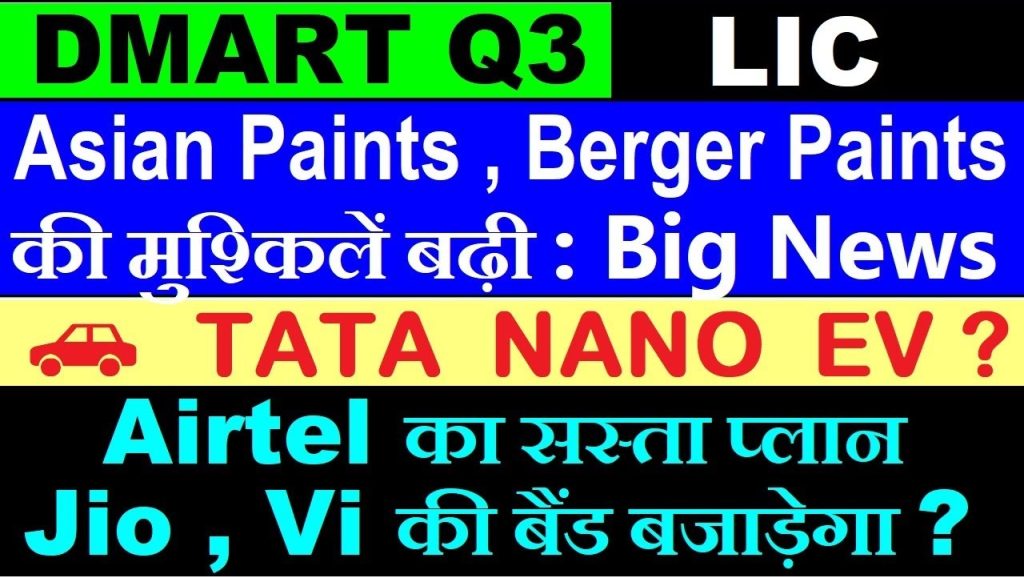
LIC’s December Business Performance
In December, LIC’s new business premium collection exceeded ₹30,000 crores. However, compared to previous data, this represents a noticeable decline. Analysts have noted a drop in new business premiums, with collections not as robust as in earlier months.
Tata Nano’s Transition to Electric Vehicles
Tata Nano, once introduced as the cheapest car, faced significant challenges due to its branding as a low-cost vehicle. The perception of being a “cheap” car led to negative market reception, overshadowing its innovative design intended for families transitioning from two-wheelers to cars. Despite its initial failure, recent discussions suggest a potential comeback of Tata Nano as an electric vehicle (EV). If launched at an estimated price of ₹2 lakhs, it could become a game-changer in the EV segment, considering the rising demand for affordable electric cars.
Telecom Industry Updates: Airtel, Jio, and Vi
The telecom sector is dominated by three major players: Airtel, Jio, and Vi. Despite offering competitive pricing, these companies have faced challenges due to increased tariffs. BSNL continues to attract price-sensitive customers with affordable plans. Recently, Airtel introduced emergency data plans starting at ₹11, providing short-term solutions for customers needing immediate recharge options. These plans offer limited data, catering to urgent requirements.
DMart’s Q3 Financial Results
DMart’s Q3 results were released later than usual, showing impressive growth. The total income for the quarter reached ₹15,996 crores, up from ₹14,500 crores in the previous quarter and ₹13,500 crores a year ago. The company’s profitability before tax (PBT) stood at ₹995 crores, with a net profit (NPAT) of ₹724 crores, indicating a steady increase in both quarterly and yearly profits.
Paint Industry: Competitive Dynamics
Asian Paints and Berger Paints are facing increased competition from international players like AkzoNobel. AkzoNobel’s potential exit from the Indian market has attracted interest from major domestic companies like JSW Group and Birla Group, aiming to acquire its assets. The acquisition could significantly enhance the market presence of the acquiring company, posing new challenges to established players like Asian Paints and Berger Paints. The paint industry’s dynamics are shifting, with new entrants intensifying competition, necessitating strategic adjustments from existing leaders.
Conclusion
The evolving landscape in industries such as finance, automotive, telecom, and paint highlights the importance of strategic adaptability. Companies like Tata and DMart are poised to leverage market opportunities, while the paint industry’s competition underscores the need for innovation and strategic acquisitions. As market dynamics continue to shift, businesses must remain agile to sustain growth and competitiveness.