


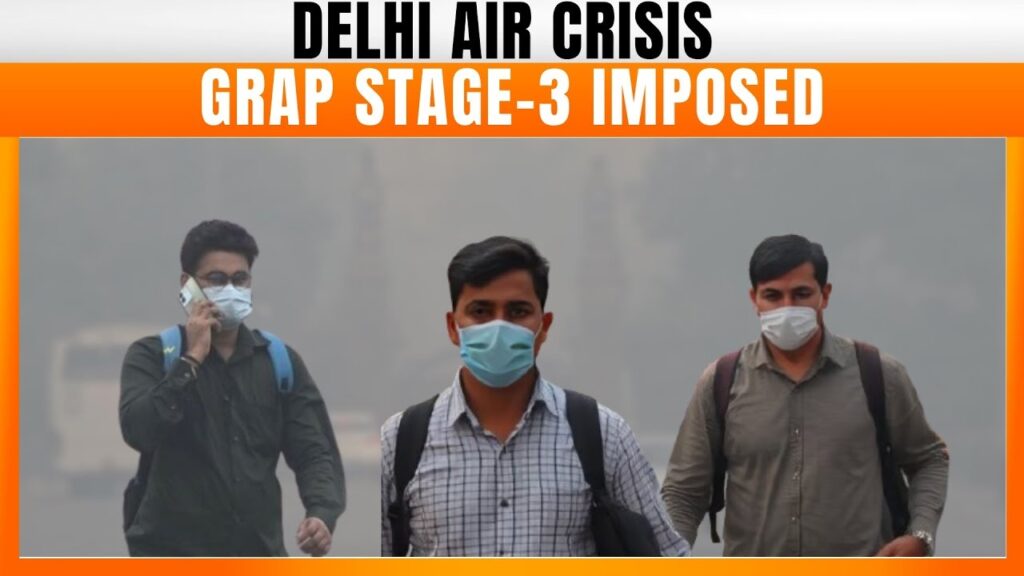
In order to remedy the deteriorating conditions in the national capital, the government has taken strict measures given the dangerously high levels of air pollution. This article traces how the decision among the authorities to implement GRAP stage III due to the civil unrest in the region owing to the rising levels of pollution along with its dire consequences on the people’s health.
Crisis of Delhi’s Air Pollution Ozone Layer
Air pollution in Delhi is on the rise and now appears to be on the verge of an out-of-control epidemic, with the AQI (air quality index) peaking at ‘very bad’ levels. Recently, the pollution levels surged, and the AQI reached an astounding 418 points, signaling concerns for human life in terms of the surrounding air. A hazardous equilibrium brought about as a result of automobile emissions, construction, and factories operating in parallel has led the national capital’s government officials to act towards taking measures to diminish the air pollution.
Shifting schools classes online during the rehabilitation: Delhi government decision
As a result of the rising levels of pollution, the Chief Minister of Delhi, Atishi Marlena has stated that all elementary schools in the nation will conduct online sessions until the pollution is under control. This step has been taken to protect the young ones including kindergarten kids against such ill-pressuring air that should be inhaled by no one.
GRAP-III Restrictions Imposed in Delhi-NCR
The region of National Capital Territory has an issue where pundits have come together to ban elements of construction to stop this breathing crisis for thousands and give the capital the clean air it needs. The ‘Graded’ Action Plan has to go through a stage one and three before getting the capital to stage three where pollution would exactly have a threshold. Because this is a problem that extends beyond Delhi. Here is what the restrictions look like, in Level III Restriants;
Suspension of Construction and Demolition Activities: The following activities are hereby temporarily suspended: demolition or construction of private housing projects, construction of sidewalks, as well as the laying down of other factors that have been known to contribute to the obliteration of fertile airspace.
Inter-State Bus and Truck Restrictions: The government imposed rules on state interstate buses, interstate trucks as well as the BS-III petrol truck and diesel vehicles from coming into contact with Delhi’s modified borders because further pollution was believed to be the key outcome.
Suspension of Mining-Related Activities: The country has put such a ban on all mining related practices which have been nuggets in causing further erosion of fertile land with dust particles from Nunshigum until Jehlum.
Regular Water Sprinkling on Major Roads: Roads that lead to overexposure of air to airborne foes is something the government is mandated to provide with a finite sprinkling of water every day to make sure airborne factors and enemies such dust be kept to a minimum level.
What is the Graded Response Action Plan (GRAP)?
The Graded Response Action Plan (GRAP) was formulated, created as a measure to address air pollution in the regions of Delhi-NCR. This plan has four tiers, each corresponding to a defined range of the AQI or Air Quality Index:
Stage I (AQI 201-300): Gradual bans such as construction activity as well usages of selective green firecrackers only.
Stage II (AQI 301-400): The ban on road dust pollution, burning waste, and construction is heightened.
Stage III (AQI 401-450): Non critical constructions are banned, inter-state buses are limited, and young kids are taught from home via computer programs.
Stage IV (AQI 451-500): Other than the banning of all construction work, traffic is curbed and schools are closed.
The aim of the different tiers is to progressively lessen the ban and allow pollutants to reducegradually while lowering the health risks faced by the residents.
Health Impacts of Severe Air Pollution
The level of air pollution in New Delhi has raised dangerous health effects risks for children, older people and even people with breathing complications. According to some health professionals, breathing in high concentrations of pollutants for an extended amount of time might result in a variety of conditions, including heart disease, chronic lung disease, and weakened immunity, all of which have severe long-term consequences. The most frequently mentioned complaints were difficulty in breathing, throat pain, headaches as well as fatigue.
Why Pollution Levels Are Increasing in Delhi
Death, Deforestation, Blight, Apparently Oxygen has a phobia of residing in Delhi. To begin with, and that may come as a surprise to you, a lot of pollutants are drawn in from diesel and petrol vehicles, particularly in the Greater Delhi region.
Construction Dust: Apparently On a flip side a huge contributor for defiled hot air as well is demolishing and construction sites follow.
Industrial Emissions: Oil refineries and chemical industries do even pollution that can not be seen, this hampers the air quality in more ways than one.
Pollution from Burning of Crop Residues: Chanpatia’s or nearby states are slowly turning to ashes every year due to the fulfilling of one depressed’s soul with agriculture residues increasing or worsening the regions smog.
Wind Pollution Pressure: Perhaps migration and pollution make a good pair, as constructing a building in the complex regions with too much pollution the place the TP have nowhere to go and get trapped underneath
Long Term Solutions and Where the Government Stands On It
While India is attempting to go green with come incentives to invest in Electric Vehicles the Union Government is at rest. Settling fuel accounts or borrowing whatever they have left to increase the the usage of EVs is a shot in the dark for them.
Increased Public Transport: The government’s focus here is to minimize the number of cars on the road, by improving and adding to the mass transit system.
Improvement in Construction Waste Management: A better approach to the management and disposal of construction wastes and materials might help to lower pollution resulting from construction sites and waste incineration.
Controls on Pollution from Industries: Any part of Delhi and NCR going under strict industrial poles would have measures on the space are likely to lower the emissions of harmful gases.
Social Go-Green Drives: Creation of awareness and education among the masses regarding the levels of pollution and its detrimental health effects, as well as promotion of green habits are no less significant .
Wrapping Up
Delhi’s crisis of pollution should be taken very seriously since it has reached unbearable levels and needs drastic measures to be adopted. Through the enactment of GRAP Stage III restrictions, closure of primary schools as well as limiting vehicle movement, the government’s intentions are to ward off the adverse effects of pollution. In the future, it is important that long-term actions and tougher measures are taken to tackle the pollution issue.