


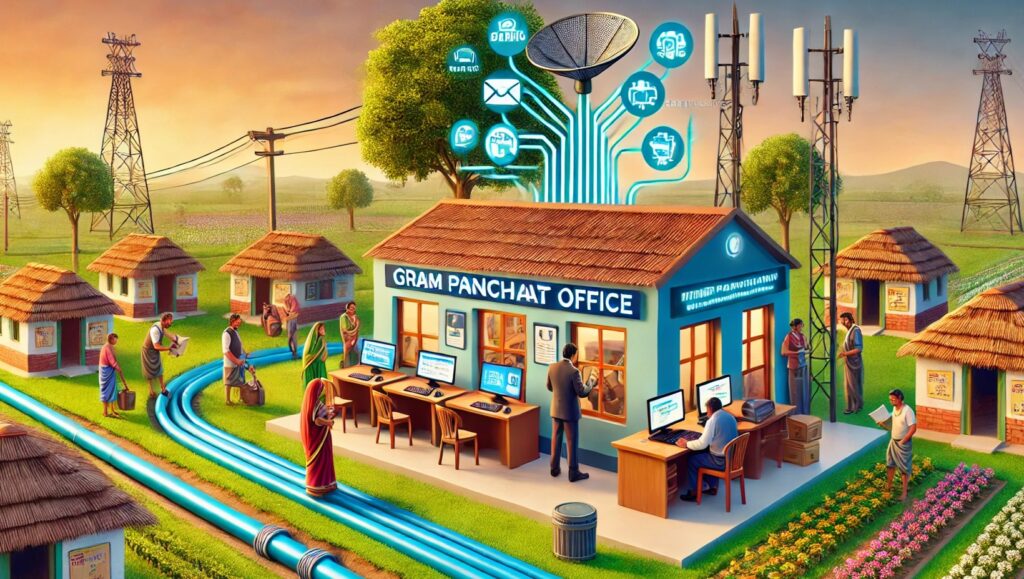
Citizen Charter 2.0 Implementation Plan in Gram Panchayats, Bringing Public Services to Rural Doorsteps. The New Citizen Charter 2.0
The central government of India is preparing to introduce Citizen Charter 2.0, aimed at delivering essential services to rural populations more efficiently. This initiative is designed to ensure that services are provided within a specified timeframe and grievances are addressed promptly. By implementing this upgraded charter across 6,40,930 village panchayats, the government aims to bridge the gap between urban and rural service delivery.
The Need for a New Citizen Charter
Since its inception in 1997, the original Citizen Charter established a framework to provide public services within defined timeframes. However, over the years, the government has recognized that rural areas are still not receiving adequate services compared to urban regions. Despite advancements in technology, many village panchayats have not yet fully embraced digital solutions. In fact, only 28% of public services are available online in rural areas, leaving the remaining 72% offline. This has resulted in significant challenges for rural citizens, particularly in areas like fee payments and document verification, where villagers often face delays and hurdles.
To address these gaps, the central government has decided to roll out Citizen Charter 2.0, which aims to bring essential services right to the doorstep of rural communities.
Global Models of Rural Public Services
Countries like Bangladesh, Ethiopia, Mozambique, Sri Lanka, and the Philippines have set benchmarks in delivering rural public services using cutting-edge digital technologies. Bangladesh’s “Access to Information” initiative, Ethiopia’s “Modular Open-Source Identity Platform,” and Mozambique’s “Digit” program are notable examples of digital public goods. Similarly, Sri Lanka and the Philippines have adopted systems like DHIS2 and Open G2P to enhance service delivery in rural areas. Inspired by these models, India’s Citizen Charter 2.0 is set to incorporate best practices from around the world.
Implementation Plan for Citizen Charter 2.0
The Ministry of Panchayati Raj is leading the effort to implement Citizen Charter 2.0 under the banner, “Meri Panchayat, Meri Adhikaar—Jan Sevaaye Hamara Dwaar” (My Panchayat, My Rights—Public Services at Our Doorstep). A series of national and regional workshops will be conducted to guide state governments on the implementation of this initiative.
The first workshop was held at the National Institute of Rural Development (NIRD) in Hyderabad, with participation from states such as Telangana, Andhra Pradesh, Gujarat, Jharkhand, Madhya Pradesh, Mizoram, and Odisha. These workshops are crucial to aligning state governments with the national strategy and ensuring a seamless rollout across all panchayats.
Digital Transformation of Panchayats
For the successful implementation of Citizen Charter 2.0, each village panchayat will require a proper building and necessary infrastructure. The central government is providing financial assistance for the construction of panchayat offices and supplying computers to village councils. The Bharat Network or fiber-optic connections supported by state governments will provide internet access to rural panchayats.
To ensure efficient service delivery, the National Informatics Centre (NIC) is setting up an online service delivery platform, and every panchayat will have a dedicated computer operator. In cases where no operator is currently available, existing staff will be trained in basic computer operations, ensuring smooth digital service management.
Progress in Digital Service Delivery
Several states, such as Gujarat, Maharashtra, Tripura, Kerala, and Rajasthan, have already made significant strides in delivering public services online in rural areas. However, states like Telangana, Andhra Pradesh, Karnataka, Uttarakhand, and Himachal Pradesh are still lagging behind. The central government, through the Ministry of Panchayati Raj, is committed to supporting these states in their efforts to catch up.
Vivek Bharadwaj, Secretary of the Ministry of Panchayati Raj, emphasized that the central government is fully dedicated to enhancing rural service delivery. The goal is to make every panchayat a hub of efficient, transparent, and accountable public services. During a regional panchayat conference held in Hyderabad, Bharadwaj underscored the importance of delivering better services to the grassroots level and improving the quality of life for rural citizens.
A Commitment to Better Governance
During the regional panchayat summit, Narendra Kumar, Director General of NIRD, stressed that the responsibility for driving positive change at the local level lies with panchayat representatives and officials. By equipping these leaders with modern tools and technologies, the government is paving the way for a governance revolution in rural India.
The central government will continue to strengthen the digital infrastructure at the grassroots level, enabling panchayats to provide timely and effective services to citizens. This digital push will not only improve governance but also reduce the bureaucratic delays that rural citizens often face.
Citizen Charter 2.0: Key Components and Action Plan
The Ministry of Panchayati Raj has outlined an action plan for Citizen Charter 2.0, under the campaign “Meri Panchayat, Meri Adhikar—Jan Sevaaye Hamare Dwaar” (My Panchayat, My Rights—Public Services at Our Doorstep). To guide the implementation process, the ministry is organizing regional workshops across states. The first workshop was held at the National Institute of Rural Development and Panchayati Raj (NIRD) in Hyderabad, involving states like Telangana, Andhra Pradesh, Gujarat, Jharkhand, Madhya Pradesh, and Odisha.
Digital Transformation of Gram Panchayats
A crucial part of implementing the Citizen Charter 2.0 is the digital transformation of gram panchayats. To facilitate this, every panchayat will require a well-established building and necessary infrastructure. The central government will provide funding for constructing these buildings and supplying computers to the panchayats. In addition, internet connectivity will be enhanced through Bharat Network or state-supported fiber cable networks.
The National Informatics Centre (NIC) will set up an online service delivery system, and each panchayat will appoint a computer operator or train existing staff to handle digital services.
Success Stories in Rural Digitalization
Several states have already made significant strides in delivering online services in rural areas. For instance, Gujarat, Maharashtra, Tripura, Kerala, and Rajasthan are leading the way in providing efficient, online public services. However, other states like Telangana, Andhra Pradesh, Karnataka, Uttarakhand, and Himachal Pradesh are lagging behind. To address this, the Ministry of Panchayati Raj is providing full support to ensure that all gram panchayats across the country can deliver seamless, transparent, and accountable services.
Commitment to Better Governance
The central government is committed to transforming every gram panchayat into an efficient hub for delivering public services. This commitment was echoed by Vivek Bhardwaj, the Secretary of the Ministry of Panchayati Raj, during a recent regional workshop at NIRD in Hyderabad. Bhardwaj emphasized the importance of panchayats working towards providing faster, better services to the public, while adopting best practices and operational strategies to ensure that digital infrastructure is strengthened at the grassroots level.
NIRD Director General Narendra Kumar also highlighted that the responsibility for positive change at the local level lies with panchayat representatives and officials. By equipping them with the latest tools and technologies, the stage is set for a governance revolution that will improve the quality of life for millions of rural residents.
Looking Ahead: A New Era of Rural Service Delivery
As India prepares to launch Citizen Charter 2.0, the focus remains on bringing better governance and enhanced services to the rural population. The program’s success will hinge on the collaboration between central and state governments, as well as the continued investment in digital infrastructure and human resources at the village level. By embracing this digital revolution, India can ensure that no village is left behind in its journey toward better public service delivery.
Citizen Charter 2.0 represents a bold step towards ensuring that rural India enjoys the same quality of services that urban areas have long benefited from. With the government’s commitment to improving transparency, accountability, and the quality of services, rural citizens can expect more efficient, reliable access to essential services in the near future.
Conclusion
The introduction of Citizen Charter 2.0 marks a significant step forward in rural governance in India. By leveraging digital technologies and global best practices, the government is committed to bringing essential services to the doorsteps of rural communities. As each village panchayat transforms into a hub of efficient service delivery, the quality of life for rural citizens is set to improve significantly.
The success of this initiative will depend on the collaboration between the central and state governments, the dedication of panchayat representatives, and the effective use of technology. With these efforts, India’s rural landscape will witness a transformation that ensures better services, greater transparency, and enhanced accountability for all.