


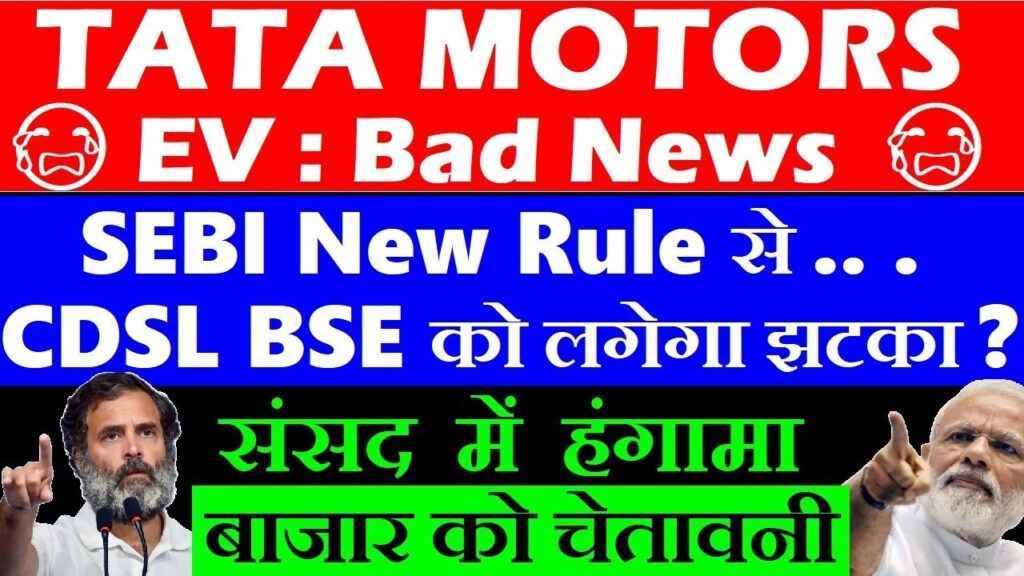
TATA MOTORS EV Faces Setback in Q2 Market Due to SEBI’s New Rules,
TATA MOTORS EV Faces Setback as SEBI’s New Regulations:
- Target on Futures and Options (F&O): SEBI is focusing on regulating the futures and options market, as it’s observed that most retail investors lose money in this segment. There are discussions about treating F&O trading similar to lotteries or cryptocurrencies due to the high risk involved.
- Impact on Broking Companies: If SEBI imposes stricter regulations or removes certain derivative products, it could significantly impact broking firms’ revenues. For instance, Zerodha’s founder has highlighted the potential revenue loss if such regulations are enforced.
- Impact on CDSL and BSE: Questions were raised about the impact on CDSL and BSE. It’s clarified that while CDSL (which deals with investor data) might see a minimal impact, BSE (which benefits from trading volumes) could see a significant impact.
- 📉 Tata Motors’ Q1 performance showed a significant decline in vehicle sales compared to last year.
- ⚡️ Commercial vehicle sales grew by 6% year-on-year, while passenger vehicle sales dropped by 1%.
- 🚗 Overall domestic sales witnessed an 8% decrease on a quarterly basis.
- 📊 Electric vehicle sales saw a sharp 34% decline from the previous year’s June figures.
- 📉 Passenger vehicle business, including EVs, reported a notable 8% decrease in sales.
- 🔋 Quarterly electric vehicle sales decreased by 1% compared to the previous quarter.
- 🚚 Commercial vehicle sales data, including heavy and light segments, were also analyzed.
- 📈 Despite challenges, commercial vehicle sales showed monthly and quarterly growth.
- 🚗 Tata Motors is heavily invested in electric vehicles (EVs), a significant part of its identity now.
- ⚡️ The market reaction to Tata Motors’ EV performance data is critical post-market closure.
- 📉 Understanding the nuances of stock market reactions to data releases is essential.
- 📈 Bull runs in the market often mitigate potential damages despite negative performances.
- 📉 Retail investors are cautioned about the risks associated with futures and options trading.
- 💰 Rushing into high-risk investments for quick wealth can lead to substantial losses.
- 📊 SEBI’s stringent regulations impact both equity and options traders significantly.
- 📈 Retail investors are warned against unrealistic expectations of quick wealth through trading.
- 📉 SEBI chairperson hinted at possible derivatives market changes, impacting brokerages and trading volumes.
- 💼 Brokerage firms like CDSL and BSE might face revenue challenges due to potential market adjustments.
- 💰 Revenue impacts for brokerage firms could be substantial if derivative products are removed.
- 📊 Market volatility and trading volumes are crucial factors affecting brokerage profitability.
- 🌍 Investor sentiment and participation levels could shift based on market regulatory changes.
- 📈 CDSL and BSE may need to adapt strategies to navigate potential market disruptions.
- 🎯 Analysis suggests potential business implications for brokerage firms in the evolving market landscape.
- 💡 Understanding market dynamics and regulatory shifts is key for informed investment decisions.
- 📉 CDSL and BSE will be affected differently by SEBI’s new rules, impacting the broking industry significantly.
- 🗳️ Recent elections have concluded, with significant implications for the political landscape and policies affecting sectors like equity and currency.
- 🏛️ The parliament session showcased intense political activity, reflecting future legislative challenges and opportunities.
- 💼 Companies in growth sectors are expected to swiftly adapt to new regulatory requirements for faster development.
- 🌍 Adani Group’s renewable energy projects are gaining attention, potentially influencing future market trends.
- 💡 The opposition’s role remains crucial despite current political dynamics favoring the majority party.
- ⚖️ Stock market participants are closely monitoring legislative developments for potential investment impacts.
- 🔍 Investors should focus on Adani-related stocks given ongoing developments in renewable energy.
Tata Motors’ Impressive Performance in Q1 FY25
In June 2024, Tata Motors reported 43,524 unit sales in the domestic market, down 8% from the previous year’s 47,235 units. However, the company recorded total sales of 2,29,891 vehicles in both domestic and international markets for Q1 FY 2024-25, a slight increase from 2,26,245 units in Q1 FY 2023-24. Across all categories, Tata Motors sold 74,147 units, a year-on-year decline of 8%, but a 2% quarterly increase. Including electric vehicles (EVs), June 2024 sales reached 43,624 units, marking an 8% year-on-year decline. EV sales alone fell dramatically, with 4,657 units sold compared to 7,025 units the previous year, a drop of 34%.
Passenger Vehicle Market Trends
The first quarter of FY25 saw a dip in passenger vehicle registrations in May and June, following a surge in April due to regional festivities. This decline was influenced by general elections and extreme weather conditions. Tata Motors’ total passenger vehicle sales, including SUVs and EVs, stood at 1,38,682 units in Q1 FY25, consistent with the previous fiscal year’s figures. The company adjusted its wholesale numbers to align with retail sales, effectively managing channel inventory. The EV market also mirrored the broader industry trend, affected by a significant increase in fleet sales in Q4 FY24 due to the expiry of the FAME II subsidy in March 2024. While personal segment sales saw a slight uptick, fleet segment sales dropped sharply but are expected to recover in the coming quarters.
Shailesh Chandra, Managing Director of Tata Motors Passenger Vehicles Ltd. and Tata Passenger Electric Mobility Ltd., expressed optimism about future demand recovery, citing strong enquiry levels despite recent low sales. He highlighted the positive outlook for the industry with the upcoming festive season, noting Tata Motors’ readiness to capitalize on growth opportunities, particularly with strong demand for SUVs like the Punch and Nexon and new launches.
Commercial Vehicle Sales and Market Insights
Tata Motors’ domestic and international sales for Q1 FY 2024-25 reached 2,29,891 vehicles, compared to 2,26,245 units in Q1 FY 2023-24. In June 2024, total domestic sales across all categories were 74,147 units, a decrease of 8% from June 2023. The commercial vehicle segment saw mixed results, with heavy commercial vehicle (HCV) sales at 8,891 units, down 8%, and intermediate and light commercial vehicle (ILMCV) sales up by 6% at 4,997 units. Passenger carriers recorded an 18% increase, while small commercial vehicles (SCV) and pickups declined by 21%. Overall, domestic commercial vehicle sales for Q1 FY25 were 87,615 units, a 7% increase from the previous year.
Growth in Medium and Heavy Commercial Vehicles
The medium and heavy commercial vehicle (M&HCV) segment showed promising growth. Domestic M&HCV sales in June 2024 were 14,640 units, compared to 14,427 units in June 2023, with Q1 FY25 sales at 40,349 units, up from 35,188 units in Q1 FY24. International M&HCV sales followed a similar trend, with 15,224 units sold in June 2024 and 41,974 units in Q1 FY25, compared to 14,770 and 36,577 units, respectively, in the previous fiscal year.
Girish Wagh, Executive Director of Tata Motors Ltd., emphasized the 7% growth in Q1 FY25 commercial vehicle sales compared to the previous year. He highlighted the M&HCV segment’s 10% rise, driven by strong demand in e-commerce, auto-aggregates, and LPG sectors. The commercial vehicle passenger business also showed robust recovery post-pandemic, with school and staff transportation segments growing by 39%. However, sales of small and light commercial vehicles faced a 6% decline, primarily due to financing challenges for first-time users.
Positive Market Outlook
Looking ahead, Wagh projected a healthy demand for commercial vehicles, supported by favorable monsoon forecasts, policy stability, and ongoing government infrastructure projects. He expected strong demand in staff, intercity, and stage carriage segments, despite a seasonal dip in school transportation. Tata Motors remains focused on supporting customer success while closely monitoring macroeconomic factors such as geopolitical developments, interest rates, fuel prices, and inflation.
Passenger Vehicle Sales Breakdown
In June 2024, Tata Motors’ domestic passenger vehicle sales, including EVs, were 43,524 units, an 8% decrease from June 2023. For Q1 FY25, total domestic passenger vehicle sales were 1,38,104 units, slightly down from 1,40,120 units in Q1 FY24. International sales also saw a decline, with 100 units sold in June 2024 compared to 124 units in June 2023, but a 75% increase in Q1 FY25 sales, reaching 578 units compared to 330 units the previous year. Total passenger vehicle sales, including EVs, were 43,624 units in June 2024 and 1,38,682 units in Q1 FY25, reflecting a 1% year-on-year decline.
Shailesh Chandra noted that the passenger vehicle industry experienced a decline in registrations in May and June due to general elections and heat waves. Despite this, Tata Motors’ Q1 FY25 wholesales remained stable compared to the previous year, as the company aligned its wholesale and retail numbers to manage inventory. The EV industry, affected by the expiration of the FAME II subsidy, saw a sharp decline in fleet segment sales but a slight increase in the personal segment.
Chandra expressed confidence in future demand recovery, supported by strong enquiry levels and the upcoming festive season. He emphasized Tata Motors’ preparedness to leverage growth opportunities, driven by strong demand for SUVs like the Punch and Nexon and new product launches in the coming months.
Post-Election Scenario: With the NDA winning the elections but not achieving a single-party majority, the political environment is expected to be tumultuous. This might affect the passage of bills and overall market sentiment.Adani Group’s Future: The Adani Group might face increased scrutiny and opposition in the coming years, especially related to their renewable energy projects and alleged connections with Chinese firms.