


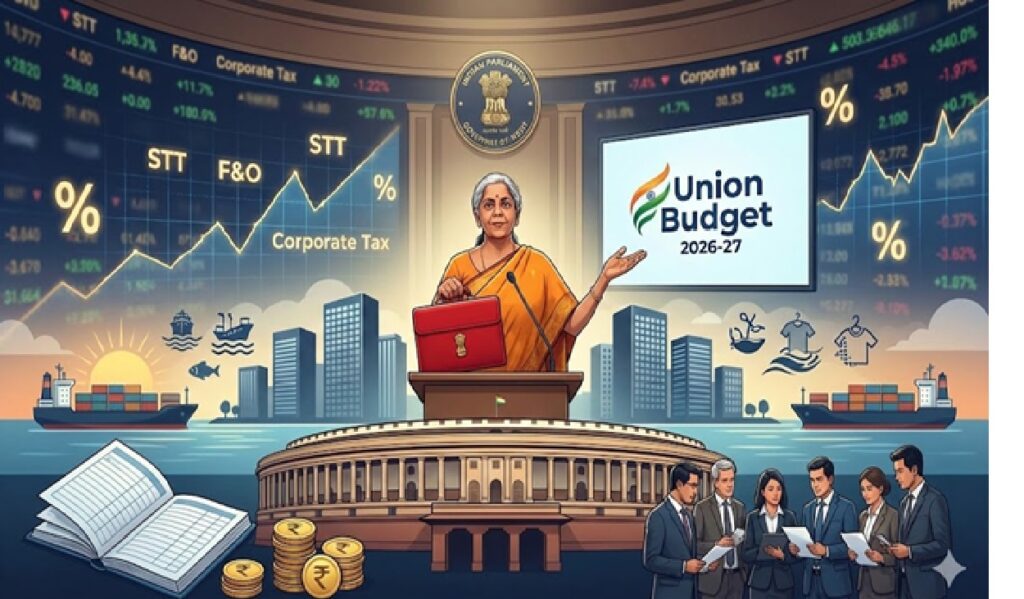
Major Changes in Securities Transaction Tax (STT) and Corporate Taxation: A Comprehensive Analysis of FM Sitharaman’s Latest Tax Reforms Impacting F&O Traders, Corporates, and Exports
India’s taxation framework is once again at the center of policy debate following the latest announcements by Finance Minister Nirmala Sitharaman. These reforms, unveiled as part of a broader fiscal restructuring exercise, mark a decisive shift in how securities transactions, corporate taxation, buybacks, and indirect taxes are treated. Among the most discussed measures is the sharp increase in Securities Transaction Tax (STT) on futures and options (F&O) trades, alongside sweeping changes to buyback taxation, Minimum Alternate Tax (MAT), Tax Collected at Source (TCS), and customs duties.
This in-depth article provides a complete, SEO- and GEO-optimized breakdown of the announced changes. It explains what has changed, why these reforms matter, and how they are likely to affect traders, investors, promoters, corporates, exporters, and the broader Indian economy. Written in clear, active, and human-centric language, this analysis is designed to help readers fully understand the policy direction and prepare for its real-world implications.
Introduction: A Turning Point in India’s Taxation Landscape
Over the last decade, India has steadily moved toward simplifying its tax system, broadening the tax base, and reducing opportunities for arbitrage. The latest announcements build on this trajectory. The Finance Minister has clearly signaled the government’s intent to curb speculative excesses, ensure equitable taxation among different classes of shareholders, and align India’s indirect tax structure with domestic manufacturing and export competitiveness.
The increase in STT on derivatives trading has particularly drawn attention from market participants, while corporates are closely evaluating the implications of MAT becoming a final tax from April 1, 2026. At the same time, exporters and manufacturers are assessing how changes in customs exemptions and duty-free import limits may affect their cost structures.
Together, these reforms represent not isolated adjustments but a coordinated policy package aimed at long-term fiscal stability and economic efficiency.
Securities Transaction Tax (STT): A Significant Hike for F&O Trades
Understanding STT and Its Role in the Market
Securities Transaction Tax is a direct tax levied on the purchase and sale of securities traded on recognized stock exchanges in India. Introduced to ensure that financial market participants contribute fairly to government revenues, STT has traditionally been positioned as a low-rate, high-compliance tax.
While STT on equity delivery trades has remained relatively stable, derivatives trading—especially futures and options—has seen exponential growth in recent years. This rapid rise in volumes, largely driven by retail participation, has prompted policymakers to reassess the existing tax rates.
Revised STT Rates on Futures Trading
One of the most impactful announcements is the increase in STT on futures contracts. The rate has been raised from 0.02% to 0.05%. While this may appear marginal at first glance, the cumulative effect on high-frequency and large-volume traders is substantial.
For professional traders, proprietary desks, and institutions that execute thousands of contracts daily, the increased STT directly raises transaction costs. This could lead to a reassessment of trading strategies, particularly those that rely on thin margins and high turnover.
Higher STT on Options Premium and Exercise
The Finance Minister also announced a hike in STT on options trading, which has become the most popular segment among retail traders. The revised rates are as follows:
- STT on options premium increased to 0.15% from 0.10%
- STT on the exercise of options increased to 0.15% from 0.125%
This move directly targets the explosive growth in options trading, where short-term speculation has dominated participation. By raising transaction costs, the government aims to discourage excessive speculative activity while nudging traders toward more informed and risk-aware participation.
Impact of STT Hike on Traders and Market Liquidity
The immediate effect of higher STT is an increase in the cost of trading. For retail traders, especially those with smaller capital bases, profitability thresholds rise. Strategies that were marginally profitable may no longer be viable.
From a market-wide perspective, there could be a short-term moderation in volumes, particularly in ultra-short-term trades. However, long-term investors and hedgers are unlikely to be significantly affected. Policymakers appear to be prioritizing market stability and revenue certainty over unchecked volume growth.
Buyback Taxation: Capital Gains for All Shareholders
A Fundamental Shift in Buyback Tax Policy
Another major reform announced relates to the taxation of share buybacks. Historically, buybacks were taxed at the company level, often resulting in favorable outcomes for certain classes of shareholders due to tax arbitrage.
The new proposal fundamentally alters this structure. Buybacks will now be taxed as capital gains in the hands of all shareholders. This ensures uniformity in tax treatment and aligns buybacks more closely with dividends and secondary market transactions.
Additional Tax Burden on Promoters
To further discourage misuse of buybacks as a tax arbitrage tool, the government has introduced an additional buyback tax for promoters. The effective tax rates under the new regime are:
- Corporate promoters: Effective tax of 22%
- Non-corporate promoters: Effective tax of 30%
This distinction reflects the government’s intent to ensure that promoters, who often exercise significant control over buyback decisions, do not disproportionately benefit from favorable tax structures.
Implications for Corporate Capital Allocation
With buybacks becoming less tax-efficient for promoters, companies may reconsider their capital allocation strategies. Dividends, reinvestment in growth, or debt reduction could become more attractive alternatives.
From a governance perspective, this change also promotes greater fairness among minority shareholders, who have long raised concerns about buybacks disproportionately benefiting promoters.
Tax Collected at Source (TCS): Rationalization Across Key Sectors
Revised TCS Rates on Specific Goods
The Finance Minister announced a rationalization of TCS rates on the sale of certain goods. The revised structure includes:
- TCS rate reduced or rationalized to 2% on alcoholic liquor, scrap, and minerals
- TCS on tendu leaves reduced from 5% to 2%
This move aims to reduce compliance burdens and improve cash flows for businesses operating in these sectors, many of which face working capital constraints.
Why TCS Rationalization Matters
High TCS rates often lead to excess capital being locked up until refunds are processed. By lowering these rates, the government is effectively improving liquidity for sellers, particularly small and medium enterprises involved in trading and processing these goods.
The rationalization also reflects a broader push toward simplifying tax administration and reducing friction in legitimate business operations.
Corporate Taxation Reforms: Strengthening the New Tax Regime
Background: Corporate Tax Reforms Since 2019
In 2019, India undertook a landmark corporate tax reform by introducing a simplified regime with significantly lower tax rates. The objective was to make Indian companies globally competitive and reduce the complexity associated with exemptions and deductions.
The latest announcements build on this foundation, focusing on MAT and the treatment of accumulated credits.
Minimum Alternate Tax (MAT) to Become Final Tax
One of the most consequential changes is the proposal to make MAT a final tax from April 1, 2026. Under the new framework:
- MAT credit will be allowed only to companies that opt for the new tax regime
- Set-off of available MAT credit will be limited to one-fourth of the tax liability under the new regime
- No further MAT credit accumulation will be permitted after April 1, 2026
This marks a decisive move toward eliminating parallel tax calculations and simplifying corporate tax compliance.
Reduction in Final MAT Rate
In line with MAT becoming a final tax, the government has reduced the final MAT rate from 15% to 14%. This reduction partially offsets the loss of future credit accumulation and makes the new regime more attractive.
Companies with accumulated MAT credits up to March 30, 2026, will continue to be able to use them within the prescribed limits, ensuring a smooth transition.
Strategic Implications for Corporates
These changes strongly incentivize companies to migrate fully to the new corporate tax regime. While some firms may face short-term adjustments, the long-term benefits include predictability, reduced litigation, and simpler tax planning.
For investors, this clarity enhances confidence in corporate earnings projections and financial disclosures.
Indirect Tax Reforms: Customs and Central Excise Simplification
Objectives of the Indirect Tax Proposals
The Finance Minister emphasized that the proposed changes to customs and central excise duties aim to:
- Simplify the tariff structure
- Support domestic manufacturing
- Promote export competitiveness
- Correct inverted duty structures
- Eliminate long-standing and redundant exemptions
These objectives align closely with India’s broader industrial and trade policies.
Removal of Select Customs Duty Exemptions
The government plans to remove certain customs duty exemptions on items that are already being manufactured domestically or where imports are negligible. This move is designed to level the playing field for Indian manufacturers and reduce unnecessary complexity in the tariff system.
By narrowing exemptions, the government also aims to minimize classification disputes and improve compliance.
Incorporation of Effective Rates into the Tariff Schedule
To further simplify duty determination, certain effective rates currently notified separately will be incorporated directly into the customs tariff schedule. This change reduces ambiguity and makes it easier for businesses to ascertain applicable rates without navigating multiple notifications.
Sector-Specific Boost: Exports of Marine, Leather, and Textile Products
Enhanced Duty-Free Import Limits for Seafood Exports
In a targeted measure to support exporters, the Finance Minister announced an increase in the limit for duty-free imports of specified inputs used in seafood processing. The revised limit is:
- Increased from 1% to 3% of the FOB value of the previous year’s export turnover
This enhancement directly benefits exporters by lowering input costs and improving global competitiveness.
Impact on Export-Oriented Industries
Marine, leather, and textile exports are labor-intensive sectors that play a critical role in employment generation. By easing input constraints and reducing costs, the government aims to strengthen India’s position in global value chains.
These measures also align with the broader goal of boosting exports while maintaining fiscal discipline.
Broader Economic and Market Implications
For Retail and Institutional Investors
Higher STT on derivatives may lead to more disciplined trading behavior. While some speculative activity may decline, long-term investors and hedgers are unlikely to be adversely affected.
The clarity in corporate taxation and buyback rules also enhances transparency, which is beneficial for investor confidence.
For Corporates and Promoters
Promoters will need to reassess their approach to buybacks and capital returns. The new tax structure encourages a more balanced consideration of dividends, reinvestment, and strategic acquisitions.
Corporates, on the other hand, gain from greater predictability in tax liabilities under the new regime.
For the Government and the Economy
From a fiscal perspective, these reforms broaden the tax base, reduce arbitrage opportunities, and stabilize revenue streams. By discouraging excessive speculation and simplifying compliance, the government strengthens the overall efficiency of the tax system.
Conclusion: A Strategic Recalibration of India’s Tax Framework
The latest tax announcements by the Finance Minister represent a strategic recalibration rather than a mere rate adjustment. By increasing STT on F&O trades, rationalizing buyback taxation, finalizing MAT, and simplifying indirect taxes, the government has sent a clear message: growth, fairness, and simplicity will guide India’s fiscal policy going forward.
While certain segments may experience short-term adjustments, the long-term outlook points toward a more transparent, efficient, and globally competitive tax environment. For traders, investors, corporates, and exporters alike, understanding and adapting to these changes will be essential in navigating the next phase of India’s economic journey.
As these reforms take effect, stakeholders who align their strategies with the new policy direction are likely to emerge stronger, more resilient, and better positioned for sustainable growth.