


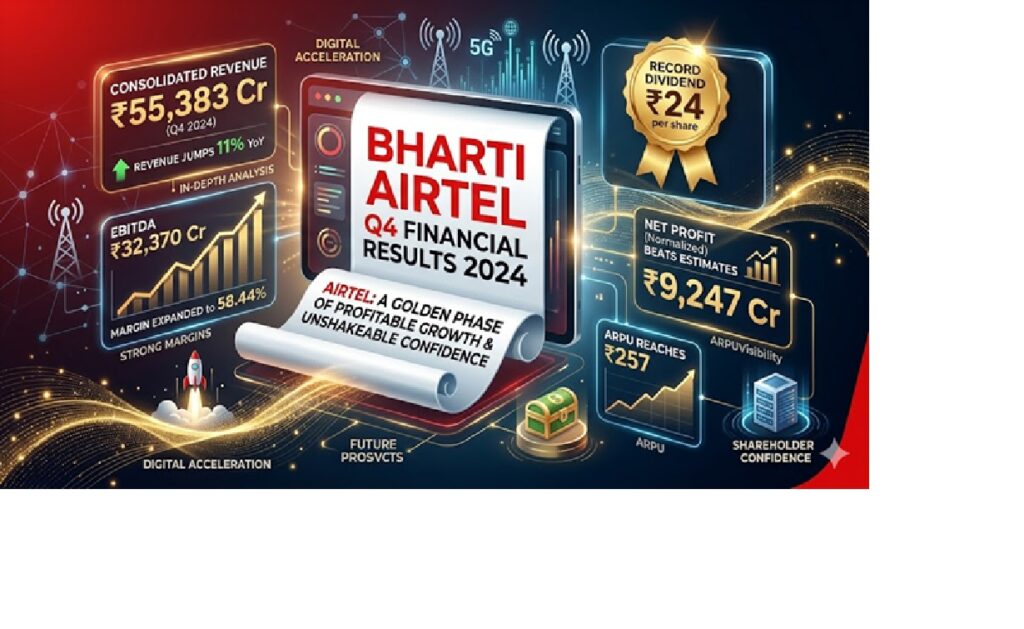
Bharti Airtel has unveiled its much-anticipated fourth-quarter financial results, delivering a performance that underscores the company’s operational strength and strategic resilience. Far from being a routine earnings release, the Q4 numbers reveal a narrative of consistent top-line expansion, robust operating leverage, and a shareholder-first capital allocation policy. The board also announced a final dividend of ₹24 per share, signaling unshakeable confidence in the company’s cash generation capabilities. This comprehensive breakdown dissects every critical metric, from revenue and expenses to net profit, exceptional items, tax dynamics, EBITDA margins, ARPU, and EPS, giving you a 360-degree view of what truly drove Airtel’s latest quarterly scorecard.
Airtel Q4 Revenue Soars: Rock-Solid Top-Line Growth Across All Time Frames
Bharti Airtel posted consolidated revenue of ₹55,383 crore for the quarter under review, a figure that not only comfortably met market expectations but also reflected the company’s ability to convert subscriber momentum into hard financial gains. On a year-on-year basis, revenue catapulted from ₹47,876 crore to over ₹55,000 crore, marking an impressive expansion of nearly 11–12%. This double-digit annual leap is no mean feat in a tariff-sensitive market where competitive intensity often suppresses pricing power. The sequential growth story is equally compelling. Compared to the preceding quarter’s ₹53,981 crore, Airtel added a solid 3% to its top line, dispelling any concerns of a seasonal slowdown. Market analysts had projected revenue in the ₹55,000–56,000 crore corridor, and Airtel’s actual print of ₹55,383 crore landed precisely within that guided range, confirming that the company’s commercial engines are firing on all cylinders.
What makes this revenue expansion particularly noteworthy is its quality. It isn’t a one-off boost fueled by non-core activities; rather, it stems from sustained improvement in India wireless services, robust home broadband uptake, and steady enterprise segment growth. The underlying subscriber mix shift towards 4G and 5G data customers continued to lift average realization, while the company’s relentless focus on network experience prompted premiumization across postpaid and family plans. The revenue figures, when read in conjunction with the ARPU trajectory, suggest that Airtel has successfully transitioned from a volume-led model to a value-driven franchise.
Cost Management Under the Lens: Expenses Stay Under Control
A healthy top line can quickly become meaningless if costs spiral out of control. Fortunately, Bharti Airtel’s Q4 expense line demonstrates disciplined financial stewardship. Total expenses for the quarter came in at ₹23,891 crore, a moderate increase when compared to the ₹23,198 crore incurred in the previous quarter, and a logical step-up from the ₹20,867 crore recorded in the same quarter last year. The year-on-year rise in costs is largely attributable to scaled-up network operations, higher spectrum amortization, and one-time regulatory levies, yet the spending remained well within the boundaries of normal operational scaling.
Crucially, the cost-to-revenue ratio showed no signs of flab. The company continues to extract efficiencies from its digital-first distribution architecture, automated customer service platforms, and energy cost optimization initiatives across its tower infrastructure. By tightly managing network operating expenses while simultaneously investing in 5G rollout and rural penetration, Airtel has preserved the elasticity of its profit margins. This equilibrium between growth investment and cost prudence forms the bedrock of its financial stability.
Net Profit Snapshot: Headline YoY Decline Masks a Stronger Operational Truth
At first glance, Airtel’s reported net profit of ₹9,247 crore might seem to have pulled back from the ₹12,475 crore recorded in the corresponding quarter of the previous year. A superficial reading could trigger alarm bells, but any seasoned investor will immediately recognize that the sharp year-on-year drop is not a symptom of business deterioration. Instead, it is the result of two technical, non-operating factors that dramatically inflated the previous year’s bottom line: a massive tax refund and a much lower exceptional charge.
In the year-ago quarter, Airtel enjoyed a net tax benefit of ₹2,891 crore owing to tax refunds, which meant the company effectively paid no tax during that period. In stark contrast, the current quarter carries a tax outgo of ₹797 crore. When comparing the two periods, this swing alone explains the bulk of the perceived profit contraction. Moreover, the net profit figure this time also absorbed a sizeable exceptional item loss of ₹3,160 crore, compared to a negligible ₹140 crore exceptional hit in the previous year. Once we strip away these distortions, the real operating engine shines through with admirable clarity.
The Exceptional Item Blow: Understanding the ₹3,160 Crore Charge
Exceptional items are, by definition, non-recurring and do not reflect the underlying earning power of the enterprise. In Q4, Airtel recognized an exceptional loss of ₹3,160 crore, a stark jump from the ₹256 crore reported in the prior quarter and the paltry ₹140 crore booked a year earlier. While the company’s detailed notes would specify the exact nature—often linked to asset impairments, restructuring costs, or regulatory provisioning—the key takeaway is that this charge substantially depressed the reported net income without indicating any deterioration in core telecom operations.
When analysts evaluate Airtel’s health, they routinely focus on pre-exceptional profits. And that’s where the numbers turn unequivocally positive. Before accounting for exceptional items and taxes, the operating profit (EBITDA) surged to ₹32,370 crore, up from ₹27,494 crore in the same quarter last year and ₹31,485 crore in the preceding quarter. This robust operating performance underscores that the company’s fundamental earning power expanded handsomely both year-on-year and sequentially. The exceptional item, while large, is a one-time aberration and does not alter the long-term investment thesis.
Tax Dynamics Decoded: How a Refund Distortion Created an Optical Illusion
Nothing confuses a headline number more than a volatile tax line. In the year-ago quarter, Airtel received a tax refund of ₹2,891 crore, transforming its tax expense into a net credit and inflating net profit beyond operational reality. This year, the company paid taxes of ₹797 crore—significantly lower than the ₹3,798 crore paid in the immediately preceding quarter, but still a far cry from last year’s net benefit. This tax normalisation is the single largest reason the year-on-year net profit comparison appears unfavourable.
When markets adjust for this tax anomaly, the real picture emerges: operating profit before tax and exceptional items grew strongly, and the net profit, after normalising for tax, came in significantly ahead of consensus estimates of around ₹7,500 crore. That Airtel delivered ₹9,247 crore despite the exceptional headwind and a positive tax charge showcases a formidable earnings resilience that should reassure stakeholders.
Operating Profit and EBITDA: The True Barometer of Business Momentum
Operating profit (EBITDA) is the lifeblood of a capital-intensive telecom business, and Airtel’s Q4 performance on this front is nothing short of stellar. EBITDA clocked in at ₹32,370 crore, translating to a robust EBITDA margin of 58.44%. This is a clear uptick from the 57.42% margin recorded in the year-ago period and a marginal improvement over the 58.32% achieved in the third quarter. The fact that the company is operating in the hallowed vicinity of a 60% EBITDA margin speaks volumes about its pricing discipline, operating leverage, and network efficiency.
This margin expansion was achieved even as Airtel continued to invest heavily in 5G infrastructure and rural footprint. The company’s ability to drive profitable growth is underpinned by a business model where incremental revenue falls almost directly to the EBITDA line due to relatively fixed network costs. With ARPU improving and data consumption soaring, the margin trajectory is likely to remain upward-biased, supporting future cash flows and debt reduction.
Airtel ARPU Reaches ₹257: The Silent Engine of Revenue Upside
Average Revenue Per User (ARPU) is the single most tracked metric in telecom, and Airtel’s reported ARPU of ₹257 aligns neatly with market forecasts that hovered around ₹256–257. The steady climb in ARPU is the result of multiple structural tailwinds: tariff repair in entry-level prepaid plans, up-trading of subscribers from feature phones to smartphones, rising data usage, and sticky postpaid additions. Airtel’s premium brand positioning allows it to capture a disproportionate share of high-value customers, which further buttresses ARPU.
At ₹257, Airtel remains India’s highest ARPU operator among the major telcos. The management’s oft-repeated ambition to push ARPU towards ₹300 is no longer a distant dream; it is a realistic medium-term target supported by ongoing tariff hikes and the accelerating adoption of 5G fixed wireless access. Every rupee increase in ARPU directly amplifies the top line by hundreds of crores, given the company’s massive subscriber base, creating a powerful operating leverage loop.
Dividend Delight: ₹24 Per Share Payout Reflects Cash Flow Confidence
In a move that will endear the board to income-seeking investors, Bharti Airtel declared a final dividend of ₹24 per share for the quarter. This generous payout underscores the company’s transition from a debt-heavy turnaround story to a cash-generating compounder. Airtel has been steadily improving its free cash flow generation, aided by lower interest costs, prudent capex, and rising EBITDA. The ₹24 dividend is not a one-off gimmick but a tangible outcome of a capital allocation framework that prioritizes shareholder returns alongside strategic investments.
The dividend announcement also signals that the worst of Airtel’s capex cycle may be behind it. With the bulk of 5G rollout and spectrum acquisition costs already absorbed, the management is comfortable returning surplus cash to shareholders while still retaining enough firepower for future growth avenues such as digital services, data centers, and enterprise solutions.
EPS Story: Normalized Earnings Power Shines Through
Earnings Per Share (EPS) provides the ultimate link between corporate performance and shareholder wealth. While the reported EPS figure may appear subdued due to the exceptional item, the normalized EPS—adjusted for one-off charges and tax anomalies—paints a much brighter picture. In the year-ago period, the optically high EPS of around ₹19 was an anomaly driven by tax credits. The current quarter’s normalized EPS, when reconciled with the ₹9,247 crore net profit and the outstanding share count, hovers around ₹15 per share, demonstrating genuine earning growth on a clean comparable basis. This underlying improvement is what fundamentally drives long-term stock performance, and it positions Airtel as a premium compounding candidate within the Indian equity universe.
Quarterly vs. Annual Trends: Decoding the Growth Algorithm
Step back and look at the multi-period trajectory, and a clear growth algorithm emerges. Revenue has risen consistently both quarter-on-quarter and year-on-year, with the Q4 performance showing a neat 3% sequential gain and a robust 11–12% annual jump. Operating profit has mirrored this trajectory, growing from ₹31,485 crore to ₹32,370 crore sequentially, and from ₹27,494 crore a year ago. Margins have expanded, and profit after tax (before exceptional items) has jumped about 9% quarter-on-quarter, signalling that the business is not just growing but also becoming more efficient.
The market’s pre-result expectation of net profit around ₹7,500 crore was decisively beaten, and the actual net profit of ₹9,247 crore was a positive surprise. This beat, despite the exceptional loss, underscores that the consensus underestimated Airtel’s operating momentum. Such positive deviations are typically rewarded by the market through valuation rerating, as they indicate the presence of earnings momentum that is yet to be fully priced in.
Strategic Context: How Q4 Results Position Airtel for the Next Growth Cycle
Beyond the numbers, Airtel’s Q4 report card arrives at an inflection point for the Indian telecom industry. With the 5G ecosystem maturing and tariff repair gaining political and regulatory acceptance, the sector is poised for a sustained up-cycle. Airtel’s operational prowess places it at the forefront of this transformation. The company is leveraging its converged digital strategy—spanning mobile, broadband, DTH, enterprise, and data center—to build a sticky ecosystem that reduces churn and increases customer lifetime value.
The robust EBITDA performance and margin expansion provide the financial bandwidth to invest in next-generation technologies without straining the balance sheet. Airtel’s de-leveraging story is also intact; stronger operating cash flows enable the company to chip away at its debt, further reducing interest costs and improving net profit. The ₹24 dividend, rather than being a drain on resources, is a powerful statement that Airtel’s capital allocation is maturing in favor of shareholders.
Investment Implications: Why Q4 Results Should Attract Long-Term Capital
For discerning investors, Airtel’s Q4 numbers distill into a few actionable takeaways. The stock, which had already been on a steady uptrend, now possesses additional fundamental support in the form of a clean EBITDA beat, ARPU visibility, and a handsome dividend yield. The price-to-earnings multiple, when applied to normalized EPS, remains reasonable given the structural growth story. Moreover, Airtel’s duopoly-like market structure alongside Reliance Jio ensures that competitive irrationality is a thing of the past; both operators are now focused on profitability rather than market share wars.
The exceptional item, while optically large, is non-recurring and will not impair future earnings. In fact, the cleansing of legacy baggage through one-time charges often paves the way for cleaner, more predictable earnings streams. As the tax base normalizes and exceptional items fade, the reported net profit will converge with the buoyant operating profit, potentially leading to a sharp jump in headline EPS in upcoming quarters. This normalization trade alone offers a compelling investment case.
Management Vision and Forward Guidance: What Airtel is Telling the Market
Though the official transcript mentions the management’s consistent refrain about needing tariff hikes and ARPU repair, the Q4 performance gives them greater ammunition to push this narrative. Airtel’s leadership has long argued that the industry requires a sustainable ARPU level to fund the massive infrastructure investments demanded by Digital India. With ARPU now at ₹257 and margins north of 58%, the company is walking the talk. The market’s initial skepticism about the management’s ability to raise tariffs without losing subscribers has been progressively invalidated.
Looking ahead, the company is likely to focus on three key levers: driving further ARPU uplift through tariff revisions and upselling premium services, accelerating home broadband and enterprise growth to diversify revenue, and sweating the existing 5G infrastructure to improve return on invested capital. The dividend policy is expected to remain shareholder-friendly, with annual payouts growing in line with free cash flow. This clarity of strategy, combined with a demonstrated ability to execute, makes Airtel a relatively predictable compounder in a volatile market.
Risks and Caveats: What Could Derail the Bull Case?
No analysis is complete without a sober assessment of risks. The biggest near-term risk is regulatory—any unexpected government levy, spectrum pricing shock, or adverse judicial ruling on adjusted gross revenue (AGR) could disrupt the financial model. While such risks have diminished, they haven’t vanished. Additionally, a delay in tariff hikes due to political pressures could slow the ARPU expansion trajectory. On the competitive front, Reliance Jio’s deep pockets and appetite for market share remain a latent threat, though recent trends suggest a more rational market structure. Currency volatility and energy costs could also pressure margins if not hedged appropriately. However, Airtel’s Q4 performance demonstrates a cushion large enough to absorb moderate headwinds without jeopardizing the investment thesis.
Conclusion: Airtel Q4 Numbers are a Resounding Vote of Confidence
Bharti Airtel’s fourth-quarter results cut through the noise with a clear message: the company has entered a golden phase of profitable growth and shareholder munificence. Revenue hit ₹55,383 crore, margins expanded to 58.44%, and the underlying operating profit surged past ₹32,000 crore. While the reported net profit declined year-on-year due to exceptional items and tax base effects, the quarterly momentum showed a 9% uptick, and the actual figure of ₹9,247 crore comfortably exceeded market estimates. The ₹24 per share dividend is the cherry on top, rewarding patient shareholders and cementing Airtel’s status as a premium telecom compounder.