


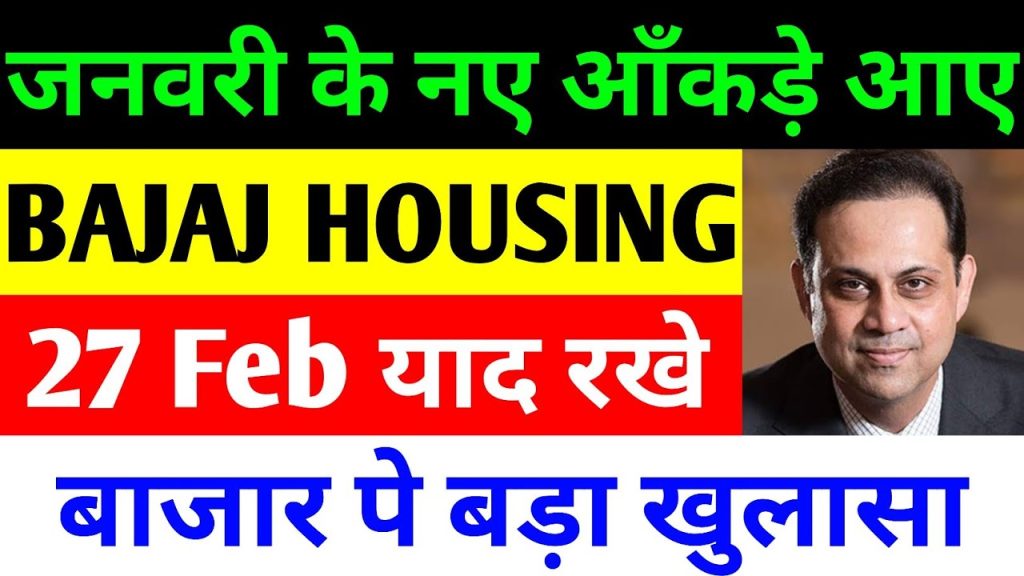
The Indian stock market has witnessed turbulent trading sessions recently, with the Bajaj Housing Finance IPO and broader financial sector stocks drawing significant attention. After days of relentless selling pressure, Bajaj Housing Finance shares finally closed in the green on February 12, hinting at tentative market stabilization. However, concerns linger as Foreign Institutional Investors (FIIs) continue their aggressive selling spree, raising questions about the sustainability of any recovery.
In this comprehensive analysis, we dissect Bajaj Housing Finance’s strategic moves, evaluate January’s mutual fund data, and decode expert predictions for the housing finance sector. Let’s dive into the factors shaping market sentiment and what lies ahead for investors.
Bajaj Housing Finance Share Price: Signs of Stability Amid Volatility
Bajaj Housing Finance Limited (BHFL), a key player in India’s affordable housing segment, saw its stock rebound to ₹1,112 on February 12 after a prolonged downtrend. While the 0.84% gain signals cautious optimism, the stock remains 18% below its 52-week high of ₹1,365.
Key Drivers of Recent Performance:
- Upcoming Institutional Meetings: BHFL announced two critical investor meetings in Pune on February 19 and 27, 2025. These sessions aim to discuss long-term growth strategies, sparking speculation about expansion plans or capital-raising initiatives.
- Mutual Fund Exodus: January’s data revealed zero mutual fund entries into BHFL, while 12 funds exited their positions. This lack of institutional confidence has contributed to the stock’s underperformance.
- Sector-Wide Pressures: Rising interest rates and inflationary headwinds have dampened demand for housing loans, impacting BHFL’s disbursement growth.
FIIs vs. DIIs: The Battle for Market Control
February’s sell-off intensified as FIIs offloaded ₹17,350 crore worth of Indian equities, marking the highest monthly outflow since January 2023. On February 12 alone, FII selling hit ₹4,969 crore, overshadowing Domestic Institutional Investors’ (DIIs) ₹5,929 crore buying activity.
Why Are FIIs Retreating?
- Global Risk Aversion: Fears of a tariff war under a potential Trump administration have spooked foreign investors.
- Overvalued Mid-Caps: Stocks like IRFC and RVNL, which rallied 200–600% in 2023, are now facing brutal corrections. IRFC plummeted from ₹229 to ₹130, while RVNL crashed from ₹650 to ₹250.
- Currency Risks: A strengthening US dollar has prompted FIIs to redirect capital to safer assets.
DIIs to the Rescue?
Domestic funds injected ₹15,357 crore into markets in February, cushioning the blow from FII exits. This divergence underscores rising retail participation and confidence in India’s long-term growth story.
Mutual Fund Data Shock: Zero Buyers for Bajaj Housing Finance in January
SEBI’s January mutual fund portfolio disclosures delivered a blow to BHFL. Not a single fund initiated a position, while 12 liquidated their holdings. This contrasts sharply with sectors like renewables and defense, which saw aggressive buying.
Implications for Investors:
- Short-Term Bearishness: The absence of mutual fund support suggests limited upside until macroeconomic conditions improve.
- Long-Term Potential: BHFL’s focus on affordable housing aligns with India’s urbanization trends, making it a strategic pick for patient investors.
Market Correction: Is the Worst Over?
The Sensex plunged 1,122 points intraday on February 12 before recovering to close 122 points lower at 76,111. Year-to-date, the index is down 4.3%, eroding ₹24 lakh crore in investor wealth.
Expert Views on Recovery:
- Dr. VK Vijayakumar (Geojit Financial Services): “Large-caps now trade at fair valuations, while mid- and small-caps remain overpriced. Shift focus to quality blue-chips like HDFC Bank or Reliance.”
- Technical Analysts: The Nifty’s RSI (Relative Strength Index) at 32 signals oversold conditions, hinting at a near-term bounce. A sustained recovery, however, hinges on FII flows reversing.
Bajaj Housing Finance IPO: Strategic Moves and Future Prospects
BHFL’s upcoming investor meetings could pave the way for its much-anticipated IPO. The company aims to leverage India’s housing deficit—estimated at 40 million units—to drive growth.
IPO Readiness Checklist:
- Asset Quality: BHFL’s GNPA stands at 1.2%, below the industry average of 2.5%.
- Digital Push: A 30% increase in digital loan approvals in Q3 FY24 enhances scalability.
- Regulatory Tailwinds: PMAY (Pradhan Mantri Awas Yojana) subsidies and RBI’s pro-growth policies bolster sector prospects.
Investment Strategy: Navigating the Current Turbulence
With markets at a crossroads, here’s how to position your portfolio:
- Large-Caps Over Mid-Caps: Opt for stable giants like Bajaj Finance or LIC Housing Finance.
- Sector Rotation: Shift from overvalued PSU stocks to undervalued IT and pharma sectors.
- Dollar-Cost Averaging: Accumulate BHFL shares gradually if the IPO launches below ₹1,100.
Conclusion: Patience and Prudence Will Prevail
The Bajaj Housing Finance IPO and broader market correction present both risks and opportunities. While FII outflows and mutual fund skepticism warrant caution, India’s structural growth drivers remain intact. Stay informed, diversify wisely, and consult a SEBI-registered advisor before making moves.
Subscribe for Real-Time Alerts: Never miss critical updates on IPOs, FII activity, and market trends. Hit the bell icon now!
Disclaimer: This article is for educational purposes only. Conduct independent research or consult a financial expert before investing.