


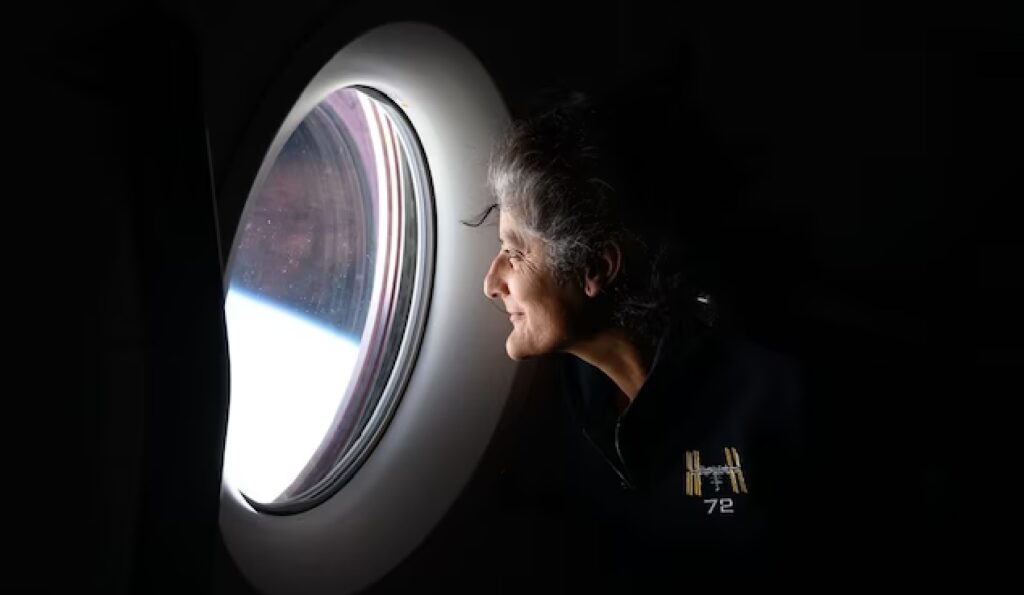
In addition to being an Indian American astronaut of NASA fame Sunita Williams has been making headlines for her work on the ISS as well. Despite the rumors about her health surrounding her, Williams has been able to not only put such concerns to rest, but also to continue with the goal of pushing for further exploration of space. Let us understand her life, the recent hurdles that she faced, and what she did in the vast expanse of space.
Sunita Williams Deals with Health Speculations From Above
Williams appeared to be afflicted by illness based on the images she captured that sparked heated debate. A portion of the audience was concerned about her self-image, because they thought it was drastically changing when they observed her sunken cheeks and her thin make. But Williams has destroyed these rumors and dispelled the allegations. In her words: “I think there are some rumors out there that I am I losing weight no, I am actually the same weight as I was when I went onboard ISS.”
Further, Williams informed that fluid shift alters some of the features of an astronaut’s body which might be pronounced if there is an absence of gravity. Put simply, she experienced most of her body fluids being drawn towards the upper region of her body. This shift might therefore make one’s visage appear more prominent in size or more almond-shaped, but according to Williams’ claim, there is no shrinkage of her body mass and no strain on her health. Utilizing the onboard equipment in ISS, Williams testified that since her arrival in June 2024, her weight has not changed.
A Mission Extended: Surmounting the Unpredictable Hurdles
Sunita Williams along with fellow crew member and astronaut Barry Wilmore blasted off to space on June 5, 2024 on board the Boeing Starliner craft. Their mission which was supposed to initially last for 8 days turned out into an endurance test due to a malfunction in the Starliner spacecraft. There was a Helium leak and five essential thrusters failed which made it impossible for them to use the spacecraft for a safe return.
As per NASA’s decision, there was a huge risk to the lives of the astronauts if they were to travel back using the Starliner – Jan Whitaker was to say there was no chance of that happening. Whitaker would be spending the trip onboard the aforementioned Spacex Dragon craft. This digital momentum has become a source of unique challenges and hurdles for the astronauts testing their physical and mental endurance.
Risks Associated With Long Space Missions To Astronauts
Long missions in space expose an astronaut to a host of health problems including Radiational Exposure. With a radius of 400 kilometers from earth, the astronauts on the orbiting space station are at a higher risk of cosmos radiations due to the thin layer of atmosphere shield around the earth. With prolonged exposure, the chances of health risks multiplying in the long run increases.
Loss of Muscle and Bone Density
The exposure to microgravity conditions for a long period may accelerate muscle wastage coupled with bone loss. To counteract these aspects, astronauts need to workout on a daily basis.
Fluid Shifts
According to Williams, in microgravity conditions, the re-distribution of fluids may result in facial puffiness or in changes in perceived weight. During that low gravitational state, it may also result in temporary alterations in the body mass.
Issues regarding Mental Health
The pertinently recall and great deal ends up remembering the isolation and concentration during space missions. This more often than not affects mental health and in a sore sore way. The primary effects were the ability to communicate with relatives as well as doing activities.
Sunita Williams: Leading Innovative Research
Irrespective of the hardships, Sunita Williams does not cease to conduct and lead fascinating experiments on the international space station. Most recently, she participated in testing the Astrobee robotic free-flyer in the Kibo laboratory module. She mounted appendages shaped like arms with gecko-like sticky pads that are supposed to illustrate the advanced methods of satellite capture. Such advances are expected to enhance the conduct of future space exploration. They include the repairing of satellites and removing space debris.
A New Era Beckons, The Comeback is Almost Here: Looking Ahead
NASA has specified that Williams and Wilmore are set to board the Space X Dragon spacecraft in February 2025 with two more astronauts. This will bring to an end an extraordinary mission of great adoptions. Their contribution of spending time on the ISS will add significant information related to the rehabilitation in the context of operational missions in the long term supporting future endeavors.
Perseverance, Exploration and Legacy
The life story of Sunita Williams is the life story of humanity in terms of resilience and being able to go into new frontiers. The work that she has done when she was up in the ISS is appreciated by millions of people and proves that even under difficult circumstances, astronauts do their best to enhance science and exploration. While she is waiting for the opportunity to return to Earth, Williams presents the into fresh and never seen before ideas and unwavering spirit that one must possess for going into outer space.