


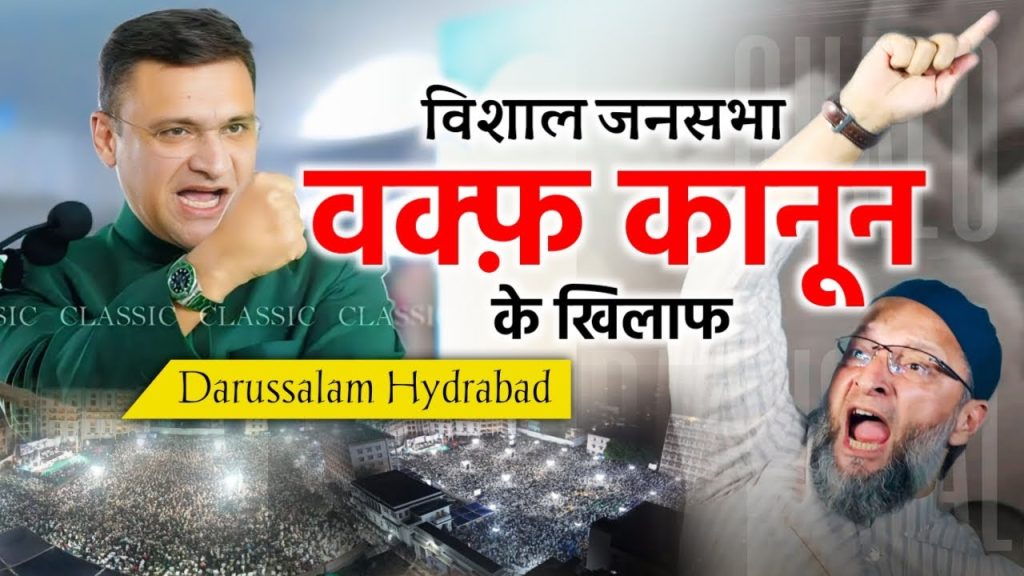
Protest Meeting Against Waqf Amendment Act 2023 at Darussalam: A Call for Unity and Action
Introduction: Rallying for Justice at Darussalam
On a vibrant evening at Darussalam, Hyderabad, a powerful protest meeting unfolded, drawing significant attention to the contentious Waqf Amendment Act 2023. Spearheaded by prominent leader Asaduddin Owaisi, this gathering marked a pivotal moment in the ongoing discourse surrounding the preservation of Waqf properties and constitutional rights. The event, held post-Maghrib prayer on April 19, 2025, united diverse voices in a collective stand against the proposed amendments, igniting a movement that resonates across Telangana and Andhra Pradesh.
This article delves deep into the heart of the protest, exploring the key figures, their compelling arguments, and the broader implications for secularism and community solidarity. With a rich tapestry of perspectives and a call to action, this narrative aims to enlighten readers, spark engagement, and establish itself as the definitive resource on this critical issue.
The Spark: Asaduddin Owaisi Leads the Charge
Asaduddin Owaisi, a revered political figure and advocate for minority rights, took center stage at Darussalam, delivering a passionate address that galvanized the crowd. His leadership in organizing this protest meeting underscored his commitment to protecting Waqf properties, which hold immense cultural and religious significance for the Muslim community. Owaisi articulated a clear message: the Waqf Amendment Act 2023 threatens to erode the autonomy of these properties, a move he deems unconstitutional and detrimental to secular values.
His speech emphasized the need for unity, urging attendees to rise above political divides and champion a cause that safeguards constitutional integrity. Owaisi’s eloquence and strategic vision transformed the gathering into more than just a protest—it became a beacon of resistance, inspiring attendees to carry the momentum forward in their communities.
A United Front: BRS Joins the Movement
Adding weight to the protest, Mahamood Ali, representing the Bharat Rashtra Samithi (BRS), issued a resounding call to action. Ali’s presence highlighted the cross-party support for the cause, as he encouraged secular Hindus to join hands with the Muslim community. His appeal was not just a political statement but a heartfelt invitation to build a coalition rooted in shared values of justice and equality.
Ali’s strategy focused on mobilizing diverse groups, ensuring that the movement transcends religious boundaries. By aligning BRS with this protest, he reinforced the party’s commitment to secularism, positioning it as a key player in the fight against the Waqf amendments. His call resonated deeply, promising to amplify the campaign’s reach and impact across Telangana.
YSRCP’s Stance: Countering Misinformation
Abdul Hafeez, representing the Yuvajana Sramika Rythu Congress Party (YSRCP), brought another layer of complexity to the protest. He addressed a critical concern: the Telugu Desam Party (TDP) IT cell’s alleged misinformation campaign. Hafeez firmly denied claims that YSRCP opposed the Waqf bill in the Rajya Sabha, clarifying the party’s position with conviction and transparency.
His intervention served as a rebuttal to the narrative being spun by TDP, aiming to protect YSRCP’s reputation while aligning with the protest’s objectives. Hafeez’s articulate defense underscored the importance of factual discourse, urging the public to scrutinize sources and support the collective effort to preserve Waqf rights. This moment highlighted the political chess game at play, with each move carefully calculated to influence public perception.
Key Features of the Waqf Act Amendment Bill 2024
- Centralized Oversight: The bill empowers district collectors to act as arbitrators in Waqf property disputes, potentially overriding traditional Waqf Board authority.
- Mandatory Registration: All Waqf properties must be registered on a government portal within six months, or they risk being classified as government property.
- Inclusion of Non-Muslims: The amendment allows non-Muslims to serve on Waqf Boards, a move critics say dilutes the religious character of these bodies.
- Limitation Act Application: Properties occupied for over 12 years by non-Waqf entities could be declared government-owned, raising fears of mass dispossession.
- Restrictions on Mutawallis: Mutawallis (custodians of Waqf properties) face stricter regulations, including potential imprisonment for non-compliance with new rules.
These changes have sparked concerns about the erosion of religious autonomy, the potential loss of Waqf assets, and the undermining of constitutional protections for minority rights.
The Controversy Surrounding the Waqf Act Amendment
The Waqf Act Amendment Bill has become a lightning rod for criticism, with opponents arguing it represents a broader agenda to marginalize India’s Muslim community. The bill’s introduction follows a series of controversial laws under the BJP government, including the Citizenship Amendment Act (CAA), the National Register of Citizens (NRC), and the ban on triple talaq, which critics claim disproportionately target Muslims.
Allegations of Targeting Muslim Identity
Opposition leaders and activists assert that the amendment is part of a systematic effort to erode Muslim religious and cultural identity. By increasing government control over Waqf properties, the bill is seen as an attempt to secularize or appropriate assets integral to Muslim heritage. Protesters argue that Waqf properties, such as mosques and dargahs, are not mere real estate but symbols of faith and community resilience.
The bill’s provision to include non-Muslims in Waqf Boards has drawn particular ire. Critics question why similar provisions do not apply to Hindu temple trusts or Sikh gurdwara committees, arguing that the move undermines the principle of equal treatment for all religious communities.
Threat to Constitutional Rights
The Indian Constitution guarantees the right to freedom of religion under Article 25 and the protection of minority rights under Article 26. Opponents of the bill argue that it violates these fundamental rights by encroaching on the autonomy of Waqf institutions. The increased role of district collectors, who may lack expertise in Islamic law, is seen as an overreach that could lead to arbitrary decisions.
Furthermore, the application of the Limitation Act to Waqf properties raises legal concerns. Waqf assets, by their nature, are inalienable and meant to serve their purpose in perpetuity. Allowing long-term encroachments to be legitimized as government property contradicts this principle and could result in the loss of thousands of acres of Waqf land.
Fears of Dispossession and Encroachment
Reports indicate that Waqf properties, particularly in states like Uttar Pradesh, Punjab, and Haryana, have already been declared government-owned in some cases. The new bill’s stringent registration requirements and short compliance window exacerbate fears that many Waqf assets could be lost due to bureaucratic hurdles or deliberate neglect. Critics cite examples like the 100 acres of Waqf land in Punjab and Haryana, which have been appropriated by government entities, as evidence of systemic dispossession.
The Protests: A Unified Stand Against the Amendment
The introduction of the Waqf Act Amendment Bill has galvanized communities across India, leading to widespread protests organized by groups like the All India Muslim Personal Law Board (AIMPLB), religious scholars, and political parties. These protests, held in cities like Hyderabad, Delhi, and Telangana, reflect a collective resolve to protect Waqf properties and uphold constitutional values.
Hyderabad Rally: A Call to Action
In Hyderabad, a massive rally organized by the AIMPLB and supported by leaders like Asaduddin Owaisi, president of the All India Majlis-e-Ittehad Muslimeen (AIMIM), drew thousands of protesters. The rally, held at Darussalam Ground, was a powerful display of unity, with participants from diverse backgrounds—men, women, youth, and elders—coming together to oppose the bill.
Speakers at the rally emphasized the need for a sustained, democratic struggle to protect Waqf properties. They urged attendees to participate in nationwide protests, including a planned demonstration at Delhi’s Talkatora Stadium, and to engage in symbolic acts like switching off lights for 10 minutes to signal their dissent. The rally underscored the importance of interfaith solidarity, with calls for Hindu and Sikh communities to join the fight against laws that threaten communal harmony.
Legal and Democratic Resistance
The AIMPLB has vowed to challenge the amendment through legal and democratic means. Lawyers representing the board are preparing to file petitions in the Supreme Court, arguing that the bill violates constitutional protections. Protesters are also drawing inspiration from past movements, such as the farmers’ protests against agricultural laws, which forced the government to repeal contentious legislation.
The slogan “Save the Constitution, Save Waqf” has become a rallying cry, encapsulating the dual goal of protecting religious rights and upholding India’s secular framework. Activists emphasize that the fight is not just about Waqf properties but about preserving the pluralistic ethos that defines India.
The Government’s Defense: Transparency or Control?
The BJP government defends the Waqf Act Amendment as a necessary reform to address longstanding issues in Waqf administration. Union Minister for Minority Affairs Kiren Rijiju has argued that the bill will enhance transparency, curb mismanagement, and ensure that Waqf properties benefit the communities they serve.
Claims of Modernization
The government highlights the need for a centralized portal to document Waqf properties, which it claims will prevent encroachments and streamline dispute resolution. The inclusion of non-Muslims in Waqf Boards is framed as a step toward inclusivity, ensuring broader representation in decision-making.
Addressing Encroachments
Supporters of the bill argue that encroachments on Waqf properties, often by powerful individuals or entities, have deprived communities of their benefits. The government contends that empowering district collectors to resolve disputes will expedite justice and protect Waqf assets from illegal occupation.
Countering Opposition Narrative
The BJP has accused opposition parties of politicizing the issue to stoke communal tensions. Leaders like Prime Minister Narendra Modi have emphasized that the amendments are not aimed at any community but are part of a broader agenda to modernize governance. The government has also pointed to consultations with select Muslim groups, such as the Dawoodi Bohra community, to bolster its claim of inclusive policymaking.
The Dawoodi Bohra Controversy: A Case of Misrepresentation?
The Dawoodi Bohra community, a Shia Muslim sect, has emerged as a focal point in the Waqf Act debate. The community, represented by senior counsel Harish Salve, sought exclusion from the Waqf Act during parliamentary committee deliberations, citing their unique religious practices and jurisprudence. The Bohras argued that their concept of “Dai Mutlaq” (absolute spiritual authority) conflicts with the Waqf Act’s framework, as their properties are managed under the guidance of their spiritual leader.
Critics, including AIMPLB members, allege that the BJP has misrepresented the Bohra community’s position to create a false narrative of Muslim support for the amendment. They claim the government selectively highlighted the Bohras’ request to deflect criticism and sow division within the Muslim community. The controversy underscores the need for unity among Muslim sects, with leaders urging Shia and Sunni communities to stand together against the bill.
Broader Implications for India’s Social Fabric
The Waqf Act Amendment transcends the issue of property management, touching on deeper questions of identity, autonomy, and national unity. Its implications extend beyond the Muslim community, affecting India’s secular and pluralistic character.
Erosion of Communal Harmony
Protesters warn that the amendment could exacerbate communal tensions by pitting communities against each other. The government’s focus on Waqf properties, while ignoring similar issues in Hindu or Sikh religious trusts, fuels perceptions of bias. The rhetoric of “religious war” from some BJP leaders, as alleged by critics, risks inflaming passions and undermining India’s tradition of coexistence.
Threat to Minority Rights
The bill’s critics argue that it fits into a pattern of policies targeting minority rights, from the CAA to the Uniform Civil Code (UCC). By challenging the autonomy of Waqf institutions, the government is seen as encroaching on the constitutional protections that safeguard minority communities. This perception could deepen mistrust and alienation among Muslims, who constitute over 14% of India’s population.
A Test for Democracy
The protests against the Waqf Act Amendment are a test of India’s democratic institutions. The ability of citizens to challenge legislation through peaceful means—whether in courts, on the streets, or in Parliament—will shape the country’s democratic trajectory. The movement also highlights the importance of interfaith solidarity, as Hindus, Sikhs, and other communities join the call to protect constitutional values.
Voices from the Ground: Why People Are Protesting
The protests have brought forth powerful voices from ordinary citizens, religious leaders, and activists, each articulating the stakes of the Waqf Act Amendment.
Religious Scholars: Protecting Faith and Heritage
Ulema (Islamic scholars) have emphasized the spiritual significance of Waqf properties, describing them as sacred trusts dedicated to God. They argue that any attempt to seize or mismanage these assets is an affront to faith and a betrayal of divine stewardship. The involvement of women, youth, and elders in protests reflects the community’s collective commitment to safeguarding their religious heritage.
Youth: Fighting for Jobs and Justice
Young protesters highlight the socio-economic role of Waqf properties, which fund educational institutions and welfare programs. They argue that the government’s focus on Waqf reforms distracts from pressing issues like unemployment, which affects 4-5% of India’s youth. By protecting Waqf assets, they seek to preserve opportunities for future generations.
Women: Defending Dignity and Rights
Muslim women have been at the forefront of the protests, challenging stereotypes about their role in public life. They view the amendment as an attack on their religious identity and a continuation of policies—like the triple talaq ban—that they believe undermine their agency. Their participation underscores the intersection of gender, faith, and politics in the Waqf debate.
The Path Forward: Unity, Resistance, and Reform
The Waqf Act Amendment has sparked a broader conversation about governance, religious autonomy, and social justice in India. As protests continue, several steps could shape the outcome of this contentious issue.
Strengthening Interfaith Solidarity
The protests have emphasized the need for unity across religious lines. By framing the Waqf issue as a defense of constitutional values, activists aim to build coalitions with Hindu, Sikh, and Christian communities. This approach could counter divisive narratives and reinforce India’s pluralistic identity.
Legal Challenges in the Supreme Court
The AIMPLB and other groups are preparing to challenge the amendment in the Supreme Court, arguing that it violates Articles 25 and 26 of the Constitution. A favorable ruling could strike down key provisions of the bill or force the government to reconsider its approach.
Sustained Democratic Protests
Drawing inspiration from the farmers’ movement, protesters plan to sustain their campaign through rallies, human chains, and symbolic acts like light blackouts. These actions aim to pressure the government while maintaining the movement’s peaceful character.
Reforming Waqf Administration
While opposing the amendment, some critics acknowledge the need for internal reforms in Waqf administration. Addressing issues like mismanagement, corruption, and encroachments through community-led initiatives could strengthen the case for autonomy and reduce the government’s rationale for intervention.
Conclusion: A Fight for Faith, Rights, and Unity
The Broader Context: Understanding the Waqf Amendment Act 2023
To fully appreciate the significance of the Darussalam protest, one must grasp the essence of the Waqf Amendment Act 2023. This legislation proposes changes to the management and governance of Waqf properties, which are endowments created for religious, charitable, or educational purposes under Islamic law. Critics, including Owaisi and his allies, argue that the amendments could centralize control, undermine local autonomy, and potentially lead to the commercialization of these sacred assets.
The Act has sparked widespread debate, with opponents viewing it as a threat to religious freedom and constitutional protections. Supporters, however, contend that it aims to streamline administration and curb mismanagement. This clash of perspectives has fueled protests across India, with Darussalam emerging as a focal point due to its strategic location and the influential voices it attracts.
Community Mobilization: Strategies and Events
The protest at Darussalam is just the beginning of a broader campaign to safeguard Waqf properties and uphold the Constitution. Organized under the aegis of the All India Muslim Personal Law Board (AIMPLB), a series of strategic events are set to unfold across Telangana and Andhra Pradesh. These initiatives reflect a well-coordinated effort to engage communities, raise awareness, and build momentum.
Major Public Gatherings: Amplifying the Voice
A grand public meeting titled “Save Waqf, Save Constitution” is scheduled for April 19, 2025, following the Darussalam protest. This event will serve as a platform to consolidate support, featuring speeches from leaders like Owaisi and Ali. The gathering aims to inspire attendees to become advocates for the cause, spreading the message far beyond Hyderabad.
Blackout Protests: A Symbolic Stand
On April 30, 2025, a unique blackout protest will take place across all districts of Telangana and Andhra Pradesh. From 9:00 PM, participants will turn off lights for ten minutes, symbolizing their resistance to the amendments. This creative approach not only draws attention but also encourages widespread participation, making it a powerful visual statement.
Round Table Discussions: Fostering Dialogue
On May 18, 2025, a city-level round table meeting will kick off a series of discussions across districts. Inviting local minority leaders and secular representatives, these sessions aim to strategize and strengthen the movement. The inclusion of diverse voices ensures a holistic approach, addressing concerns from multiple angles.
Women’s Public Gatherings: Empowering Change
Women will take center stage on May 22, 2025, with a dedicated gathering at Eidgah Bilali Hockey Ground in Masab Tank, Hyderabad. This event empowers female participants to lead the charge, highlighting their critical role in the campaign. It’s a testament to the inclusive nature of the movement, recognizing the power of women’s voices.
Human Chain Protests: Uniting Communities
On May 25, 2025, a human chain protest will stretch across cities and districts from 2:00 PM to 2:30 PM. Families, including women and children, are encouraged to join, fostering a sense of community solidarity. District conveners will designate specific locations, ensuring a coordinated and impactful demonstration.
Sit-in Protests: A Peaceful Demand
On June 1, 2025, a central sit-in protest will occur at Indira Park Dhana Chowk, Hyderabad, from 3:00 PM to 5:00 PM. Prominent representatives from both states will attend, with a separate venue at NTR Stadium for women. This peaceful demonstration underscores the movement’s commitment to non-violent resistance, demanding immediate action from authorities.
Public Meetings: Building Momentum
Ongoing public meetings will be organized across districts in consultation with local leadership. Additionally, women-specific programs in districts like Mahbubnagar and Warangal will address gender-specific concerns, coordinated by Adv. Saheba at 8106912114. These efforts ensure the campaign remains dynamic and responsive to community needs.
The Stakes: Why Waqf Matters
Waqf properties are more than just land or buildings; they represent a legacy of philanthropy and community welfare. Historically, these endowments have funded mosques, schools, hospitals, and orphanages, serving as a cornerstone of Muslim society. The proposed amendments threaten to disrupt this tradition, raising fears of encroachment and exploitation.
For the Muslim community in Telangana and Andhra Pradesh, the stakes are personal and profound. Losing control over Waqf properties could diminish their ability to support charitable causes, eroding a vital social safety net. This protest, therefore, is not just about legislation—it’s about preserving a way of life.
The Role of Secularism in the Movement
Secularism emerges as a central theme in this campaign, with leaders like Mahamood Ali emphasizing its importance. By inviting secular Hindus to join the cause, the movement seeks to bridge religious divides, promoting a united front against perceived injustices. This inclusivity strengthens the argument that the Waqf issue transcends religion, touching on universal principles of fairness and autonomy.
The involvement of secular representatives in round table discussions further reinforces this ethos. It positions the campaign as a national concern, appealing to a broader audience and enhancing its legitimacy. In a polarized political landscape, this approach offers a refreshing call for collaboration.
Challenges and Opposition
The path to success is fraught with challenges. The TDP IT cell’s misinformation campaign, as highlighted by Abdul Hafeez, poses a significant hurdle. False narratives can sway public opinion, requiring the movement to counter with clear, evidence-based communication. Additionally, political rivalries may complicate efforts to maintain a united front.
Government response—or lack thereof—will also shape the campaign’s trajectory. Without concessions or dialogue, protests may escalate, testing the resolve of participants. Overcoming these obstacles demands strategic planning, robust outreach, and unwavering commitment from all involved.
The Path Forward: Sustaining the Momentum
To sustain the movement, organizers must leverage the energy from Darussalam and beyond. Regular updates through social media, local media, and community networks will keep the public engaged. Training sessions for activists can equip them with the tools to counter misinformation and mobilize support effectively.
Collaboration with legal experts will also be crucial. Challenging the Waqf Amendment Act 2023 in court could provide a long-term solution, complementing grassroots efforts. By combining street protests with legal action, the campaign can address both immediate and structural concerns.
Conclusion: A Movement for the Ages
The protest meeting at Darussalam on April 19, 2025, stands as a defining moment in the fight to protect Waqf properties and uphold the Constitution. Led by Asaduddin Owaisi, supported by Mahamood Ali and Abdul Hafeez, and fueled by a diverse coalition, this movement embodies resilience and hope. As events unfold across Telangana and Andhra Pradesh, the call to “Save Waqf, Save Constitution” grows louder, uniting communities in a shared mission.
This article has explored the key players, strategies, and stakes involved, offering a comprehensive view of a campaign poised to shape the future. For those passionate about justice, secularism, and community welfare, the time to act is now. Join the movement, amplify the voice, and help secure a legacy for generations to come.