


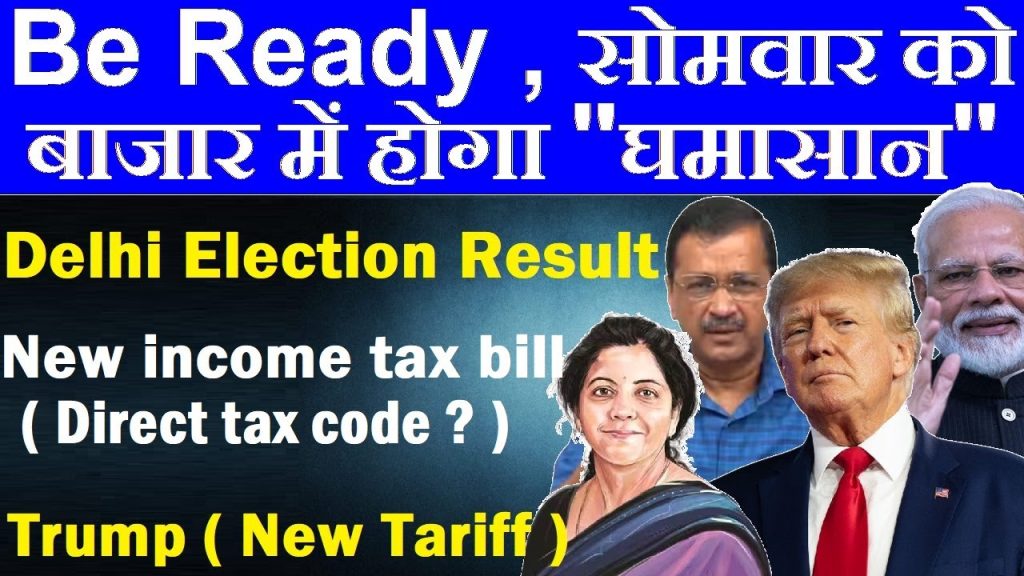
The Indian stock market is bracing for significant turbulence as three critical events converge: the Delhi Election Results, the introduction of a New Income Tax Bill, and renewed global trade tensions sparked by Donald Trump’s tariff policies. This trifecta of developments promises to shape market trends, investor sentiment, and economic strategies in the coming weeks. In this comprehensive analysis, we unpack these events, their implications, and actionable insights for investors.
1. New Income Tax Bill: Key Changes and Market Reactions
Cabinet Approval Sets the Stage
The Union Cabinet’s recent approval of the New Income Tax Bill has sent ripples through financial circles. Designed to replace the existing Direct Tax Code (DTC), the bill aims to simplify tax structures, revise income slabs, and align India’s taxation system with global standards. While specifics remain under wraps, experts speculate that the bill could introduce progressive tax rates, incentivize investments, and streamline compliance.
Parliamentary Debate and Investor Sentiment
The bill is slated for presentation in Parliament next week, where debates will likely focus on its impact on middle-class taxpayers, corporate entities, and foreign investors. Market analysts warn that uncertainty around the bill’s final form may trigger short-term volatility. However, clarity post-approval could bolster long-term confidence, especially if the reforms favor disposable income growth and corporate profitability.
Preparing for Tax-Driven Volatility
Investors should monitor sectors sensitive to tax reforms, such as FMCG, real estate, and banking. A favorable tax regime could spur consumer spending, while stringent measures might dampen sentiment. Historical data suggests that markets often react sharply to tax policy shifts, making this a pivotal moment for portfolio adjustments.
2. Delhi Election Results: Political Stability and Economic Implications
BJP’s Landslide Victory: A Market-Friendly Outcome
The Delhi Assembly Election Results, announced on Saturday, saw the BJP securing a decisive majority with 48 seats, while the AAP trailed with 22. Markets typically favor political stability, and this outcome aligns with the central government’s policies, reducing the risk of legislative gridlock.
Why Markets Prefer Majority Governments
A clear majority ensures smoother policy implementation, critical for infrastructure projects, labor reforms, and FDI inflows. The BJP’s dominance at both central and state levels minimizes bureaucratic delays, fostering a conducive environment for economic growth. Sectors like infrastructure, renewable energy, and manufacturing are poised to benefit.
No Negative Spillover Expected
Despite initial concerns, the election outcome hasn’t introduced political friction. With the AAP’s reduced influence, investors anticipate continuity in Delhi’s governance, particularly in initiatives like smart city projects and public transport upgrades. This stability is likely to cushion markets against election-driven volatility.
3. Trump’s Tariff Threats: Global Trade Tensions Resurface
Reciprocal Tariffs: A Trade War Redux?
Former U.S. President Donald Trump’s announcement of reciprocal tariffs on imports has reignited fears of a global trade war. The policy targets countries imposing high tariffs on U.S. goods, with India potentially facing retaliatory measures on sectors like textiles, pharmaceuticals, and IT services.
Impact on Indian Markets
Indian exporters, particularly in the $100 billion IT sector, could face margin pressures if tariffs escalate. However, domestic-focused industries like cement, utilities, and healthcare may remain insulated. Investors should track U.S.-India trade negotiations and hedge export-heavy portfolios.
Lessons from 2018
During Trump’s previous tenure, tariffs triggered a 12% correction in the Nifty 50. While markets eventually recovered, the episode underscores the need for diversification. Analysts advise increasing exposure to defensive stocks (e.g., consumer staples, utilities) and gold as a hedge.
4. Currency Volatility and RBI’s Strategic Moves
Rupee Under Pressure: RBI’s Balancing Act
The Indian rupee has hovered near ₹83/USD, driven by dollar outflows and rising crude prices. New RBI Governor Sanjay Malhotra faces the dual challenge of stabilizing the rupee without stifling growth. Recent MPC meetings hint at cautious forex interventions and liquidity management.
Sector-Specific Risks
A weaker rupee benefits IT and pharma exporters but raises import costs for energy and electronics firms. Investors in sectors like aviation (fuel-dependent) and electronics (component imports) should brace for margin squeezes.
5. Expert Strategies to Navigate Market Uncertainty
1. Rebalance Portfolios
Shift toward sectors resilient to political and trade shocks: healthcare, utilities, and consumer goods.
2. Monitor Tax Reforms
Stay updated on parliamentary debates around the New Income Tax Bill. Tax-friendly policies could boost equities, while complex regulations may favor bonds.
3. Hedge Against Currency Risks
Consider currency-hedged ETFs or diversifying into multinational corporations with USD revenues.
4. Leverage Technical Analysis
Identify support/resistance levels for Nifty (e.g., 18,200 support) and Bank Nifty (42,500 resistance) to time entries/exits.
Final Thoughts: Stay Informed, Stay Agile
The convergence of domestic policy shifts, political outcomes, and global trade dynamics demands vigilance. While short-term volatility is inevitable, long-term investors can capitalize on dips in high-quality stocks. Keep an eye on RBI’s policy moves, U.S. trade negotiations, and parliamentary sessions to stay ahead of the curve.
Pro Tip: Watch our detailed video analysis on the New Income Tax Bill and Trump’s tariff policies for deeper insights (links in the description).
By understanding these interconnected factors, investors can transform market chaos into strategic opportunities. Remember, informed decisions are your best defense against uncertainty.
Disclaimer: This article is for informational purposes only. Consult a financial advisor before making investment decisions.