


Introduction
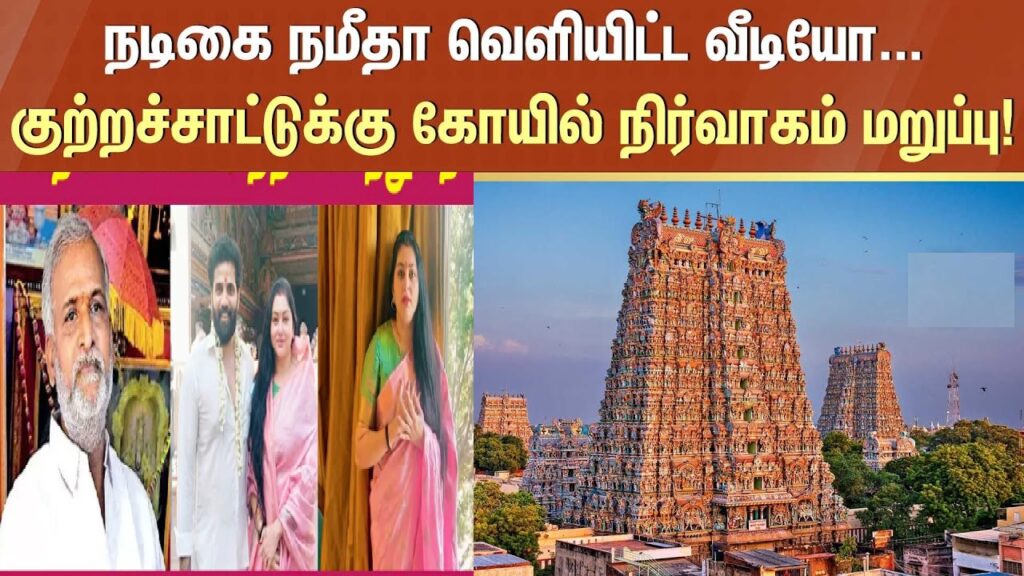
In a recent development that has captured the attention of the public, popular actress Namitha has made serious allegations against the administration of the Madurai Meenakshi Amman Temple. The incident has sparked widespread discussion and controversy, particularly on social media. Namitha, a well-known figure in Tamil Nadu and a prominent member of the Bharatiya Janata Party (BJP), took to her social media platforms to share her grievances about an unpleasant experience at the temple. This article delves into the details of the incident, the response from the temple authorities, and the implications of this controversy.
Namitha’s Allegations: What Happened?
Namitha visited the historic Madurai Meenakshi Amman Temple with her husband, expecting a routine darshan. However, her visit took an unexpected turn when she was reportedly stopped by the temple officials. According to Namitha, the officials demanded proof of her religious identity, specifically asking for her Hindu certification and caste certificate. Namitha expressed her dismay, stating that she was deeply offended by this request. She further claimed that the officials spoke to her and her husband in a rude and disrespectful manner.
Namitha’s video detailing the incident quickly went viral, attracting significant attention and concern from the public. She also lodged a formal complaint with the Tamil Nadu Hindu Religious and Charitable Endowments (HR&CE) Minister, Shekhar Babu, urging him to take appropriate action against the temple officials involved.
Temple Authorities’ Response: A Different Perspective
In response to Namitha’s allegations, the Madurai Meenakshi Amman Temple administration issued a statement denying any wrongdoing. The authorities clarified that they did not treat Namitha disrespectfully or ask for any religious or caste certification. They stated that Namitha was asked to wait briefly due to standard procedures, as she was visiting during a time of heightened security and protocol.
The temple administration further explained that their inquiries were routine and intended to ensure the smooth management of VIP visits. They maintained that after the necessary checks, Namitha was allowed to proceed with her darshan without any issues. The officials emphasized that they adhere strictly to the temple’s rules and regulations, which apply to all visitors, regardless of their status.
The Broader Context: Religion and Caste in Tamil Nadu Temples
The controversy surrounding Namitha’s visit to the Madurai Meenakshi Amman Temple highlights broader issues related to religion and caste in Tamil Nadu. Temples in the state, like many other parts of India, have historically been sites where caste and religious identities play a significant role in determining access and privileges. Although significant progress has been made in recent years to promote inclusivity, incidents like this show that tensions still exist.
The demand for religious and caste certificates, as alleged by Namitha, is particularly sensitive in a state like Tamil Nadu, where caste politics and religious identity have deep historical roots. The state’s temples are managed by the HR&CE department, which is responsible for ensuring that temple practices align with secular and inclusive principles. Any perceived deviation from these principles, especially involving celebrities or public figures, can lead to significant public outcry and media attention.
Social Media and Public Reactions
Namitha’s allegations and the subsequent response from the temple authorities have triggered a wave of reactions on social media. Supporters of Namitha have expressed outrage over the incident, criticizing the temple authorities for their alleged behavior. They argue that celebrities, like any other devotees, should be treated with respect and dignity, without being subjected to unnecessary scrutiny.
On the other hand, some individuals have defended the temple administration, suggesting that the officials were simply following protocol. They point out that high-profile visits often require additional security measures, and that the officials’ actions were not intended to offend but to ensure safety and order within the temple premises.
Conclusion: The Need for Clarity and Sensitivity
The incident involving Namitha at the Madurai Meenakshi Amman Temple underscores the need for clarity and sensitivity in managing public interactions at religious sites. While temple authorities have the responsibility to maintain security and order, it is equally important that they do so in a manner that is respectful and inclusive.
In an era where social media can amplify individual experiences to a global audience, institutions must be mindful of how their actions are perceived. The controversy surrounding Namitha’s visit to the Madurai Meenakshi Amman Temple serves as a reminder that even routine procedures can become flashpoints if not handled with care and consideration.
Moving forward, it is essential for temple administrations, particularly those managing historically and culturally significant sites, to review their protocols and ensure they are aligned with the principles of inclusivity and respect for all devotees, regardless of their social status or identity.