


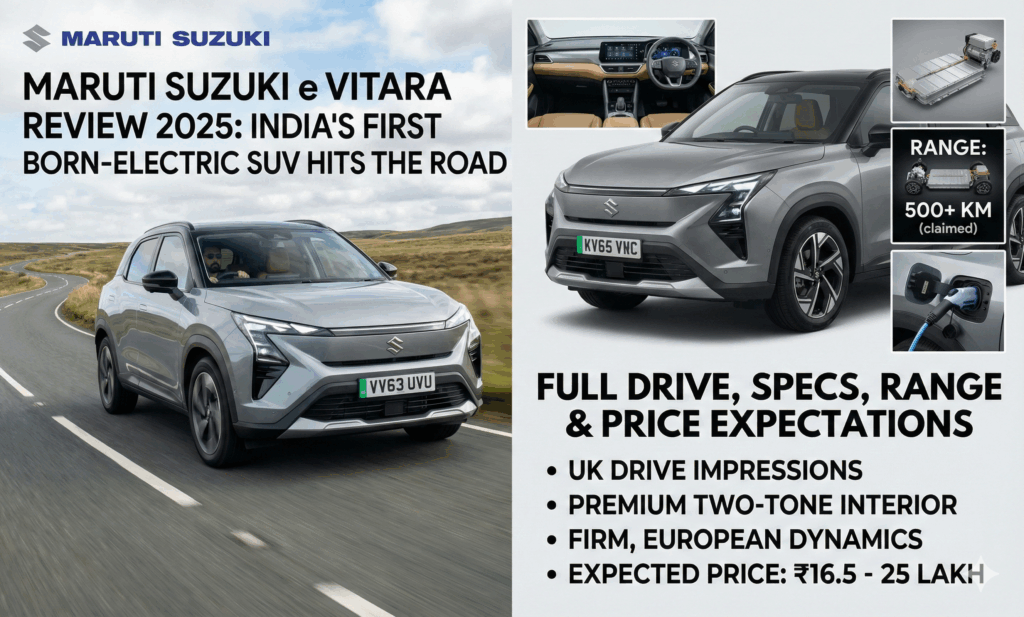
The Maruti Suzuki e Vitara marks a historic turning point for India’s largest carmaker. After decades of dominating the petrol and diesel segments, Maruti has finally launched its first ground-up electric SUV – the e Vitara. We flew to the United Kingdom to drive the global-spec Suzuki e Vitara months before its official India launch in mid-2025, and the experience proves one thing: Maruti is no longer playing it safe.
Maruti Suzuki e Vitara Design: The Metal Beast That Looks Nothing Like a Regular Maruti
Maruti calls it the “Metal Beast,” and the moment you stand next to the e Vitara, you understand why. Sharp creases, aggressive angular headlights, and bold fender flares give it a muscular, almost brutalist stance that stands completely apart from the soft, rounded Grand Vitara or Brezza.
The front fascia grabs attention with split LED headlights and a closed-off grille finished in body-colored panels. The hood features deep sculpting, and the bumper carries strong horizontal lines that scream toughness. Move to the side and the drama continues – a rising shoulder line, flush door handles (rear ones hidden), black cladding, and 18-inch alloy wheels with an aggressive five-spoke design.
At the rear, the protruding LED tail lamps connected by a sculpted element (but no full-width light bar – a refreshing change) complete the look. Maruti deliberately avoided the overused continuous light bar trend, and in person, the separated clusters actually look premium and distinctive.
Overall length sits at 4,270 mm, width at 1,800 mm, and height at 1,635 mm – making it slightly longer and wider than the Grand Vitara, with a commanding 220 mm ground clearance perfect for Indian roads.
Maruti Suzuki e Vitara Interior: Premium Two-Tone Cabin That Feels a Generation Ahead
Step inside and the biggest surprise awaits: this does not feel like a typical Maruti interior built to a cost. India-bound models will get the stunning tan-and-grey dual-tone theme with a mix of leatherette and soft-touch cloth upholstery. Contrast stitching, brushed silver accents, and a layered dashboard design elevate the ambience dramatically.
The steering wheel is a highlight – a unique squircle (square-circle) shape wrapped in perforated leather feels sporty and grippy. Ahead of the driver sits a 10.25-inch digital instrument cluster and a 10.1-inch central touchscreen placed under a single glass panel – though the two screens sit at slightly different heights and have mismatched bezels. It’s quirky, but you quickly get used to it.
Physical controls remain a big win. A row of piano-black buttons and a proper volume knob sit below the central AC vents, along with toggle switches for temperature – perfect for Indian traffic when you don’t want to poke at a touchscreen.
Feature list for India is expected to be generous:
- Panoramic sunroof
- 360-degree camera
- Powered driver seat
- Wireless charger + cooled glovebox
- Infinity-branded 9-speaker sound system
- Heads-up display (top variants)
- Level-2 ADAS with adaptive cruise control, lane-keep assist, and AEB
- 7 airbags as standard
Maruti Suzuki e Vitara Rear Seat Experience: Sliding Seats Save the Day
Rear passenger space is a mixed bag. Legroom is genuinely impressive – the bench can slide forward or backward independently on both sides (a rare feature in this segment), giving you flexibility between knee room and boot space.
However, the battery pack under the floor forces a high seating position with a knees-up posture, and headroom is tight for anyone above 5’10”. Maruti has scooped out the roofliner, but tall passengers will still brush the headlining.
The middle seat doubles as a comfortable armrest with two cleverly angled cup holders that keep drinks level even when the armrest is down. Thoughtful details like these show Maruti has sweated the small stuff.
Boot space stands at 373 litres with seats in the rearmost position – decent but not class-leading. Slide the bench fully forward and you unlock close to 450 litres. No powered tailgate yet, but a 40:20:40 split-folding rear seat offers excellent versatility.
Maruti Suzuki e Vitara Battery, Motor & Performance: Relaxed Yet Punchy Everyday Electric
India will get two battery options:
- 49 kWh battery + 144 hp front motor (FWD)
- 61 kWh battery + 174 hp front motor (FWD) (A 184 hp AWD dual-motor version with 61 kWh exists globally but is unlikely for India at launch.)
We drove the 61 kWh 174 hp version in the UK. Acceleration is strong but deliberately linear – 0-100 km/h should come up in around 8.5 seconds. There’s no neck-snapping torque dump you get in some EVs; instead, Maruti has tuned the throttle for smooth, predictable power delivery that feels perfectly judged for Indian city and highway conditions.
Three drive modes (Eco, Normal, Sport) and adjustable regenerative braking (via touchscreen + paddle shifters) are present. Sport mode sharpens throttle response noticeably without turning the e Vitara into a rocket ship – exactly what most family buyers want.
Maruti Suzuki e Vitara Real-World Range & Charging Expectations
Maruti claims over 500 km on the 61 kWh pack under Indian testing conditions (likely MRC cycle), while the 49 kWh variant should deliver around 400 km. Official ARAI figures will be revealed closer to launch, but expect realistic highway ranges of 350-380 km (49 kWh) and 450-480 km (61 kWh) with AC on – very competitive numbers.
Charging:
- 11 kW AC charger (0-100% in ~6 hours for 61 kWh)
- Up to 85 kW DC fast charging support expected (10-80% in under 40 minutes)
Maruti Suzuki e Vitara Ride & Handling: Firm, European-Tuned Dynamics
The e Vitara rides on MacPherson struts up front and a torsion beam rear – standard fare, but tuned firmly for European tastes. At highway speeds, the SUV feels planted and confident. Body roll is well controlled, and the steering weighs up nicely.
Over broken patches, the firm suspension thuds more than it absorbs, and some road noise filters into the cabin on coarse surfaces. Maruti will likely soften the India-spec car slightly to better handle potholes and speed breakers – something we’ll confirm at the media drive.
Maruti Suzuki e Vitara Expected Pricing & Rivals in India (2025)
Maruti Suzuki e Vitara expected price range (ex-showroom):
- 49 kWh base variants: ₹16.5 – 19 lakh
- 61 kWh top variants: ₹22 – 25 lakh
Direct rivals:
- Hyundai Creta Electric (51.4 kWh) – ₹20-27 lakh expected
- Tata Curvv EV (55-65 kWh) – ₹18-25 lakh
- Mahindra XEV 9e / BE 6 (59-79 kWh) – ₹22-30 lakh
- Upcoming Honda Elevate EV & Toyota Hyryder EV
At the lower end, the 49 kWh e Vitara could undercut the Creta Electric by a solid margin, while the 61 kWh version will go head-to-head with the Curvv EV and upcoming Mahindra electrics.
Final Verdict: Is the Maruti Suzuki e Vitara the Electric Family SUV India Has Been Waiting For?
The e Vitara is not perfect. Rear headroom is tight, the ride is firm, and ultimate efficiency numbers are still awaited. But it finally brings a born-electric SUV wearing the Maruti badge – one that looks distinctive, feels genuinely premium inside, drives with ease, and will carry Maruti’s legendary reliability and service network advantage.
For millions of Indian buyers waiting to make the switch to electric without compromising on peace of mind, the Maruti Suzuki e Vitara feels like the right car at the right time. Pricing will be the final trump card – and if Maruti plays it the way they usually do, the e Vitara won’t just compete; it will dominate.
The electric era for India’s largest carmaker has officially begun – and it looks sharper, bolder, and more exciting than anyone expected.