


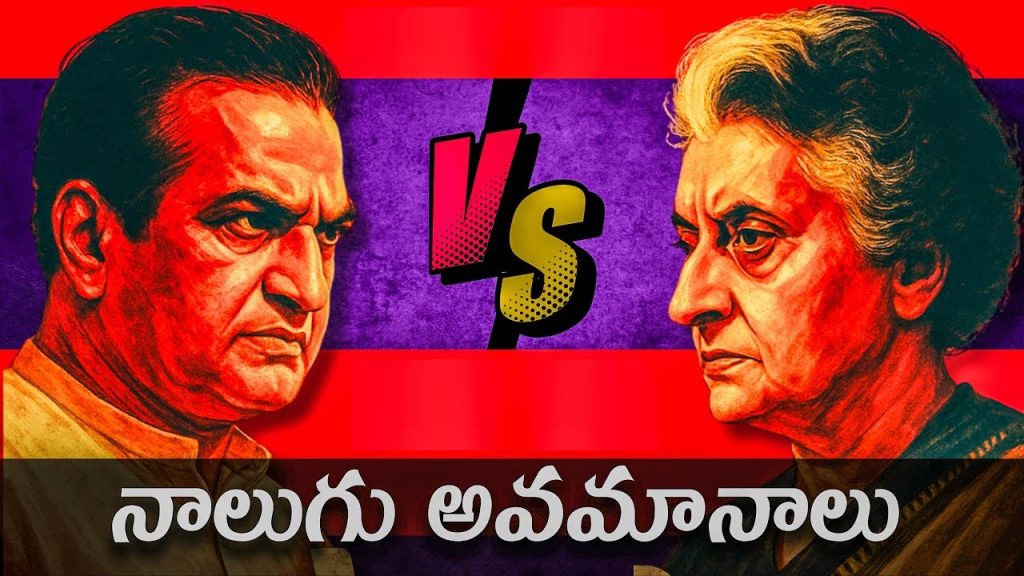
The political landscape of India in the early 1980s buzzed with intensity, marked by fierce rivalries and strategic power plays. At the heart of this dynamic era was the riveting confrontation between Nandamuri Taraka Rama Rao (NTR), a charismatic film star turned politician, and Indira Gandhi, the formidable Prime Minister of India. Their clash, rooted in a series of perceived humiliations and bold political maneuvers, shaped a critical chapter in Indian politics. This article delves into the four key incidents that fueled Indira Gandhi’s quest for political revenge against NTR, exploring how these events unfolded and their lasting impact on India’s political narrative.
The Genesis of a Political Rivalry
The story begins in 1983, a pivotal year when NTR, a celebrated Telugu cinema icon, ventured into politics by founding the Telugu Desam Party (TDP). His entry was not just a career shift but a seismic disruption in Andhra Pradesh’s political arena, challenging the Congress party’s dominance led by Indira Gandhi. NTR’s magnetic persona and populist promises resonated with the masses, setting the stage for a dramatic showdown. The rivalry was not merely about power; it was a clash of ideologies, charisma, and influence, with each leader wielding their unique strengths to outmaneuver the other.
NTR’s Rise: From Silver Screen to Political Arena
NTR’s transition from a revered actor to a political force was unprecedented. Known for portraying mythological and heroic roles, he brought the same larger-than-life aura to politics. His nine-month campaign across Andhra Pradesh culminated in Tirupati, a symbolically significant location, where he leveraged his cinematic fame to connect with voters. Unlike Tamil Nadu’s MGR, another actor-turned-politician, NTR faced skepticism about his political viability. Critics, including his son-in-law Chandrababu Naidu, then a Congress minister, doubted whether NTR’s star power would translate into votes. Yet, NTR’s grassroots approach and relatable rhetoric proved them wrong, setting the stage for a historic electoral battle.
The First Humiliation: Tirupati’s Political Showdown
The first significant clash occurred in Tirupati during the 1983 election campaign. Indira Gandhi, a towering figure in Indian politics, arrived to deliver a speech, with arrangements meticulously overseen by Chandrababu Naidu. However, NTR’s campaign team strategically scheduled a rival event just a kilometer away, capitalizing on his local popularity. As Indira spoke in English, her audience dwindled, drawn instead to NTR’s electrifying Telugu oration. This public shift was a stinging embarrassment for Indira, marking the first of four perceived humiliations. The incident underscored NTR’s ability to command crowds, turning a routine campaign stop into a public relations disaster for Congress.
The Power of Local Connect
NTR’s success in Tirupati highlighted the importance of cultural resonance in politics. While Indira’s English speeches appealed to urban elites, NTR’s use of Telugu and relatable imagery struck a chord with rural voters. His impromptu decision to address nearby villages when denied a permit for Tirupati showcased his adaptability and grassroots appeal. This event not only humiliated Indira but also signaled the rise of regional leaders who could challenge the central authority of Congress.
The Second Strike: Challenging Central Authority
NTR’s ascent to Chief Minister of Andhra Pradesh in 1983 intensified the rivalry. His manifesto promised transformative welfare schemes, but their implementation required central government funds—funds Indira was reluctant to release after the Tirupati fiasco. NTR responded by questioning the very structure of India’s federal system. In a bold speech at a South Indian Chief Ministers’ meeting in Bangalore, he declared, “If there are no states, where is the center? The center is a myth.” This provocative statement challenged Indira’s centralized authority, positioning NTR as a champion of state autonomy.
Uniting the Opposition
NTR’s rhetoric didn’t stop at words. He galvanized opposition leaders across India, from Jammu and Kashmir’s Farooq Abdullah to West Bengal’s Jyoti Basu, forming a formidable coalition against Congress. His leadership in the National Front, a coalition of opposition parties, amplified his influence, threatening Indira’s political dominance. By rallying leaders from diverse regions, NTR transformed his regional success into a national challenge, further stoking Indira’s resolve to counter his growing influence.
The Third Blow: The Vijayawada Mahanadu
The third humiliation unfolded during the TDP’s Mahanadu in Vijayawada on May 28, 1983, coinciding with NTR’s birthday. The event drew opposition leaders from across India, showcasing NTR’s ability to unite disparate factions. However, the presence of MGR, a close ally of Indira, introduced tension. MGR’s hasty exit from the event, citing urgent commitments, was perceived as a betrayal, earning him the moniker “black sheep” among NTR’s allies. Despite a sudden downpour threatening to derail the event, NTR’s impassioned speech rallied over 500,000 supporters, turning a potential failure into a triumphant display of his popularity. This massive show of strength in the face of adversity further embarrassed Indira, highlighting her inability to match NTR’s mass appeal.
The Symbolism of Resilience
The Vijayawada Mahanadu was more than a political gathering; it was a testament to NTR’s resilience and connection with the Telugu people. His ability to hold the crowd’s attention in pouring rain underscored his charismatic leadership. The event also exposed the fragility of Congress’s alliances, as MGR’s departure signaled internal divisions. For Indira, this was a stark reminder of NTR’s growing influence, pushing her to devise strategies to undermine his political momentum.
The Final Insult: The Kashmir Controversy
The fourth and most significant humiliation occurred during the National Development Council (NDC) meeting on July 12, 1984. NTR used this platform to confront Indira directly, questioning her decision to replace Jammu and Kashmir’s Chief Minister Farooq Abdullah with Ghulam Mohammed Shah, a pro-Pakistan candidate. NTR’s vocal criticism of Indira’s alleged dictatorial tendencies, particularly her misuse of Article 356 to dismiss state governments, resonated with other opposition leaders. When Indira attempted to silence him, claiming his remarks wouldn’t be recorded, NTR’s retort—“This is exactly what I’m talking about, suppressing the opposition is dictatorship!”—prompted a walkout by him and three other Chief Ministers. This public defiance in front of national leaders was a devastating blow to Indira’s authority.
The Kashmir Plot: A Strategic Maneuver
Indira’s decision to replace Farooq Abdullah was driven by personal and political motives. Farooq’s alliance with NTR and his refusal to grant Indira a holiday home in Kashmir fueled her animosity. The appointment of Ghulam Mohammed Shah, facilitated by Governor Jagmohan Malhotra after B.K. Nehru’s principled refusal, was a calculated move to weaken NTR’s ally. The infamous incident involving Farooq and Bollywood actress Shabana Azmi, where he was photographed joyriding with her, provided Indira the pretext to orchestrate his removal. This strategic maneuver not only humiliated Farooq but also sent a message to NTR about the consequences of challenging her authority.
Indira’s Revenge: A Political Conspiracy
The cumulative impact of these four humiliations drove Indira to plot her revenge. Intelligence reports painted NTR as an ambitious leader with national aspirations, potentially a “kingmaker” in Indian politics. Fearing his growing influence, Indira dispatched her trusted officer Rajeshwar to Hyderabad, offering funds and concessions to placate NTR. However, NTR’s refusal to compromise and his continued criticism of Congress’s authoritarianism escalated tensions. The seeds of Indira’s revenge were sown during the NDC meeting, where NTR’s bold defiance galvanized her resolve to neutralize his political threat.
The Astrological Forewarning
Renowned astrologer Bengaluru Venkataraman had predicted a tumultuous period in NTR’s life, a prophecy that seemed to align with Indira’s plans. Her strategy culminated in a political conspiracy to destabilize NTR’s government, leveraging internal TDP dissent and external pressures. While the specifics of her revenge unfold in a subsequent chapter, the groundwork was laid through these confrontations, setting the stage for a dramatic political upheaval in Andhra Pradesh.
The Lasting Legacy of NTR vs. Indira
The NTR-Indira rivalry was more than a personal feud; it was a battle for India’s political soul. NTR’s advocacy for federalism and state autonomy challenged the Congress’s centralized control, inspiring regional leaders to assert their rights. His ability to unite opposition factions laid the foundation for future coalitions, reshaping India’s political landscape. For Indira, the clash exposed vulnerabilities in her leadership, highlighting the limits of her authority against a charismatic regional challenger.
Lessons in Political Strategy
NTR’s success stemmed from his ability to blend cinematic charisma with political acumen. His grassroots campaigns, cultural resonance, and fearless critique of central authority made him a formidable opponent. Indira, despite her national stature, struggled to counter NTR’s regional appeal, revealing the challenges of maintaining centralized power in a diverse nation. Their rivalry underscores the importance of adaptability, coalition-building, and public engagement in political success.
Conclusion: A Clash That Defined an Era
The saga of NTR versus Indira Gandhi is a compelling tale of ambition, resilience, and revenge. Through four pivotal humiliations, NTR challenged Indira’s dominance, exposing the fault lines of Indian federalism. While Indira’s revenge plot aimed to curb NTR’s rise, his legacy as a champion of regional empowerment endures. This epic clash not only shaped Andhra Pradesh’s political trajectory but also left an indelible mark on India’s democratic evolution.
For readers eager to explore the aftermath of Indira’s revenge and NTR’s response, stay tuned for the next installment. Share your thoughts in the comments, and if this article resonates, like and share it with friends to keep the conversation alive.